
AI Trip Cost Estimator: See Your Full Trip Budget Before You Book – Most travelers either guess at what a trip will cost and get burned, or spend two hours across Booking.com, Google Flights, and a dozen forum threads trying to manually add everything up.
Neither approach gives you a reliable number before you’ve committed to anything.
The AI trip cost estimator on GetOutTrip solves that gap.
Enter your origin, destination, trip length, number of travelers, budget type, and travel month, and the tool returns a full cost breakdown across four categories: accommodation, food, transport, and activities.
You get a calibrated range, not a single magic number, and that’s the point.
Tool Highlights
- The tool breaks trip costs into four categories, not one lump sum, which makes budget decisions much easier to act on.
- Travel month matters: shoulder season trips can cost 20-40% less than the same trip in peak season.
- Group size changes per-person math in non-obvious ways; adding a fourth traveler to a private room often costs nothing extra.
- The output is a calibrated range, not a confirmed price. Use it for planning and savings targets, then verify against live prices.
- Running the tool twice on two different destinations is one of the fastest ways to make a destination decision when cost is a factor.
What the Four-Category Cost Breakdown Actually Shows You
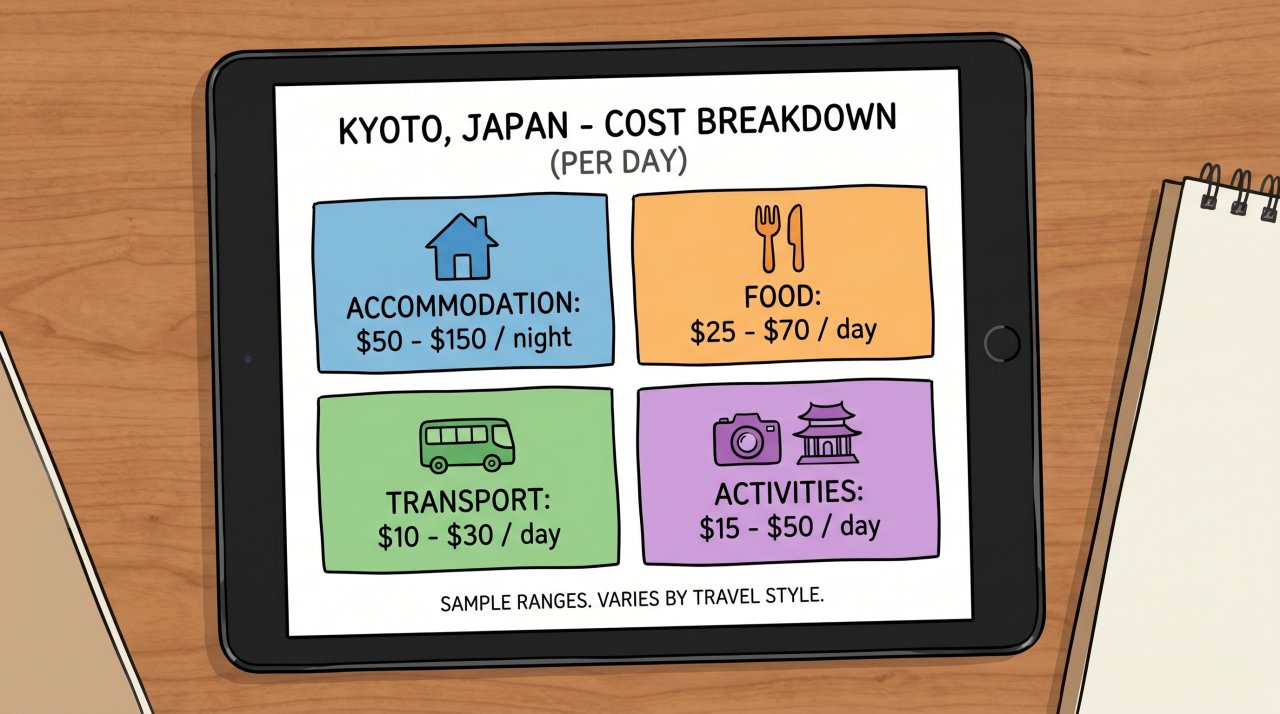
The output of the AI trip cost estimator isn’t a single number.
It’s a structured breakdown across four spending categories, with a low-to-high range for each one, displayed in your chosen currency.
This format matters because it tells you where your money is actually going, not just what the total might be.
Here’s what falls under each category:
- Accommodation covers the nightly cost of where you stay. At the Budget tier, that means hostels, guesthouses, and budget hotels. At Standard, you’re looking at mid-range hotels and well-reviewed Airbnbs. At Luxury, it’s boutique properties, resorts, or five-star hotels. The estimate accounts for destination pricing, not a global average.
- Food covers daily meals and drinks. The range here is wider than most people expect. In Southeast Asia on a budget, you might be looking at $10-15 per person per day. In Scandinavia at Standard level, that figure can reach $60-90 per day before you’ve ordered anything adventurous.
- Transport covers getting around at the destination, not your international flights. That includes airport transfers, local metro or bus usage, ride-hailing, and occasional longer intercity routes if your trip spans multiple locations. The tool does not estimate your inbound flights, which is a deliberate limitation covered later in this post.
- Activities covers entrance fees, tours, experiences, and day trips. This is the category most travelers underestimate. A single popular tour in Machu Picchu, a cooking class in Bangkok, or a snorkeling excursion in the Maldives can each run $40-150 per person. The estimate factors in your budget tier and gives a realistic daily range for that destination.
Each category is shown as a range, not a fixed quote.
The final summary also includes a combined total range, so you can see the full picture in one number if needed.
If you want to figure out how that daily cost breaks down relative to your actual dates, pairing this output with the AI Itinerary Planner gives you a day-by-day structure to map spending against.
How Group Size Changes the Per-Person Math
Adding more travelers to the form doesn’t simply multiply the total cost by the number of people.
That’s the part most travelers miss, and it’s where the AI trip cost estimator produces some genuinely useful numbers.
The accommodation category shows this most clearly.
A private room or apartment has a fixed nightly cost that gets divided across however many people are sharing it.
One person in a private double in Lisbon might pay $90 a night.
Two people in the same room each pay $45.
Three people in a family room at $120 a night drop to $40 each.
The per-person estimate adjusts for this.
Where the Economies of Scale Actually Apply
The shared accommodation effect is strongest when you cross from solo to pair, and again when you cross from two travelers to three or four sharing a larger room or apartment.
Beyond that, you’re often looking at two separate rooms anyway, and the per-person accommodation cost stops falling.
Transport costs at the destination follow a similar curve, but only for private options.
Renting a private minibus or booking a private tour for four is meaningfully cheaper per person than booking solo.
However, group tours and public transport cost the same per person regardless of how many are traveling together.
The tool accounts for whether your budget tier would typically involve shared or private transport options.
When Private Beats Shared on Cost
There’s a crossover point where booking a private transfer or tour becomes cheaper per person than the group alternative.
For four travelers heading from an airport to a city center, a private taxi often costs less per person than four individual shuttle tickets.
For a group of six, private day tours to popular sites regularly undercut group tour pricing by 15-30%.
This math is destination-specific, and the estimator factors it in.
If you’re traveling as a group of four or more, the Luxury tier sometimes shows a smaller gap over Standard than you’d expect, precisely because of this dynamic.
For travelers going solo, that same accommodation math works against you.
One person in a private room pays the full room rate.
If the solo premium is meaningful for your destination, you might want to check what a solo travel planner surfaces about hostel-friendly destinations where shared dorms bring the accommodation cost back in line with group travelers.
What Does Travel Month Do to the Estimate?
The Travel Month input isn’t just a date field.
It’s one of the two most powerful variables in the form, alongside budget type.
Month determines which price tier your trip falls into: peak season, shoulder season, or low season.
And the price differences across those tiers are not minor.
At popular beach destinations in Southeast Asia (Bali, Koh Samui, Phuket), accommodation costs during peak season (December through February) can run 40-70% higher than the same property in the shoulder months of April, May, or October.
In Europe, a mid-range hotel in Barcelona in August might cost double what the same hotel charges in March.
Peak Season vs. Shoulder Season: Where the Savings Are Real
Shoulder season is the sweet spot most experienced travelers know about.
You get mostly good weather, far fewer crowds, and noticeably lower prices across all four categories.
Activities and tours often run cheaper too, because operators are filling slots rather than managing waitlists.
The estimator reflects this.
Run the same trip in August and then again in October, and you’ll typically see accommodation costs drop 20-40%, with activity pricing falling 10-20% in crowd-sensitive destinations.
The difference on a 10-day trip for two people can easily amount to $500-1,000 in total savings.
Low Season: The Full Picture
Low season pricing is genuinely low, but the estimator won’t tell you whether it’s worth it for your specific destination.
In some places, low season means a light rainy period with one shower a day and half the accommodation prices.
In others, it means monsoon conditions that close half the sites on your list.
That’s context the cost estimate doesn’t carry.
If you’re choosing a month partly on the basis of cost and partly on weather, the AI Best Time To Visit Planner covers the climate and crowd picture that the cost estimator doesn’t address.
The two tools work well together: one tells you what the trip will cost in a given month, the other tells you whether that month is actually a good time to go.
What an AI Cost Estimate Gets Right, and Where You Still Need Live Prices
An AI trip cost estimator is a calibration tool.
Understanding what it’s good at, and where it stops, will save you from either over-trusting it or dismissing it too quickly.
In our experience running multiple destinations through this tool, the accommodation and food estimates land closest to real-world booking prices, typically within 15-25% for mid-range travelers.
That’s close enough to make meaningful budget decisions.
Activities and transport carry more variability because prices in those categories change frequently and differ widely by operator.
What the Estimate Captures Well
The tool is calibrated against destination-specific cost data, not global averages.
It knows that street food in Vietnam costs less than a sit-down meal in Vienna.
It knows that a standard guesthouse in Chiang Mai is not priced like a standard hotel in Zurich.
Within a budget tier and month, the ranges it produces for accommodation and food are credible starting points for budgeting.
It also handles currency conversion correctly.
If you’re traveling from the UK to Japan, the output shows both GBP and JPY.
You can see what a daily food budget looks like in yen, which is useful when you’re actually on the ground.
What Needs Live Price Verification
Flights are not included.
The tool estimates in-destination costs only: where you sleep, what you eat, how you get around locally, and what you do.
Your international airfare, airport fees, and travel insurance sit outside the output.
Those costs need to come from a live search.
Accommodation prices fluctuate by specific dates.
A range of $60-90 per night for Standard accommodation in a given city is a useful anchor, but the actual rate for your specific dates on your preferred platform might be $75 or $110.
The estimate tells you what to expect at that tier in that destination, not what a specific hotel charges on a specific Saturday in June.
The categories where AI estimates diverge most from live prices are typically activities and private transport.
Tour operators set their own prices, promotions change seasonally, and new experiences appear and disappear.
For activities, treat the estimate as a spending envelope, not a quote.
Budget $X for this category, then allocate it against the specific experiences you actually want.
For a destination where visa costs add meaningfully to the trip total, the AI Travel Visa Requirements Checker covers visa fees and entry requirements that won’t appear in a cost breakdown focused on in-country spending.
Using the Estimate to Make an Actual Trip Decision
A cost estimate is only as useful as what you do with it.
Here are the specific ways the output translates into real planning decisions.
The most direct use is running the tool twice: once for your first-choice destination and once for a backup or alternative.
If you’re weighing Portugal against Croatia for a two-week trip in May, two estimates give you a cost delta in actual numbers rather than the vague sense that “one might be cheaper.” If Portugal comes back at $2,800 for two people at Standard level and Croatia at $2,200, you have a concrete $600 gap to weigh against your other preferences.
If cost is the tiebreaker, the answer is clear.
If it’s not the tiebreaker, you at least know what you’re trading.
If you’re choosing between two destinations and want a deeper side-by-side analysis beyond just cost, the AI Destination Comparison Tool runs a structured comparison across climate, crowd levels, cost, and traveler type fit, pulling the full picture together in one place.
Setting a Savings Target
The second major use case is saving.
Once you have a total range, you have a target.
If the estimate comes back at $3,200-4,100 for a 12-day trip, you know what you’re aiming for.
That’s the number you set as a savings goal, build a timeline around, and decide whether to take the lower end as your floor or the higher end as a safe buffer.
Most people book a trip with only a rough idea of what it will cost until they’ve already committed to flights and accommodation.
Having that number before you book anything means you can decide whether the trip is financially realistic now, or whether a shorter version, a different month, or a different budget tier makes more sense.
Sharing the Estimate with Travel Companions
If you’re planning a group trip, the cost estimate is a useful document to share before anyone commits.
Running it for your group size and preferred budget tier, then sharing the output, gives everyone the same starting expectations.
It’s much easier to have a budget conversation before booking than after someone has already found a hotel they love that’s $50 a night over what others had in mind.
If your group is split between budget preferences, try running the estimator at Budget and Standard for the same destination and month.
The gap between tiers, shown in concrete numbers, often resolves the disagreement faster than any other conversation.
For groups wanting to really stretch the trip planning detail, the AI Cheap Travel Advisor surfaces specific money-saving angles: cheaper entry points, alternative accommodation areas, and lower-cost ways to do the same experiences.
Running the Estimator: The Seven Input Fields
The form takes seven inputs, and the quality of your estimate depends on how accurately you fill each one.
Here’s what each field actually controls.
- Trip From sets your origin. This is used to calibrate relative travel costs rather than estimate your flights, so entering your home city or country works fine.
- Trip To is your destination. Be as specific as possible. “Thailand” and “Bangkok” will return similar results, but if you’re spending most of your time in Chiang Mai or Koh Samui, the destination type affects accommodation and activity pricing.
- Trip Duration runs from 1 to 30 days. Enter the number of nights you’ll actually be there. A 10-day trip with 9 nights of accommodation and a departure morning is 9 or 10 depending on whether your last day carries meaningful spending.
- Number of Travelers is where the group math discussed earlier takes effect. Enter everyone who will be sharing accommodation together.
- Budget Type is the tier selector: Budget, Standard, or Luxury. If you’re unsure, Standard is the safe default. You can always run it twice at different tiers to see the cost gap.
- Travel Month drives the seasonal pricing logic. Enter the month you’re actually planning to travel, not a hypothetical ideal month.
- Your Currency / Destination Currency lets you set both the currency the output is shown in and the local currency at the destination. If you’re traveling from Australia to Italy, set AUD as your currency and EUR as the destination currency, and the breakdown shows both.
The tool supports currency output in major global currencies.
Setting both your home currency and the destination currency is particularly useful for trips to countries with large exchange rate gaps, where understanding the local-currency equivalent of your daily budget helps you manage spending on the ground.
Once you submit, the estimate typically returns within a few seconds.
If you want to then take that destination budget and build an actual day-by-day schedule around it, the AI Itinerary Planner uses the same destination, duration, month, and budget tier fields to generate a full activity plan you can cross-reference against the cost ranges.
The best time to know what a trip will cost is before you’ve booked anything.
That’s the whole point of running a budget estimate at the research stage, not after flights are purchased and accommodation is locked.
The AI trip cost estimator gives you a structured, category-level view of where your money will go, honest about its range rather than pretending to be a confirmed quote.
Start with the Standard tier for your destination and month, run it once for your top choice, and then run it again for your backup option.
The numbers that come back will either confirm your instinct or give you a specific reason to reconsider.
Frequently Asked Questions (FAQs)
The estimator focuses on in-destination costs: accommodation, food, local transport, and activities.
It does not calculate international flight prices, which fluctuate significantly by booking date and route.
Use the estimate as your ground costs baseline and research flight prices separately.
The Budget tier estimates are calibrated to hostel or guesthouse accommodation, street food and local restaurant meals, public transport, and free or low-cost activities.
In general, estimates for popular budget routes in Southeast Asia and Central America are consistently accurate within a 15 to 20 percent range of real spending.
Yes, and this is one of its most practical uses.
Run the estimator for each destination separately with the same inputs, then compare the total and per-category breakdowns to see which destination fits your budget better before committing to flights or accommodation.