
AI Food Travel Guide: Find Exactly What to Eat and Where – The AI food travel guide on GetOutTrip tells you what to eat, where to find it, and when locals actually eat it.
Not “sample regional cuisine.” Specific dish names, specific markets, specific restaurant types, with cost estimates and dietary labels attached.
You type in your destination, add your dietary preferences if you have them, pick a food interest (street food, fine dining, cooking classes, food markets, or local specialties), and the guide builds a culinary map of that destination from the ground up.
This GetOutTrip guide covers what the output looks like, why the dietary filter matters more than most people expect, and which destinations produce the most detailed results.
Tool Highlights
- Tool: AI Food Travel Guide
- Category: Discover (Trip Discovery)
- Cost: Always Free
- Input fields: 6 (Destination, Dietary Preferences, Budget, Trip Duration, Food Interests, Currency)
- Output type: Named dishes with meal context, food markets, restaurant type recommendations, culinary experiences, cost ranges
- Best use case: Planning a food-focused trip, adapting for dietary restrictions, building a food itinerary across multiple days
- Currency support: Yes, destination currency and your home currency
- Device compatibility: Any browser, desktop and mobile
What a Real Food Guide Output Actually Looks Like
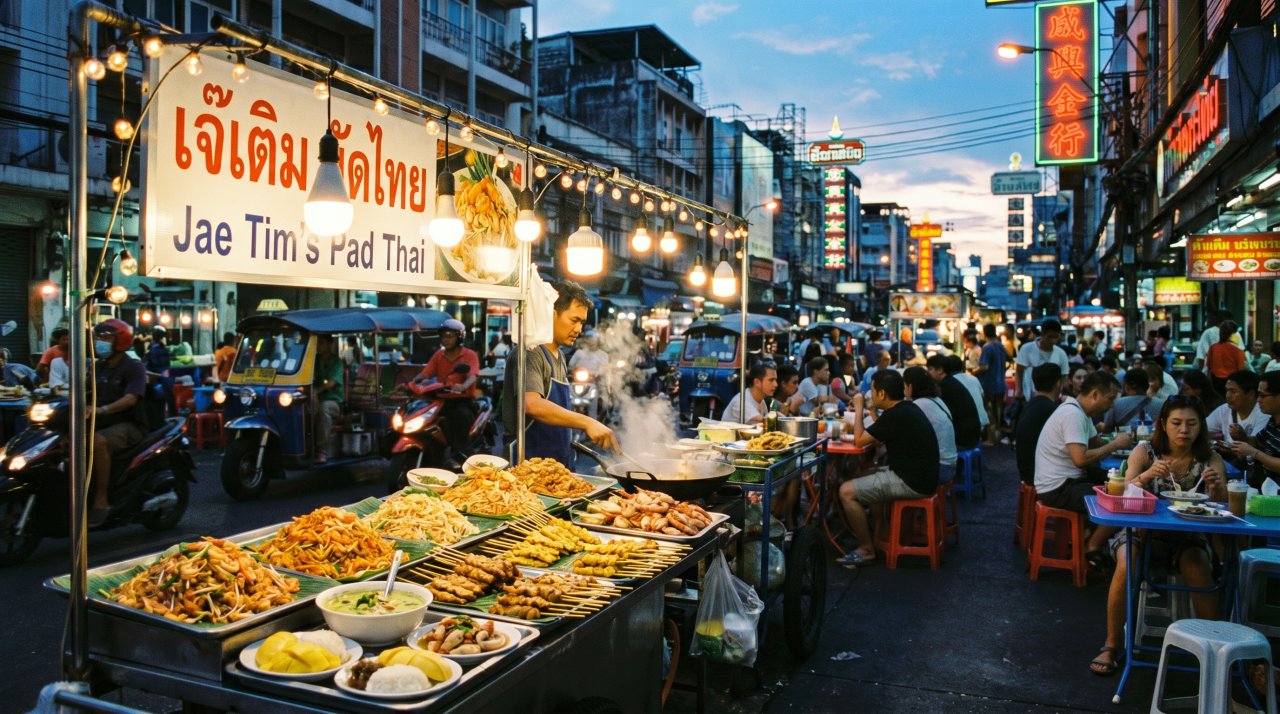
Most city travel guides give you a paragraph about the food and a few restaurant names.
The AI food travel guide gives you something more structured: a breakdown of what to eat by meal type, where to find each dish, what it typically costs, and which dietary labels apply.
The depth of the output surprises most people the first time they run it.
Take Bangkok as an example.
A typical output for Bangkok with no dietary filters includes:
- Breakfast: Jok (rice congee with pork and ginger, found at morning-only street stalls in Chinatown, around 40-60 THB / USD 1.10-1.70)
- Lunch: Pad kra pao (stir-fried minced meat with holy basil and a fried egg on rice, ubiquitous at lunch spots, 60-80 THB / USD 1.70-2.20)
- Afternoon snack: Mango sticky rice from Chatuchak Weekend Market, 80-120 THB, seasonal availability noted (March to June peak)
- Dinner: Tom yum goong (spicy prawn soup) at floating market restaurants versus street stall versions, with a cost difference flagged (street: 80-100 THB vs. sit-down: 150-250 THB)
- Night food: Roti vendors at Khao San Road area, open from 9pm, around 30-50 THB
The guide also notes when locals eat.
Bangkok dinner service starts around 6:30pm, but many street stalls open at 5pm and hit peak quality before 7pm.
That kind of meal-timing context doesn’t appear in standard travel guides, and it makes a real difference when you’re deciding whether to arrive at a market at opening or at the lunch rush.
The output also flags restaurant type distinctions.
For Bangkok, it separates rot khen (push-cart street vendors), shophouse restaurants, air-conditioned food courts in malls (often cheaper than you’d expect, with English menus), and tourist-facing restaurants near major sights (pricier, more generic).
Knowing which category a recommendation falls into changes how you find it and what you pay.
What Changes When You Add Dietary Preferences
Filtering by dietary preference isn’t just a way to remove dishes you can’t eat.
For destinations where your preference is non-default, the filter changes the entire logic of the guide.
This is where the tool earns its value.
Vegetarian in Vietnam
Vietnam’s food culture is heavily meat and seafood-based.
Most pho and bun bo Hue broths are made with bone stock.
Many dishes that look vegetarian contain fish sauce or dried shrimp.
A traveler going in without a filter will get recommendations that are technically off-limits, with no guidance on what to ask or where to go instead.
Run the same query with Vegetarian selected, and the output shifts.
It surfaces the com chay (vegetarian rice) tradition, which runs deep in Buddhist communities.
It points toward pagoda-adjacent restaurants that serve meat-free versions of classic Vietnamese dishes, often on the 1st and 15th of the lunar month, when vegetarian eating spikes.
It names dishes like banh cuon chay (steamed rice rolls without pork filling) and bun rieu chay (vegetarian crab-tomato noodle soup).
It flags which markets have reliable vegetarian stalls and which ones to avoid.
This isn’t a generic substitution list.
It’s a culturally specific guide to how vegetarian eating actually works in that food culture.
Halal in Japan
Japan’s food scene is outstanding, and it’s also one of the harder places to eat Halal.
Pork shows up in broths, marinades, and seasonings across many traditional dishes.
The Halal filter outputs a different guide entirely: it focuses on halal-certified ramen shops in major cities (there are more than people expect), identifies areas with Muslim-friendly restaurant clusters (Asakusa in Tokyo, Namba in Osaka), names dishes that are structurally halal-compatible (onigiri with salmon or tuna, soba noodles with certain broths, tempura with rice), and flags which convenience store chains stock halal-certified products.
It also notes the distinction between halal-certified and halal-friendly, because those aren’t the same thing in Japan, and understanding that difference saves a lot of confusion on the ground.
Gluten-Free in Italy
Gluten-free in Italy sounds difficult.
The output tells a more nuanced story.
Italy has one of the highest rates of celiac disease diagnosis in Europe, and the Italian Celiac Association (AIC) certifies restaurants with a recognizable symbol.
The guide names AIC-certified restaurant types to look for, flags which traditional dishes are naturally gluten-free (risotto, polenta, fritto misto if made without flour coating), and identifies which regions, like Sicily and Sardinia, have stronger traditions of naturally gluten-free staples.
It also flags which words to look for on menus (senza glutine) and which kitchen cross-contamination risks apply in pasta-heavy restaurants.
This level of specificity doesn’t come from a travel blog.
It comes from understanding how a dietary restriction interacts with a specific food culture, and then mapping that intersection onto real meals and real places.
How Food Interests Shape the Entire Output
The Food Interests input is the most underused field in the form.
Most people skip it.
That’s a mistake.
Selecting Street food versus Fine dining versus Cooking classes versus Food markets versus Local specialties produces what are essentially four completely different guides for the same city.
This matters because these aren’t overlapping categories.
They’re different food worlds.
Street Food
A street food output for Mexico City centers on tacos de canasta (basket tacos, served from a bicycle, 8-15 MXN each), the tostadas at Mercado de Jamaica, tlayudas from Oaxacan-run stalls in Colonia Roma, and elotes (grilled corn) and tamales from morning street carts in working neighborhoods like Tepito.
It gives you the neighborhoods, the hours (many top taco spots run 6am-11am and are closed by lunch), and the price range you should expect before you walk up.
It also flags what “authentic” actually means in street food terms, which is often the opposite of tourist-facing.
The best al pastor in Mexico City is rarely near the main sights.
Fine Dining
The same Mexico City query with Fine dining selected gives you a structurally different output: a breakdown of the tasting menu scene (Pujol, Quintonil, and their tier of restaurants), typical price ranges (1,800-4,500 MXN per person for tasting menus, USD 90-225), booking lead times (Pujol typically requires 4-6 weeks), dress code norms, and which neighborhoods concentrate the top-end restaurant scene (Polanco, Condesa, Roma Norte).
It notes which elements of traditional Mexican cuisine fine dining restaurants work with, so you understand what you’re ordering at a cultural level, not just a menu level.
Cooking Classes
A cooking class output is different again.
It identifies the type of cooking experience available in the destination (market-to-table classes in Oaxaca, hands-on mole workshops, tortilla-making classes for 2-3 hours versus full-day immersions), typical pricing (650-1,800 MXN for a half-day class, USD 32-90), what to look for in a reputable operator, and which cooking styles or techniques the destination is actually known for.
You don’t take a pasta-making class in Oaxaca.
You don’t take a mole negro class in Florence.
The output is calibrated to what’s genuine in that place.
If you’re building a day-by-day plan around food, the AI Itinerary Planner lets you slot these food experiences into your overall schedule so they sit alongside other activities without conflicting with opening hours or cooking class booking windows.
Which Destinations Produce the Richest Output
Not all destinations generate the same depth of output.
The quality of the guide correlates with the depth and distinctiveness of the food culture, the degree of regional variation, and the strength of meal structure traditions.
High-Output Destinations
- Japan produces some of the most detailed food guide output of any destination in the tool. Japan’s food culture has extreme regional specificity: tonkotsu ramen is from Fukuoka, miso ramen from Sapporo, shio ramen from Hakodate. Kaiseki (multi-course traditional meal) is distinct from izakaya (pub-style) eating, which is distinct from konbini (convenience store) culture, which is its own legitimate food category. The tool captures these distinctions. An output for Tokyo is different from one for Kyoto, which is different from one for Osaka, which is famously the most food-obsessed city in the country.
- Vietnam is similarly granular. Pho in Hanoi has a cleaner, more austere broth than in Ho Chi Minh City. Banh mi construction varies by city. Cao lau is specific to Hoi An and made with water from a particular well, which the output actually notes. This kind of place-specific detail is what separates a genuine culinary guide from a generic list.
- Italy generates strong output because of its deep regional structure. The food differences between Piedmont (butter, truffles, tajarin pasta), Campania (pizza, buffalo mozzarella, sfogliatella), and Sicily (arancini, granita, couscous influences from North Africa) are substantial, and the tool treats them as separate food cultures rather than variations on a theme.
- Mexico and India are both countries where the regional variation is enormous, and both produce rich output when you specify a region or city rather than the country name. “India” as a destination query produces broad strokes. “Kolkata” or “Chettinad” produces something you can actually use at the market.
Lower-Output Destinations
Destinations with thinner food culture data or less-documented culinary traditions produce shorter, less specific guides.
Smaller island nations, some Central Asian destinations, and locations where food culture is genuinely less differentiated will generate fewer named dishes and more general advice.
This isn’t a failure of the tool; it’s an accurate reflection of what’s there.
A food guide for the Faroe Islands is going to be shorter than one for Osaka, and it should be.
If you’re deciding between destinations partly on the basis of food culture, the AI Best Time to Visit Planner can layer in seasonal food event context, like truffle season in Umbria or cherry blossom hanami picnic culture in Japan, so your arrival timing aligns with what you actually want to eat.
Using the Food Guide in Practice
Getting a strong output is one thing.
Knowing what to do with it is another.
A few things make the difference between a food guide you read on the plane and one you actually use on the ground.
Sequencing Food Experiences Across a Trip
Food has a natural rhythm across a day and across a trip.
A good food guide output respects that rhythm.
Cooking classes work best earlier in the trip, when you can repeat what you’ve learned at local restaurants in the days that follow.
Food markets often have shorter windows than people expect (many wrap up by 11am).
Street food scenes peak at different times depending on culture: midday in Vietnam, late evening in Bangkok, after midnight in Mexico City.
When you run the food guide for a multi-day trip, enter your actual trip duration in the Trip Duration field.
The output organizes the recommendations differently for a 3-day trip versus a 10-day trip.
For a short stay, it prioritizes the highest-value food experiences and flags which ones are genuinely unmissable.
For longer trips, it structures variety, so you’re not eating at the same category of restaurant every day.
Bridging the Gap Between Recommendations and Bookings
Some recommendations in the output have obvious booking paths: tasting menus, cooking classes, and guided market tours can all be booked through standard platforms.
Street food stalls, shophouse restaurants, and neighborhood markets can’t be booked.
They’re found.
For the “found” category, the output gives you enough context to locate them: the neighborhood, the market name, the time of day, the physical format (look for the cart with the red awning, not the sit-down place next door).
For the bookable category, use the food guide output as your research base, then confirm current availability through booking platforms.
Budget matters here.
If you’re watching your spending, the AI Trip Cost Estimator lets you model food costs by budget tier so you know what a street-food-heavy trip versus a mix-of-fine-dining trip actually runs per day, converted into your home currency.
When a Recommendation Is Hard to Find
Occasionally a recommended dish or market turns out to be seasonal, has moved, or isn’t as accessible as the output suggests.
This happens more with street food in cities with active urban planning (Singapore, for example, has a policy of consolidating hawker culture into licensed centers, so the spontaneous street stall is less common than the output might imply).
When you hit a gap like that, the food guide’s restaurant type recommendations fill in.
If the specific char kway teow stall the output mentions is gone, you know you’re looking for a hawker center, you know the general neighborhood, and you know what to order when you find an equivalent.
The output gives you enough conceptual grounding to improvise.
Before you travel, it’s worth pairing the food guide with the AI Local Etiquette and Culture Guide to understand dining customs: whether you share dishes or order individually, how to get a waiter’s attention without causing offense, whether tipping is expected or actually discouraged, and what local table manners signal respect.
Eating well abroad isn’t just about knowing what to order.
It’s about knowing how to eat in a way that fits where you are.
Food Travel Is How You Actually Know a Place
Eating your way through a destination is one of the most efficient ways to understand it.
Markets reveal what people actually cook at home.
Street food shows you how a city lives at 7am.
Choosing between a bowl of pho that costs USD 1.50 and one that costs USD 4 tells you something about the local economy.
A cooking class gives you a cultural history lesson inside the practical task of making something edible.
The AI food travel guide doesn’t replace any of that.
What it does is cut the research time from hours to minutes and give you enough specific, culturally grounded information to go into each food experience with context.
You still have to show up and eat.
But you’ll know what you’re eating, why it’s prepared that way, what it should cost, and where the right version of it lives.
If you want that food experience woven into a complete daily plan, the AI Itinerary Planner integrates food stops, market visits, and cooking class slots into a day-by-day schedule around your other activities.
And if you’re packing for a destination where food adventures involve early morning markets, overnight trains between food cities, or outdoor eating in variable weather, the AI Travel Packing List Generator builds a destination-specific kit so you’re not lugging the wrong bag to the wrong place.
Start with the food.
The rest of the trip will follow.
Frequently Asked Questions (FAQs)
The guide typically recommends restaurant types, market names, and dish categories rather than specific restaurant names, since individual venues open, close, and change quality faster than AI training data can track.
Use the guide to know what category of dining experience to seek, then cross-check current reviews to find a specific venue that fits.
Yes. The Dietary Preferences field accepts multiple restrictions at once, such as “vegetarian and gluten-free” or “halal and no shellfish.”
The output adjusts all dish and venue recommendations accordingly, though the range of suggestions narrows as the number of restrictions increases, particularly in destinations with limited dietary flexibility.
Yes. Street food is one of the food interest options and produces its own distinct output focused on market stalls, street vendors, and specific dishes eaten in informal settings.
It is one of the most consistently detailed areas of the guide for destinations with strong street food cultures, including Southeast Asia, Mexico, India, and Turkey.