
AI Travel Safety Advisor: Beyond the “Exercise Caution” Warning – The AI Travel Safety Advisor on GetOutTrip is a free tool that generates destination-specific safety briefings covering crime patterns, health risks, common scams, transport safety, areas to avoid, and local emergency contacts.
You enter a destination, add optional details about your nationality, month of travel, and specific concerns, and get a structured safety overview in seconds.
It’s designed for travelers who have already read the government advisory and still don’t know exactly what they’re walking into.
Tool Highlights
- Tool category: Practical
- Cost: Always free
- Input fields: 6 (Destination, Traveler Nationality, Month of Travel, Travel Style, Specific Concerns, Currency)
- Output type: Structured destination safety briefing
- Best use case: Pre-trip safety research for any international destination
- Device compatibility: Works on desktop, tablet, and mobile
What “Exercise Caution” Actually Tells You (And What It Doesn’t)
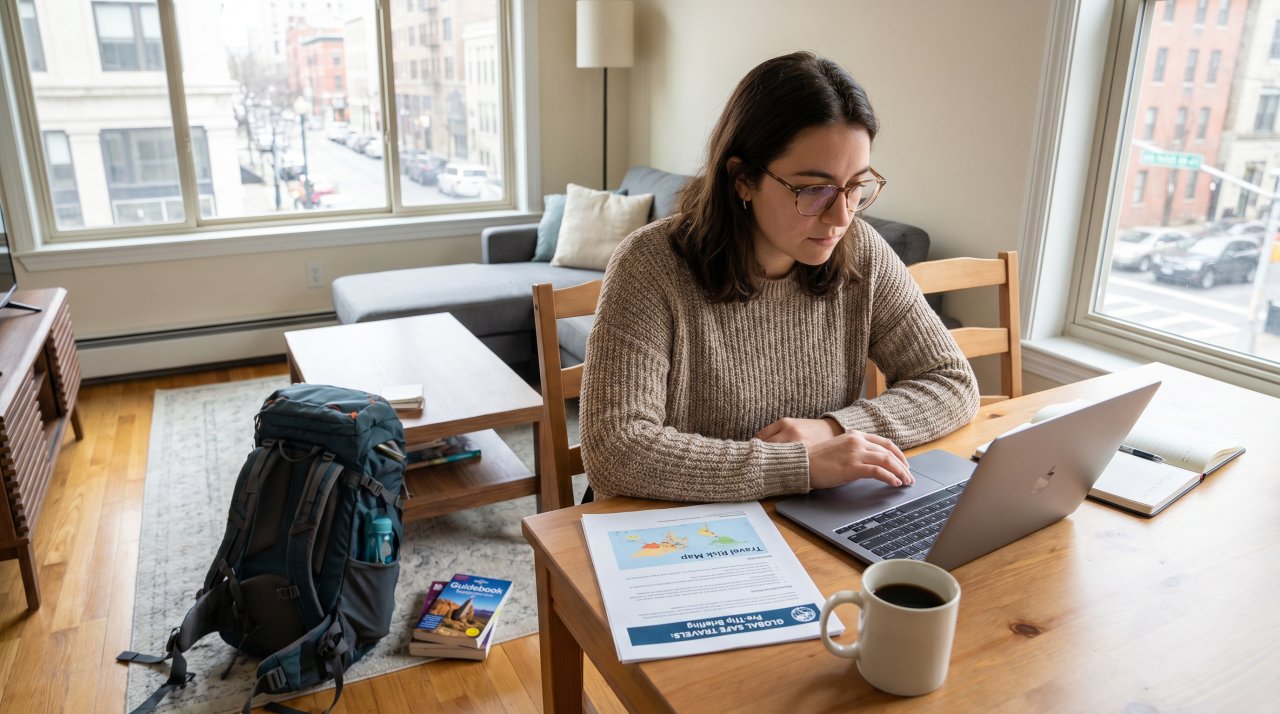
Government travel advisories from the UK’s Foreign, Commonwealth and Development Office (FCDO), the US State Department, and Australia’s DFAT are genuinely useful.
They represent official government assessments of risk, backed by intelligence, consular reporting, and diplomatic relationships.
For many destinations, they’re the first place you should look.
But they’re written to cover entire countries, and they work at a binary level.
“Exercise caution” is one of the most common advisory ratings, sitting between “normal precautions” and “advise against non-essential travel.” It applies to dozens of countries right now, covering everything from minor petty crime hotspots to countries with active regional conflict in one province and a peaceful coast a few hours away.
The rating doesn’t tell you which part you’re going to, and it doesn’t adapt to your situation.
Consider what a solo female traveler heading to a coastal resort town and a business traveler flying into the capital of the same country actually need to know.
One needs to understand nighttime transport safety, beach area scams, and whether accommodation in her chosen neighborhood is well-regarded by other solo travelers.
The other needs to know about political demonstration patterns near the central business district, which taxi services are safe from the airport, and what the local emergency number is.
A country-level advisory rating doesn’t split that difference.
The Gap Between “Caution” and Knowing What to Do
What a traveler actually needs before departure is a neighborhood-level understanding of the specific destination, not the country.
They need to know which areas to avoid after dark, which common scams target tourists arriving at the main train station, whether the water is safe to drink, how reliable the local ambulance service is, and whether their nationality creates any particular sensitivities at that destination.
This is what a destination-specific safety briefing should deliver, and it’s the gap the AI Travel Safety Advisor on GetOutTrip is built to fill.
It doesn’t replace official advisories.
It translates them into actionable, specific information that you can actually use to plan your movements.
Before you fly, you’ll also want to check visa requirements for your passport alongside the safety picture, since entry requirements and safety conditions often shift together during politically unstable periods.
What the Safety Briefing Actually Covers
The output from the AI Travel Safety Advisor is structured into categories rather than delivered as a block of text.
That structure matters because different categories require different actions from you.
Here’s what a typical briefing covers, using a destination like Medellín, Colombia as an example.
- Crime and personal safety. The briefing covers the general crime profile of the destination, with specifics on the types of crime most likely to affect tourists: bag snatching in high-footfall tourist areas, express kidnapping (a short-term theft where victims are driven to ATMs), drink spiking in bar districts, and which specific neighborhoods carry higher risk. For Medellín, this means a clear note that El Poblado and Laureles are generally considered safe by backpacker standards, while certain northern comunas require more caution and local guidance.
- Transport safety. This covers which transport options carry risk and which are reliable. Unlicensed taxis and unofficial rideshares are a frequent crime vector in many destinations, and the briefing names which app-based services are considered safe, whether airport transfers need pre-booking, and what the night transport situation looks like.
- Health risks. This section flags vaccination recommendations, food and water safety, and any disease risks specific to that destination and season. For Colombia, that includes altitude sickness awareness for travelers moving from Bogotá to coastal areas, mosquito-borne disease risks in lower-altitude regions, and the state of tap water across different cities.
- Common scams. Scams are destination-specific, and knowing the local playbook in advance is genuinely protective. The briefing names the scams that target tourists at that destination, from the “friendly local who insists on guiding you” who later presents a bill, to fake police officers, to currency exchange sleight of hand.
- Areas to avoid. This is more granular than a country-level advisory can be. The briefing names specific neighborhoods, districts, or areas that carry elevated risk, and in some cases distinguishes between day and night safety levels for the same area.
- Emergency contacts. The briefing closes with local emergency numbers for police, ambulance, and fire, plus the traveler’s consulate or embassy contact information in-country.
Why Your Nationality and Specific Concerns Change the Output
The Traveler Nationality field is optional, but it’s worth filling in.
Nationality affects safety in ways that are specific and practical, not just theoretical.
Consular support varies significantly by country.
A British national in distress has access to FCDO consular services at UK embassies and high commissions worldwide, while a traveler holding a passport from a smaller nation may have no diplomatic representation in-country at all, which means understanding how to reach the nearest embassy of a country with a consular agreement becomes part of the safety plan.
Nationality also affects perceived risk in certain destinations.
Some countries have diplomatic tensions that create localized hostility toward specific nationalities.
Some destinations are regularly targeted by scammers who identify tourists by their apparent nationality and adjust their approach.
Including your nationality gives the briefing more specific consular guidance and, where relevant, flags any particular sensitivities for your passport.
The Most Powerful Input: Specific Concerns
The Specific Concerns field is the most flexible and arguably the most valuable input in the tool.
It’s a free-text field where you describe anything that shapes your personal safety picture.
This is where the briefing stops being generic and starts being specifically about you.
- Solo female travelers can flag that they’re traveling alone. The output then specifically addresses nighttime safety, recommended accommodation areas for solo women, which transport options are safer after dark, and whether the destination has particular cultural norms around women traveling without companions.
- LGBTQ+ travelers can note that in the Specific Concerns field. This matters enormously for some destinations. Legal status, social attitudes, and practical safety vary from “no practical concerns” in most of Western Europe to “significant legal risk” in destinations where same-sex relationships remain criminalized. The briefing addresses this directly and specifically when you flag it.
- Travelers with health conditions can describe relevant medical factors. Someone managing a chronic condition that requires regular medication can ask about pharmaceutical availability, prescription recognition, and the quality of medical facilities at the destination. Someone with a severe allergy can ask about food labeling norms and hospital proximity in the specific area they’re staying.
- Travelers visiting for events. Large festivals, sporting events, and political gatherings carry their own safety considerations: crowd crush risk, opportunistic pickpocketing at scale, and sometimes heightened police presence that creates its own dynamics. Flagging the event you’re attending gets you safety context specific to that kind of crowd environment.
This specificity is what separates the AI Travel Safety Advisor from a generic travel safety page.
If you’re planning a solo trip and want to pair the safety briefing with a full itinerary tailored to solo travel, the AI Solo Travel Planner builds a route with safety-aware accommodation and activity recommendations alongside it.
How Month of Travel Shapes the Health and Safety Profile
Timing matters in ways that country-level advisories rarely surface.
The AI Travel Safety Advisor takes Month of Travel as an optional input, and it changes the health section of the output meaningfully.
- Malaria and mosquito-borne disease seasonality. In many tropical and subtropical destinations, malaria risk, dengue risk, and other mosquito-borne illness risk rises sharply during the wet season, when standing water increases mosquito breeding. A traveler visiting Thailand in October (mid-wet season) faces a different mosquito exposure profile than one visiting in February. The briefing flags this and recommends prophylaxis consultation with a travel health clinic before departure.
- Extreme heat windows. The Arabian Peninsula, parts of South Asia, and sections of Southern Europe and North Africa have heat conditions in peak summer months that create genuine health risk, particularly for older travelers, those with cardiovascular conditions, and anyone planning extended outdoor activity. The tool flags these windows and recommends scheduling outdoor activity for early morning or evening.
- Hurricane and cyclone seasons. The Atlantic hurricane season runs from June through November, with peak activity in August and September. The Western Pacific typhoon season has a similar profile. Traveling to the Caribbean, Central America, or Southeast Asia during peak season doesn’t mean you’ll encounter a storm, but it means understanding evacuation protocols, monitoring active weather systems, and having travel insurance that covers natural disaster cancellations.
- Monsoon flooding and road safety. In destinations across South and Southeast Asia, the monsoon season doesn’t just mean rain. It means road closures, landslide risk on mountain routes, flash flooding in low-lying areas, and ferry service cancellations to island destinations. The briefing flags which types of transport and which routes carry elevated risk during the month you’re traveling.
- Political and civic calendars. Election periods, national holidays, and major religious observances can affect safety conditions in ways that aren’t captured in a standing advisory. Large public gatherings, road closures, and in some cases elevated political tension can all affect how you move around a destination. Entering your month of travel helps the briefing surface any relevant events on the local calendar.
The AI Travel Safety Advisor doesn’t replace a consultation with a travel health clinic before departure, and it’s explicit about that.
Malaria prophylaxis, yellow fever vaccination requirements, and destination-specific medical recommendations require a qualified clinician’s assessment.
The briefing points you in the right direction; the clinic gives you the prescription.
For seasonal timing beyond safety, the AI Best Time To Visit Planner weighs up weather, crowd levels, and cost across months to help you find the best window for your destination.
What to Do With the Briefing Before You Leave
Getting a safety briefing is only useful if you act on it.
Here’s how to turn the output into actual pre-departure preparation.
- Share it with someone at home. The emergency contacts section of the briefing should go to whoever is your emergency contact at home. Not just the local police number, but the nearest embassy or high commission contact, and your accommodation details. Most travel safety guidance recommends leaving an itinerary with someone at home, and the AI briefing gives you a structured document to work from.
- Cross-reference with current conditions. The AI safety briefing draws on training data and pattern knowledge, not a live news feed. In the week before you travel, cross-reference the briefing against current reporting. Check the FCDO, State Department, or DFAT advisory for your destination. Check local news sources if you can read the language, or international outlets that cover the region. Look for anything that has changed since the briefing’s underlying information was current: a recent protest movement, a disease outbreak, an election result.
- Verify health recommendations with a travel clinic. Any vaccination or prophylaxis recommendation in the briefing needs professional verification before you act on it. Travel health requirements change, and what you need depends on your personal medical history, your existing vaccination record, and the specific areas you’re visiting within a country. Book a travel health appointment ideally six to eight weeks before departure, earlier for destinations requiring yellow fever vaccination.
- Use it to build your pre-departure checklist. The safety briefing pairs naturally with a full pre-departure prep list. The AI Travel Checklist Before Departure generates a destination-specific task list that covers documents, insurance, health prep, and logistics. Running both together means you’re not just aware of the risks but actually prepared for them.
- Act on the scam section specifically. The scam section is the most immediately actionable part of the briefing. If you know that unlicensed taxis at the main airport use a specific approach to target new arrivals, you’re far less likely to be caught by it. If you know that strangers offering unsolicited “help” in a particular district are typically running a lead-in to a money request, you can respond accordingly. Read this section carefully, not as a reason to be paranoid, but as information that makes you a less predictable target.
- Pack what the safety context requires. If the briefing flags medical facility quality as limited in your destination, that changes what you put in your first aid kit. If it flags that cash is the only reliable payment method in the areas you’re visiting, you arrive prepared with the right amount. If it flags sun exposure as a serious risk in the season you’re traveling, you pack accordingly. For a full packing list that takes your destination, climate, and activities into account, the AI Travel Packing List Generator builds a destination-specific list you can work through item by item.
- Consider the cultural context alongside the safety picture. Some safety considerations are directly tied to local customs and laws. Dress codes at religious sites, laws around photography, behavior in public spaces, and rules around alcohol consumption are all factors that affect your legal and social safety at a destination. The AI Local Etiquette and Culture Guide covers these norms in detail, and it sits naturally alongside the safety briefing as part of the same pre-departure preparation session.
A Note on What This Tool Is and Isn’t
The AI Travel Safety Advisor gives you a structured, destination-specific safety briefing generated from a broad base of training knowledge.
It’s genuinely useful for the kind of granular, practical safety context that government advisories don’t provide.
But it has real limitations, and being clear about them is part of using the tool responsibly.
It does not have a live connection to current news or real-time data.
Conditions at a destination can change rapidly, and the briefing you receive reflects knowledge patterns rather than what happened last Tuesday.
Always verify against official advisories and current reporting close to your departure date.
It’s not a substitute for professional travel health advice.
The health section points you toward the right questions to ask a clinician, but the clinician has to give you the actual answers.
It’s also not an exhaustive security assessment.
Travelers heading to destinations with active conflict, genuine security risks at the high end of government advisory scales, or destinations under formal “do not travel” advisories need specialist security advice beyond what a general AI safety tool can provide.
What it is: a significant improvement over reading a country-level advisory and still not knowing what “exercise caution” means for your specific trip.
For most travelers going to most destinations, the AI Travel Safety Advisor closes that gap between official advice and practical knowledge.
That’s the problem it was built to solve, and it solves it well.
Safety conditions change. Always check the official travel advisory from your government (FCDO, US State Department, DFAT, or equivalent) and current local news before departure. This tool provides AI-generated guidance for informational purposes and does not constitute professional safety or medical advice.
Frequently Asked Questions (FAQs)
The safety briefing draws on AI training data with a knowledge cutoff date and does not pull live news or real-time government advisories.
For current safety conditions, always cross-check the output with your government’s official travel advisory close to your departure date, particularly for destinations with fast-changing security situations.
No. The AI safety advisor is a practical briefing tool that explains what safety considerations mean in real-world terms.
Official government travel advisories remain the authoritative source and should always be checked.
The two sources complement each other: government advisories tell you the official status, while this tool helps you understand what that status means for your specific trip.
Yes. The Specific Concerns field accepts detailed inputs, including specific neighborhoods or types of areas.
Entering a specific concern such as “Is the Medina of Fez safe for solo female travelers at night” produces more targeted guidance than entering only the city name, though hyperlocal neighborhood information is more reliable for well-documented destinations than for less commonly visited places.