
AI Local Etiquette Guide: Know the Customs Before You Land – Most cultural missteps abroad don’t come from a bad attitude.
They come from assumptions.
You assume tipping works the same way it does at home, that the gesture you use to signal “okay” is universally friendly, that modest dress means what it means in your city.
It doesn’t, and nobody hands you a correction slip in the moment.
The AI local etiquette guide on GetOutTrip is built around exactly this gap.
Enter your destination, add your home country for comparison context, and you get a specific, practical breakdown of the cultural norms that are most likely to catch you off-guard, written for the places where your home habits diverge most from local expectations.
Tool Highlights
- Tool category: Practical
- Cost: Always free
- Input fields: 5 (Destination, Your Country, Trip Type, Language, Your Currency / Destination Currency)
- Output type: Structured cultural guide covering greetings, tipping, dress codes, religious site protocols, photography norms, table manners, and useful local phrases
- Best use case: Pre-trip cultural preparation, especially for destinations with significant etiquette differences from your home country
- Language support: Generates local phrase guides in the destination's language
- Device compatibility: Works on desktop and mobile browsers
Why Most Travelers Arrive Culturally Underprepared
The internet has a lot of generic “how to be a respectful traveler” content.
Most of it is well-meaning and nearly useless.
“Be aware of local customs.” “Dress appropriately.” “Learn a few words.” These are instructions without content.
They don’t tell you that in Japan, you don’t tip because it can be read as condescending to a professional doing their job well.
They don’t tell you that in Morocco, a firm handshake is standard with men but that initiating physical contact with someone of the opposite gender can be considered forward.
They don’t tell you that in Thailand, pointing your feet toward a religious image is an insult serious enough to warrant an apology.
The problem isn’t that travelers don’t want to do right.
It’s that the research required to actually understand a specific destination’s norms takes real time, across multiple sources that often contradict each other.
A travel forum might say one thing about dress codes in Istanbul, a travel blog another, and a government advice page a third.
None of them know whether you’re coming from a culture where eye contact with strangers is warm and normal or one where it reads as confrontational.
The comparison context is missing from almost every generic guide.
Generic etiquette advice is also often filtered through the lens of a single traveler origin, usually American or British.
If you’re coming from South Korea, Brazil, or the UAE, the cultural gaps you’re navigating are completely different, and the guidance that matters most is different too.
A destination-specific AI etiquette guide that accounts for your home country changes the entire frame of reference.
Before you finalize your pre-trip research, it’s worth running through the pre-departure checklist tool alongside the etiquette guide.
The two cover different ground: one handles logistics, the other handles culture.
Both matter when you’re preparing for a destination with unfamiliar norms.
What the Etiquette Guide Actually Produces: A Real Destination Example
The output of the AI local etiquette guide isn’t a list of bullet points scraped from a tourist board website.
It covers six distinct categories, each with specific, contextual guidance.
Here’s what those categories look like in practice, using Japan as the destination.
Tipping Culture
For Japan, the guide would tell you clearly: don’t tip.
In restaurants, in taxis, at hotels.
Not because service workers don’t deserve appreciation, but because tipping in Japan can make a professional feel like you’re questioning whether their pay is sufficient.
The money may even be politely handed back to you.
This is one of the more counterintuitive norms for travelers arriving from the United States, where 18-20% is considered the floor for reasonable service.
The output names that difference explicitly when you enter your home country.
Dress Codes by Venue Type
Rather than a blanket “dress modestly” instruction, the guide breaks dress expectations down by context: temples and shrines, restaurants (fine dining vs.
casual), beaches, and everyday street settings.
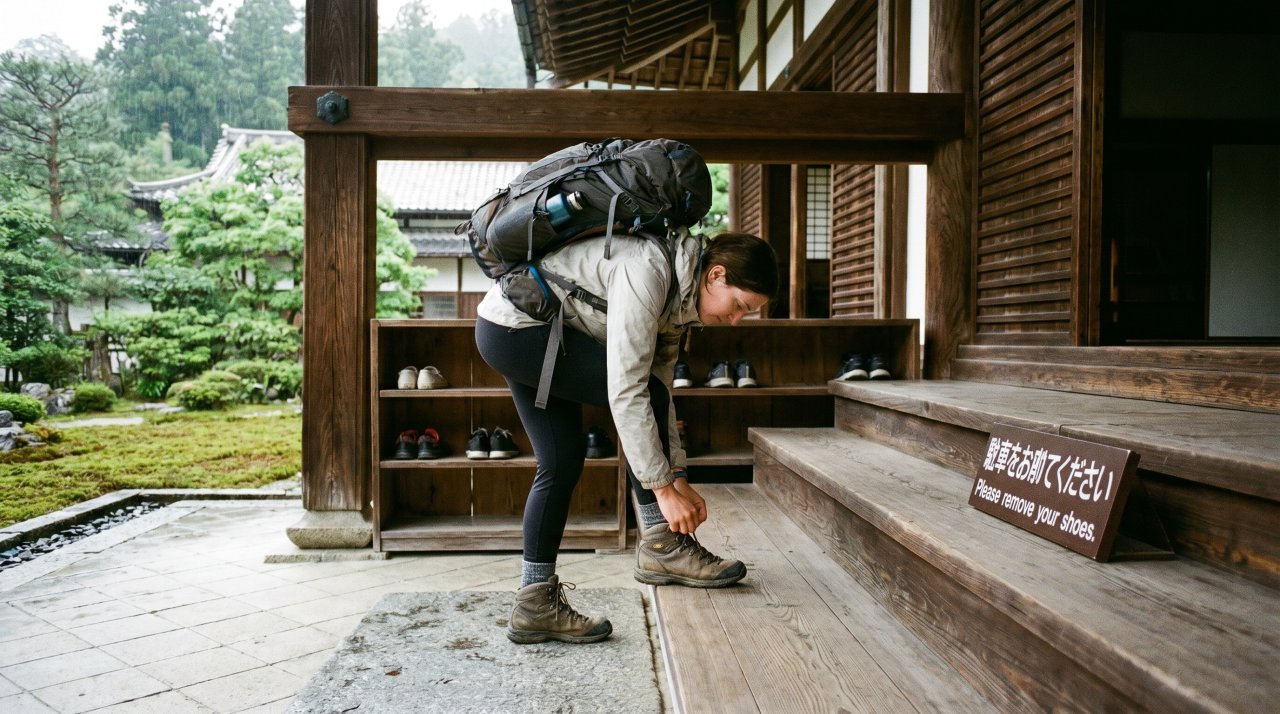
For Japan, that means knowing that you’ll be removing your shoes frequently and that a pair with easy fastenings is practical, not just a preference.
It means knowing that many onsen (traditional hot spring baths) require you to be fully unclothed and that tattoos may result in access being denied at traditional facilities.
Religious Site Protocols
Japan’s guide would cover the difference between Shinto shrines and Buddhist temples, and the specific rituals at each: where to purify your hands, how to approach the main hall, whether photography is permitted inside.
For a destination like India or Morocco, this section expands considerably, covering mosque visit protocols, appropriate entry times, and whether non-believers can enter certain sites at all.
Greetings and Physical Contact
In Japan, the ojigi (bow) is the standard greeting, and its depth communicates relative social status.
Handshakes happen mainly in international business settings.
The guide tells you how to respond when someone bows to you without making it awkward, and what level of formality is appropriate in different contexts: meeting a host family vs. checking into a hotel vs. greeting a shopkeeper.
Photography Norms
Not every country has the same relationship with cameras.
In Japan, photographing inside shrines and temples is often restricted or prohibited, and pointing a camera at strangers on the street without asking is generally considered rude, especially in quieter neighborhoods.
The etiquette guide covers where photography is welcome, where you should ask first, and where you should put the camera away entirely.
Table Manners and Dining Customs
For Japan, the guide would cover: how to use chopsticks correctly (and the specific things you should never do, like sticking them upright in a bowl of rice), how to pour drinks for others before yourself, the etiquette around izakaya ordering, and why slurping noodles is not only acceptable but signals that you’re enjoying the food.
These are the kinds of details that make you feel like a thoughtful guest rather than a tourist who wandered in.
The Categories That Catch Travelers Off-Guard Most Often
Across most destinations, three categories generate the most genuine cultural friction for foreign travelers: tipping expectations, photography without consent, and dress code misreads in religious contexts.
These are also the three where well-intentioned travelers cause unintentional offense most often, precisely because they assume the rules are close enough to home rules that they don’t need to check.
Tipping is the clearest example of how dramatically norms diverge.
In the United States, 20% is standard.
In Japan, tips are refused.
In Iceland, tipping isn’t expected but is no longer unusual.
In Brazil, a 10% service charge is often added to the bill automatically, making an additional tip redundant.
In Egypt, small tips for almost every service are expected and appreciated, even for things that wouldn’t trigger a tip at home.
None of these are wrong.
They’re just different, and getting them backward either insults someone or leaves you looking like you don’t know where you are.
Photography norms are similarly fragmented.
In Morocco’s medinas, many locals prefer not to be photographed and may ask for payment if you take a portrait.
In India, some temples prohibit photography of the deities entirely, even when the rest of the temple is open to cameras.
In Myanmar, photographing military installations can create serious legal problems.
The AI local etiquette guide covers destination-specific photography norms in a way that generic travel advice simply doesn’t.
Dress codes at religious sites are perhaps the most commonly misread category.
“Cover up” is not sufficient guidance when the specifics vary this much: some mosques require women to wear a headscarf throughout, others lend scarves at the entrance, some require both men and women to cover their knees, and a small number have restrictions about non-Muslims entering at all.
The guide gives you the specifics for the site type, not a blanket rule.
Some cultural missteps can escalate beyond social awkwardness into genuine safety situations, particularly around photography of government buildings, military facilities, or politically sensitive locations.
The AI Travel Safety Advisor covers this kind of destination-specific risk in more detail, and it pairs well with the etiquette guide for destinations where cultural context and safety overlap.
What Your Home Country Input Actually Changes
The “Your Country” field in the etiquette guide is optional.
You can generate a useful cultural overview without it.
But when you fill it in, the output shifts from neutral description to a specific, comparative guide, and that shift is where most of the practical value lives.
Without a home country: “In Thailand, it is considered disrespectful to touch someone’s head.”
With the United States as home country: “Unlike in the US where casual physical contact, including touching someone’s shoulder or head, is generally friendly and unremarkable, in Thailand the head is considered the most sacred part of the body.
Touching it, even with good intentions, is disrespectful.
This applies to adults and children alike.”
The second version is actually useful because it tells you specifically what to stop doing, not just what the local rule is.
Travelers who already know not to touch heads in Thailand don’t need the reminder.
Travelers from cultures where warm physical contact is a normal expression of friendliness absolutely do.
The comparison function is particularly valuable across a handful of well-documented cultural gaps: tipping cultures (US vs.
Japan/Iceland/Scandinavia), greeting formality (Northern Europe vs. Latin America vs. East Asia), gender interaction norms (Western Europe vs. parts of the Middle East and South Asia), and punctuality expectations (Germany and Japan vs. much of Latin America and West Africa).
These aren’t stereotypes; they’re documented patterns that create the majority of cross-cultural friction in travel contexts.
Some cultural gaps are also less obvious than they appear.
Australian travelers in Japan, for example, share a similar surface-level informality and directness with Americans, but both groups need the same Japan-specific adjustments.
Meanwhile, a South Korean traveler in Japan is navigating a significantly different set of gaps, because some Korean and Japanese customs are similar and some are exactly reversed.
The home country input captures this distinction in a way that a country-neutral guide cannot.
The cultural context the guide covers isn’t limited to behavior in temples and restaurants.
Dining culture is itself deeply embedded in local etiquette, and if you want to go beyond the table manners section into the actual food culture of your destination, the AI Food Travel Guide maps local dishes, market experiences, and dining customs with much more depth.
Before the Trip vs. During: When to Read It, What to Remember
The etiquette guide is designed primarily as a pre-trip resource, and that’s when it works best.
Reading it two or three days before you depart, rather than the night before, gives you time to absorb the genuinely new information rather than just skim it.
Not everything in the output needs to be memorized.
Some sections are reference material you’ll consult when you need them.
Religious site protocols, for example, are useful to have on your phone when you arrive at a temple or mosque, rather than something you need to carry in your head for the whole trip.
The dress code guidance is worth reading and deciding in advance what to pack, since some adjustments, like bringing a scarf for mosque visits, need to happen before you leave home.
What’s worth actually committing to memory before you arrive: the tipping norms, the greeting conventions, and two or three local phrases.
These are the situations that come up without warning, where you don’t have time to pull out your phone and check.
If you know in advance that you don’t tip in Iceland, that you say salamat as thanks in the Philippines, and that you greet Moroccans with your right hand, you’re already well ahead of the average tourist.
Getting the Most from the Language Input
The Language field in the guide generates a set of useful local phrases, transliterated where necessary so you can actually pronounce them.
This isn’t a replacement for a translation app, but it’s something more specific: a curated list of phrases that matter in the cultural context you’ve already been reading about.
For Japan, that means knowing how to say sumimasen (excuse me / sorry, used constantly and appropriately for almost any mild disruption), itadakimasu (the phrase said before eating), and okaikei onegaishimasu (the bill, please).
These aren’t just useful words.
They’re signals that you’ve put in some effort, and locals notice.
For a destination like Morocco, the guide might surface phrases in Moroccan Arabic (Darija) rather than Modern Standard Arabic, because that’s what people actually speak in the markets and riads where you’ll spend your time.
This kind of destination-specific precision is what separates the language section from a generic phrasebook.
Once you’ve absorbed the cultural context, the next step is building a trip plan that actually works with that knowledge.
The AI Itinerary Planner lets you set the destination, travel style, and duration, then generates a day-by-day plan that factors in the kinds of sites and experiences the culture guide has helped prepare you for.
Saving the Guide for On-the-Ground Reference
The etiquette guide output is formatted cleanly enough to copy into a notes app or save as a PDF on your phone.
If you’re visiting a destination with multiple distinct cultural layers, like India, where regional norms in Tamil Nadu differ meaningfully from those in Rajasthan, you can run the guide twice with more specific destination inputs and keep both versions on hand.
A few things are genuinely more useful in the moment than in advance: the photography norms section, for example, is worth having accessible when you’re at a market or entering a religious site.
The dining etiquette section is helpful to scan before your first significant meal.
Treat the guide as a layered resource rather than something to read once and put away.
If you’re still in the early stages of trip research, the cultural preparation the etiquette guide provides pairs naturally with entry requirements research.
The AI Travel Visa Requirements Checker handles the practical side of whether you need a visa and what documentation to prepare, while the etiquette guide handles what happens once you’re through the border.
Cultural preparation is one of the least glamorous parts of travel research and one of the most practically valuable.
The travelers who come home with stories of warm interactions with locals, of being welcomed into a family’s home or invited to share a meal, are rarely the ones who winged it.
They’re usually the ones who showed up knowing enough to show respect.
The AI local etiquette guide on GetOutTrip gives you that knowledge in about ten minutes, for any destination, built around the specific gaps between where you’re from and where you’re going.
Use it before you pack.
Frequently Asked Questions (FAQs)
Yes. For destinations with prominent religious sites, the guide includes specific dress code requirements, behaviour expectations inside temples, mosques, churches, or shrines, rules around photography, and any fees or documentation required for entry.
This information is included regardless of whether you enter it as a specific interest.
Yes, when Language is entered as an input or when the destination has a clearly associated national language, the output typically includes a short selection of useful phrases with phonetic pronunciation guidance, covering greetings, thank you, excuse me, numbers, and common request phrases.
The guide is calibrated to the destination you enter.
Regional and city-level cultural differences are reflected where they are significant, for example the difference between Bangkok and rural northern Thailand, or between coastal and inland Morocco.
For large and culturally diverse countries, the output notes where regional variation is significant enough to research further.