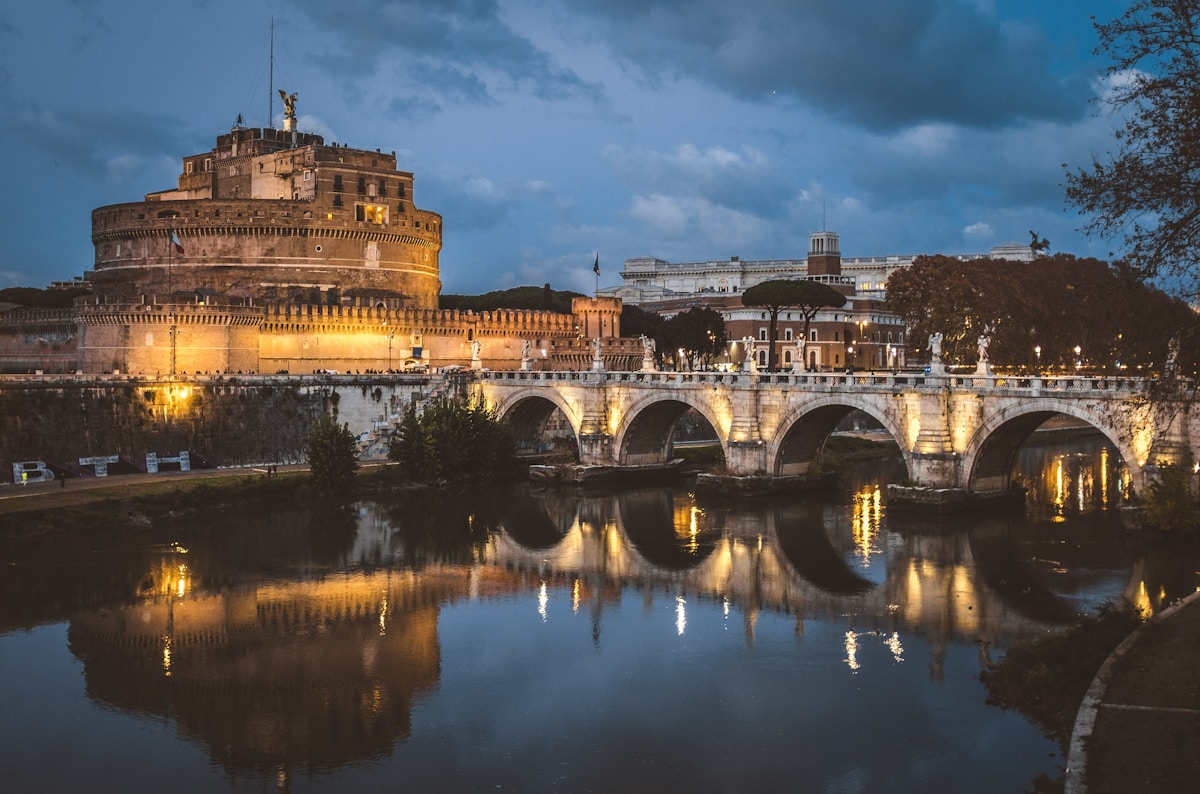





Castel Sant’Angelo started life as a tomb.
Emperor Hadrian commissioned it around AD 123 as a mausoleum for himself and his family, and the cylindrical drum of stone rising above the Tiber has dominated Rome’s skyline ever since.
Over the centuries it transformed from a mausoleum into a military fortress, a papal residence, a prison, and finally the Museo Nazionale di Castel Sant’Angelo — one of the most layered, visually dramatic sites in the entire city.
Visitors move through a genuinely diverse range of spaces: Roman-era foundations, medieval battlements, Renaissance papal apartments decorated with rich frescoes, and exhibitions covering weapons, ceramics, and fine art.
The climb through the spiralling internal ramp — the same ramp Hadrian’s funeral cortege once used — is an experience in itself.
Each level opens up a new chapter of Roman and papal history, and it never feels like a standard museum shuffle.
The rooftop terrace is the undisputed highlight.
From up there you get an unobstructed, 360-degree panorama over the Tiber, Vatican City, and the terracotta roofscape of Rome stretching to the hills.
Come in the late afternoon if you can — the light turns golden, the crowds thin slightly, and the view borders on absurdly good.
Comfortable, closed-toe shoes are strongly recommended; the ramp and stone floors make anything with heels a bad idea.
The first Sunday of every month offers free admission, which sounds ideal until you see the queue.
If you’re visiting on a regular day, book tickets online in advance through the official CoopCulture website to skip the line entirely.
Allow at least 90 minutes inside, or a full two hours if you plan to linger on the terrace.
Rome’s 1,900-year-old fortress delivers papal intrigue, panoramic views, and a rooftop that stops you in your tracks.
Castel Sant’Angelo is one of Rome’s most visited monuments, and for good reason.
Built by Emperor Hadrian around AD 123, it has served as a mausoleum, a fortress, a papal prison, and now a national museum spanning nearly 2,000 years of layered history.
This GetOutTrip guide covers everything you need: current ticket prices, transport options, the best time to visit, and an honest look at what you will and won’t get from your time here.
Castel Sant’Angelo Rome: History, Tickets, and What to Actually Expect
Castel Sant’Angelo is the kind of monument that delivers more than the photos suggest.
Built by Emperor Hadrian around AD 123 as a mausoleum for himself and his dynasty, this cylindrical fortress on the right bank of the Tiber River has been a military stronghold, a refuge for fleeing popes, a prison, and now the Museo Nazionale di Castel Sant’Angelo.
A single visit covers Roman antiquity, medieval warfare, Renaissance opulence, and one of the finest views in the city, all without leaving the building.
Key Highlights
- Address: Lungotevere Castello, 50, 00193 Roma RM, Italy
- Opening hours: Tuesday to Sunday, 9:00 AM to 7:30 PM (last admission 6:30 PM); closed Mondays, 25 December, and 1 January
- Admission: Adults €16 (rising to €18 from 1 July 2026); EU citizens aged 18 to 25 pay €2; under 18s enter free
- Free entry: First Sunday of every month (no booking required)
- Nearest metro: Lepanto (Line A), approximately 15-minute walk
- Time needed: 90 to 120 minutes for a self-guided visit; allow up to 3 hours with a guided tour
- Best season: April to June and September to October for mild weather and manageable crowds
- Official website: direzionemuseiroma.cultura.gov.it
Why a 1,900-Year-Old Tomb Earns Two Hours of Your Roman Itinerary
Not every famous landmark in Rome justifies the queue.
Castel Sant’Angelo does, and the reason is variety.
Most visitors come expecting a castle and leave having walked through five distinct historical eras, each with its own visual texture.
The Roman-era burial chambers feel ancient and sombre; the medieval battlements are chunky and purposeful; the Renaissance papal apartments are lavishly frescoed, with ceilings that belong in a different conversation entirely.
The rooftop terrace is the headline act, and rightly so.
You get a 360-degree view over the Tiber, St.
Peter’s Basilica, and Rome’s terracotta roofscape stretching toward the Janiculum Hill.
No building in this part of the city sits higher.
That view alone justifies the ticket price for most visitors, but the floors below it are genuinely worth your time rather than something to rush through.
It suits history enthusiasts, architecture fans, and anyone who wants to understand how medieval and Renaissance Rome actually functioned.
Visitors looking for a quick selfie-and-leave experience might find the interior unexpectedly dense.
If you’re still deciding between this and other Roman monuments, the AI Destination Comparison Tool on GetOutTrip can help you weigh options across similar sites.
From Hadrian’s Tomb to Papal Escape Route: What You Are Actually Visiting
The building has a biography as eventful as most human lives.
Emperor Hadrian began construction in AD 123, and his ashes were interred here in AD 139.
For the next two centuries it served as a dynastic mausoleum for Roman emperors.
By the medieval period it had been converted into a military fortress, integrated into the Aurelian Wall, and equipped with a fortified corridor that would become one of history’s more useful architectural decisions.
The Passetto di Borgo: A Corridor That Saved Papal Lives
The Passetto di Borgo is an elevated, covered walkway roughly 800 metres long, running directly from Castel Sant’Angelo to the Vatican.
It was used by Pope Clement VII in 1527 to escape the Sack of Rome, when imperial troops ransacked the city and killed or captured thousands.
The pope sheltered inside the castle for months while the destruction continued outside.
You can see the Passetto from the castle’s upper levels, and selected guided tours include access to sections of the corridor itself.
The Papal Apartments: Renaissance Excess Done Well
The appartamenti papali on the upper floors were built and decorated during the 15th and 16th centuries as a luxurious private residence for popes who used the castle as a secure bolt-hole.
The Hall of Apollo and the Hall of Perseus are painted with full fresco cycles, rich in mythological scenes and architectural trompe-l’oeil.
The scale is modest compared to the Vatican’s state rooms, but the quality is high and the context makes them more interesting.
These are rooms where actual political decisions were made under actual threat of violence.
The Bronze Angel That Named the Castle
The castle’s name comes from a plague.
In AD 590, according to the account written by Pope Gregory the Great, the Archangel Michael appeared above the mausoleum and sheathed his sword, signalling the end of a devastating epidemic that had been killing Romans for months.
The building was renamed in his honour.
The current bronze statue of the angel, installed on the rooftop platform, was cast in 1753 by Peter Anton von Verschaffelt and replaced earlier marble versions.
It remains the most-photographed element of the exterior.
Getting to Castel Sant’Angelo Without Wasting Time on Bad Routing
Walking is genuinely the best option if you are already in central Rome.
From the Vatican, it is a 10-minute walk across the Ponte Sant’Angelo.
From the Pantheon it takes around 20 minutes on foot.
From the Spanish Steps, allow 25 to 30 minutes via Via della Conciliazione.
If you are using public transport, the closest metro station is Lepanto on Line A, a 15-minute walk east along the Tiber.
Bus lines 23, 34, 40, 49, 64, 280, and 492 all stop at Piazza Pia, which is a 3 to 5 minute walk from the entrance.
Taxis will drop you on Lungotevere Castello directly.
There is no car park at the site, so driving and parking nearby adds unnecessary complexity to what is otherwise a straightforward arrival.
Booking Tickets, Beating the Queue, and Not Making the Usual Mistakes
The standard adult ticket costs €16 through the official CoopCulture booking portal.
From 1 July 2026, that price rises to €18.
Book online in advance, always.
Walk-up queues on summer weekend mornings can stretch to 45 to 60 minutes, and the ticketing area is not shaded.
Online booking costs a small pre-booking fee but eliminates the queue problem entirely.
The Free Sunday Trap and How to Handle It
The first Sunday of every month is free for all visitors, which sounds ideal until you encounter the reality.
These days attract crowds that can make the internal ramp genuinely uncomfortable, particularly in summer.
If you value elbow room over saving €16, pick a Tuesday or Wednesday morning in the off-season instead.
If you do go on a free Sunday, arrive at 9:00 AM, not 10:30 AM.
What to Wear and What to Expect Inside
Wear closed-toe walking shoes with a flat sole.
The rampa elicoidale, Hadrian’s original internal spiral ramp, is beautiful but made of uneven ancient stone, and the descent can be slippery after rain.
The interior is cool on the lower levels and fully exposed to sun and wind on the rooftop terrace, so layers make sense for spring and autumn visits.
Wheelchair access is limited.
The spiralling ramp and stone staircases make full independent access difficult for mobility-impaired visitors.
If accessibility is a key planning concern, the AI Accessible Travel Planner on GetOutTrip can help you assess the site and identify alternatives or workarounds before you arrive.
Photography is permitted throughout.
Flash is not allowed in the fresco rooms, which is a reasonable request given the condition of the paintings.
The rooftop terrace is the best photography spot in the morning, when the light hits St.
Peter’s dome directly from the east.
Not sure whether to go in spring or September?
The AI Best Time To Visit Planner can match your travel window to the actual crowd patterns at Rome’s major sites.
What’s Worth Visiting Before or After You Leave the Castle
The Ponte Sant’Angelo is the pedestrian bridge directly outside the main entrance, lined with ten marble angels sculpted by Bernini’s workshop in the 1660s.
Walk across it twice: once arriving, once leaving.
The quality of the carving is noticeable even to a non-specialist eye, and the bridge frames the castle as a postcard composition that the rooftop view itself can’t replicate.
From there, the Piazza Navona is a 15-minute walk southeast, anchored by Bernini’s Fountain of the Four Rivers and lined with café terraces.
The Pantheon is 20 minutes on foot from the castle, and pairing the two sites in a single half-day works well.
Vatican City is 10 minutes in the opposite direction.
If your Rome itinerary is still taking shape, use the AI Itinerary Planner to sequence these sites efficiently rather than doubling back across the city.
The Prati neighbourhood, immediately surrounding the castle, has a solid concentration of mid-range restaurants and cafés that are notably less tourist-inflated than the immediate Vatican strip.
Via Cola di Rienzo is the main street for food and grocery shopping if you are self-catering nearby.
Planning the Larger Rome Trip Around This Visit
Castel Sant’Angelo typically sits as one anchor in a 3 to 5 day Rome itinerary, usually paired with Vatican City on the same day or the following morning.
Two hours inside the castle is the honest minimum; if you add the Ponte Sant’Angelo walk and a proper lunch in Prati, you are looking at a half-day.
Rome in summer is hot, crowded, and expensive.
April, May, September, and October offer better weather, shorter queues, and lower accommodation rates.
If you want a full cost breakdown before committing to dates, the AI Trip Cost Estimator generates a personalized Rome budget based on your travel style and group size.
It covers accommodation, transport, food, and entrance fees, which adds up faster in Rome than most visitors anticipate.
Before you leave home, it is worth running through a pre-departure checklist to make sure you have your booking confirmations, travel insurance details, and any other Rome-specific logistics sorted.
It sounds like admin, but losing a pre-booked ticket confirmation on the day is not the way you want to start a visit to a site that charges €18 for a walk-up replacement.
Highlights
Interesting Facts
Facilities
How to Get to Rome

| From | Train | Bus | Flight | Ferry | Book |
|---|---|---|---|---|---|
| Florence IT | $18.62 1h 26min | $6.99 3h 5min | $73.36 50min | — | Check Fares → |
| Napoli IT | $15.81 1h 9min | $4.65 2h 40min | $101.49 50min | — | Check Fares → |
| Milan IT | $40.87 2h 50min | $6.99 7h 45min | $65.35 1h 10min | — | Check Fares → |
| Venice IT | $39.69 3h 53min | $5.82 6h 20min | $88.43 1h 10min | — | Check Fares → |
| Paris FR | $97.07 10h 11min | $87.81 20h 20min | $74.94 1h 55min | — | Check Fares → |
| Barcelona ES | $382.90 34h 7min | $95.41 19h 50min | $50.92 1h 50min | $55.62 19h | Check Fares → |
| Madrid ES | $462.52 36h 55min | $187.33 29h 50min | $45.10 2h 25min | — | Check Fares → |
| Bari IT | $38.52 4h 9min | $11.67 5h | $27.99 1h 5min | — | Check Fares → |
| Salerno IT | $17.45 2h 2min | $5.25 3h 45min | $101.49 50min | — | Check Fares → |
| Sorrento IT | $25.76 2h 26min | $23.41 2h 55min | $101.49 50min | — | Check Fares → |
Prices shown are starting fares and may vary. Book via Omio to compare all available options.
Castel Sant’Angelo earns its reputation without needing to shout about it.
The building itself is the story — you’re literally walking through nearly 2,000 years of Roman and papal history, one ramp at a time.
The Renaissance papal apartments are genuinely spectacular, decorated with frescoes and furnished as they would have been during the height of the Vatican’s political power.
And then you step out onto the rooftop terrace and everything else in Rome suddenly looks small.
The main caveat is the crowd management.
On busy summer days and free-entry Sundays, the internal ramp can feel uncomfortably congested — it’s narrow, it’s ancient, and patience becomes a virtue.
Book online, arrive early (right at 9 AM is ideal), and you’ll have the lower levels largely to yourself before tour groups pile in around mid-morning.
For the money — €16 for the standard ticket — it’s one of the best-value major monuments in Rome.
Frequently Asked Questions (FAQs)
The standard adult admission ticket to Castel Sant’Angelo is €16, rising to €18 from 1 July 2026. Visitors aged 18–25 from EU countries qualify for a reduced rate of €2, while under-18s enter free. On the first Sunday of every month, admission is free for everyone — no reservation needed, though expect longer queues on those days.
Castel Sant’Angelo is generally closed on Mondays. However, from July 2026, the museum is introducing Castle Mondays — the first Monday of each month will be open from 2:00 PM to 8:00 PM (last admission 7:00 PM) with a special ticket price of €5. On all other Mondays, the standard closure applies, alongside 25 December and 1 January.
Plan for a minimum of 90 minutes to 2 hours to cover the main highlights — the Hadrian Ramp, the papal apartments, the museum collections, and the rooftop terrace. If you add a guided tour or take time to explore the temporary exhibitions, a full half-day is easily justified. The terrace alone tends to hold people longer than expected, especially in good light.