



Best Parks in Milan: From Parco Sempione to Parco Nord – Milan’s parks are underappreciated.
The city built its image on fashion and design, and the green spaces don’t make the same kind of international headlines — but for residents and visitors who know the city well, the park network is one of its genuinely distinctive features.
The city has several categories of park: large historic parks adjacent to major landmarks (Parco Sempione), 19th-century public gardens (Giardini Pubblici), smaller intimate gardens with historic pedigree (Guastalla, Villa Belgiojoso Bonaparte), newer landscape design parks (Biblioteca degli Alberi), and large suburban nature reserves (Parco Nord, Idroscalo).
Between them, they cover every type of outdoor use — from a 20-minute lunchtime walk to a full day of nature and cycling.
For a free outdoor day that combines parks with other no-cost activities, free outdoor activities in Milan covers the broader picture of what doesn’t cost anything in the city.
Key Takeaways
- All parks listed in this guide are free to enter; some interior attractions (Torre Branca in Sempione, museums in Giardini Pubblici) charge admission
- The best parks for first-time visitors are Parco Sempione (Castello Sforzesco adjacency, central location) and Biblioteca degli Alberi (modern design, Bosco Verticale views)
- April–May is the peak season for ornamental gardens; September–October for autumn foliage in the larger parks
- Giardini della Guastalla and Villa Belgiojoso Bonaparte are the best-kept secrets — very few tourists despite being close to central areas
- Parco Nord and Idroscalo are worth the metro journey for cycling, birdwatching, and real nature escapes
When Are Milan’s Parks at Their Best?
Spring (late March through May) is the best season for Milan’s parks and ornamental gardens. The formal gardens at Guastalla and Villa Belgiojoso Bonaparte are at peak bloom in April.
The Giardini Pubblici tree canopy is at its most dense and shaded from May through September.
Parco Sempione’s lawns are at their most used and alive from late spring through early autumn.
Autumn (September–October) is the second-best season, particularly for photography — the deciduous trees in Giardini Pubblici, Parco Nord, and Monte Stella produce reliable autumn color.
October is pleasant for walks without summer crowds.
Winter (November–February) reduces the appeal of formal gardens but doesn’t close the parks.
Parco Sempione in fog — a realistic possibility in December and January — is unusually atmospheric.
Summer (July–August) brings intense heat; the parks that have significant tree cover (Giardini Pubblici, Guastalla) are more comfortable than open spaces.
August sees Milanese residents largely leave the city, which makes the parks quieter than any other month.
For how the seasonal timing affects your overall Milan trip planning, best time to visit Milan’s parks and gardens covers the full calendar.



How to Get to Milan

| From | Train | Bus | Flight | Ferry | Book |
|---|---|---|---|---|---|
| Rome IT | $27.99 3h 10min | $6.99 7h 45min | $59.41 1h 10min | — | Check Fares → |
| Paris FR | $92.50 6h 49min | $56.18 12h | $45.40 1h 25min | — | Check Fares → |
| Florence IT | $25.64 1h 44min | $9.33 3h 15min | $183.33 5h 45min | — | Check Fares → |
| Venice IT | $24.12 3h 3min | $8.16 3h 30min | $192.48 5h 55min | — | Check Fares → |
| Zurich CH | $85.48 3h 17min | $17.56 3h 35min | $151.21 55min | — | Check Fares → |
| Napoli IT | $35.01 5h | $10.50 9h | $35.90 1h 20min | — | Check Fares → |
| Nice FR | $20.96 3h 45min | $25.75 4h 20min | $104.80 1h 5min | — | Check Fares → |
| Barcelona ES | $284.54 13h 42min | $56.56 13h 20min | $35.64 1h 35min | $78.10 22h | Check Fares → |
| Geneva CH | $106.56 4h 23min | $25.75 4h 35min | $144.61 1h 5min | — | Check Fares → |
| Genova IT | $15.34 1h 33min | $5.82 1h 45min | — | — | Check Fares → |
Prices shown are starting fares and may vary. Book via Omio to compare all available options.
1. Parco Sempione: Milan’s Most Central Green Space
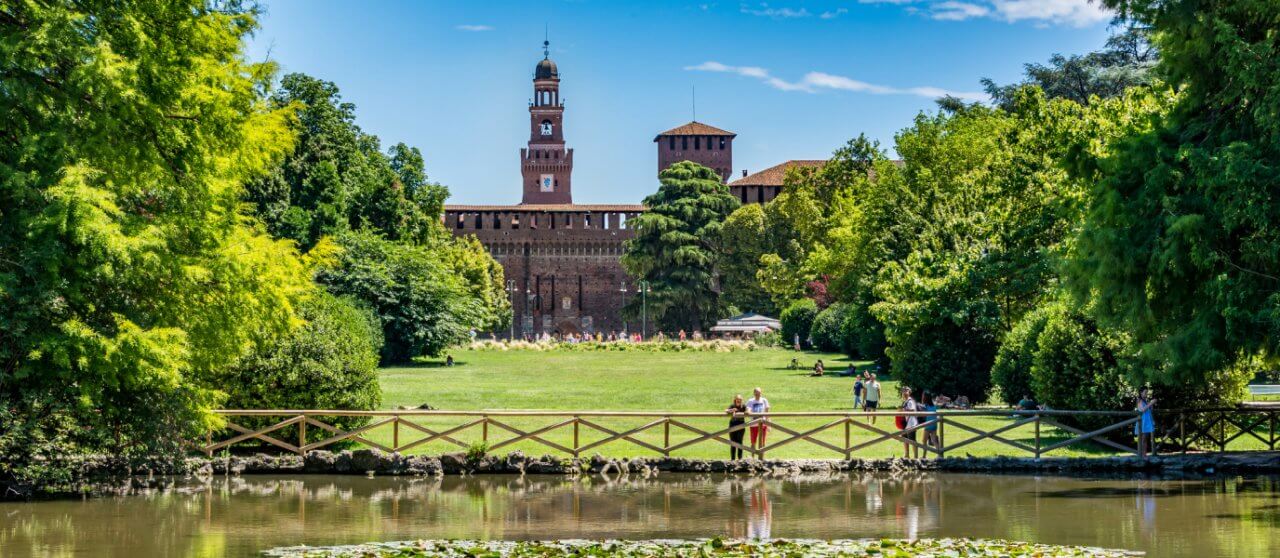
Parco Sempione is the largest park in central Milan — 95 acres of lawns, paths, ornamental features, and trees, directly behind Castello Sforzesco.
It’s the most visited park in the city, and for good reason: it’s free, central, adjacent to a major landmark, and large enough that busy weekend crowds disperse quickly once you move beyond the main paths.
Character and Use
The park was designed by Emilio Alemagna in the late 19th century in an English landscape style — irregular paths, undulating terrain, and a small ornamental lake at its center.
Milanese families use it for weekend picnics; weekday mornings see joggers and dog walkers before the tourist footfall begins.
The lawn areas are genuinely good for sitting — the grass is maintained, and informal use is standard.
On summer evenings, the park extends the social life of the Castello Sforzesco area, with people bringing food and drinks to the lawns.
Bar Bianco, inside the park, is a popular spot for outdoor drinks, and the area around the Arco della Pace becomes one of Milan’s best-known aperitivo zones from around 6:30 p.m.
through summer and autumn nights.
What’s in the Park
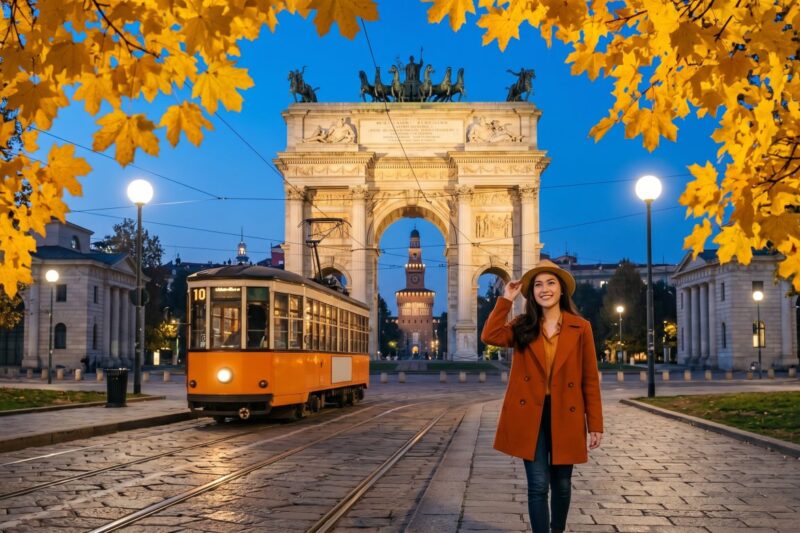
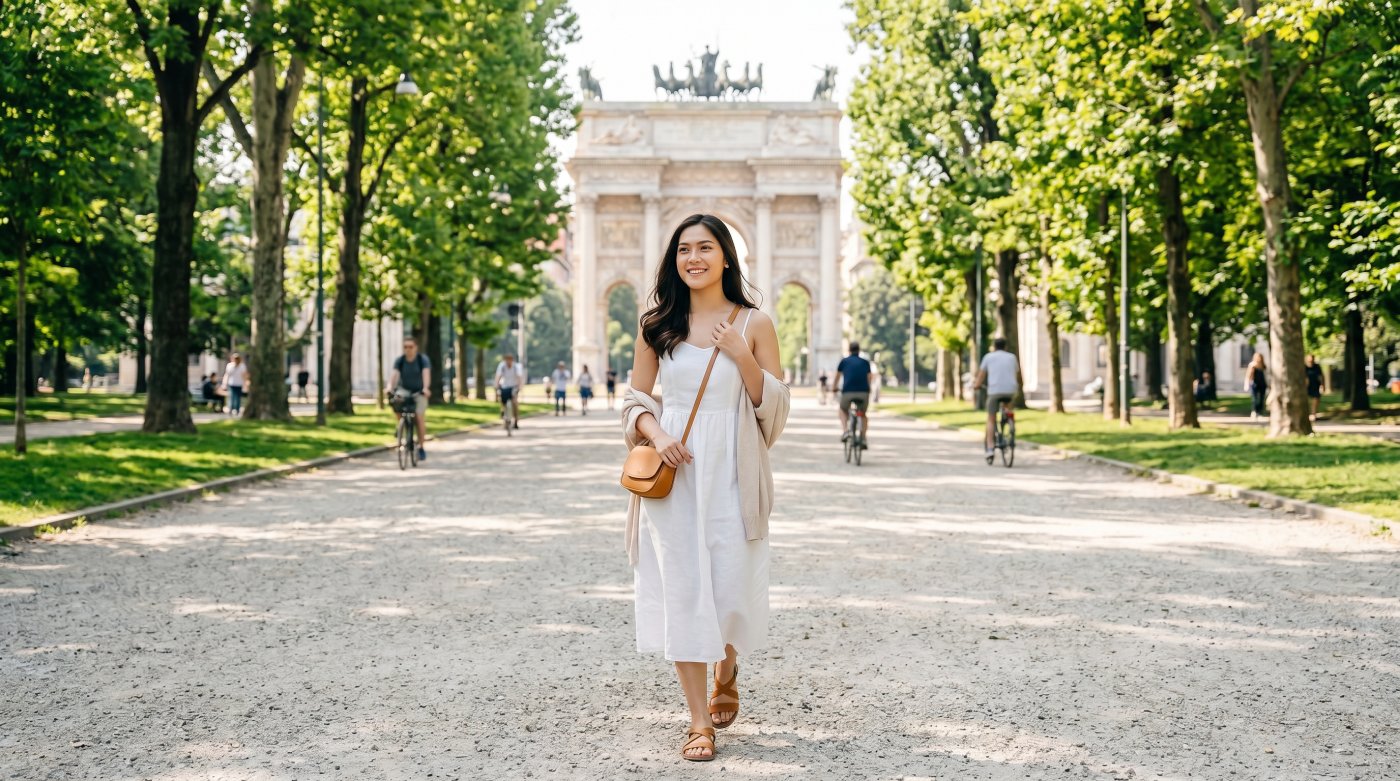
- Arco della Pace: The 19th-century neoclassical triumphal arch at the park’s northern end, built to commemorate the Congress of Vienna and completed in 1838. It sits in the center of a circular piazza at the top of Corso Sempione and is free to view from outside and from the surrounding piazza; the interior of the arch is not publicly accessible as a visitor attraction — it is admired entirely as an exterior monument.
- Torre Branca: A steel viewing tower designed by Gio Ponti and built in 1933 for the fifth Triennale exhibition, still operational. Views across the city are excellent on clear days, including the Alps to the north. Admission: €9 (from January 2026). Opening hours are limited: Wednesday 10:30 a.m.–12:30 p.m., Friday 10:30 a.m.–12:30 p.m. and 3:00–7:00 p.m., Saturday 10:30 a.m.–2:00 p.m., 2:30–7:30 p.m., and 8:30 p.m.–midnight, Sunday 10:30 a.m.–2:00 p.m. and 2:30–7:30 p.m. The tower closes in heavy rain or high wind — call ahead (+39 02 3314120) to confirm. Free admission on Wednesdays for school groups and retirees. Maximum 5 people per elevator ride; each visit lasts approximately 6–7 minutes.
- Arena Civica: A 19th-century neoclassical amphitheater within the park, still used for track and field events and occasional concerts. The exterior is visible from the park paths; interior access depends on events.
- Acquario Civico: Milan’s civic aquarium, in a Liberty-style (Art Nouveau) building at the park’s southeastern edge near the Arena Civica — one of the oldest functioning aquariums in Italy (opened 1906 for the Milan International Exhibition). Admission: €5 full price, €3 reduced (over 65, university students, EU citizens aged 18–25); free for visitors aged 0–17, disabled persons with companion, and ICOM members. Free entry for all visitors on the first Sunday of each month and on the first and third Tuesday of each month after 2:00 p.m. Free entry for under-25s on the second Tuesday of each month. Open Tuesday–Sunday; closed Mondays.
- Triennale di Milano: Italy’s only museum dedicated to design, at the park’s southern edge on Viale Alemagna 6. Entry to the building is free; individual exhibitions are separately ticketed — a day ticket covering all active exhibitions is available at a combined discounted rate (check triennale.org for current pricing, which varies by exhibition configuration). Open Tuesday–Sunday, 10:20 a.m.–8:00 p.m.; closed Mondays.
Getting There
Metro M1 or M2 to Cadorna–Triennale (10-minute walk to the park’s southern entrance via Viale Alemagna), or Metro M1 to Cairoli (directly adjacent to Castello Sforzesco and the park’s eastern entrance).
The park is also easily walkable from the Duomo in approximately 20 minutes on foot along Via Dante.
2. Giardini Pubblici Indro Montanelli: Historic Gardens Near Porta Venezia
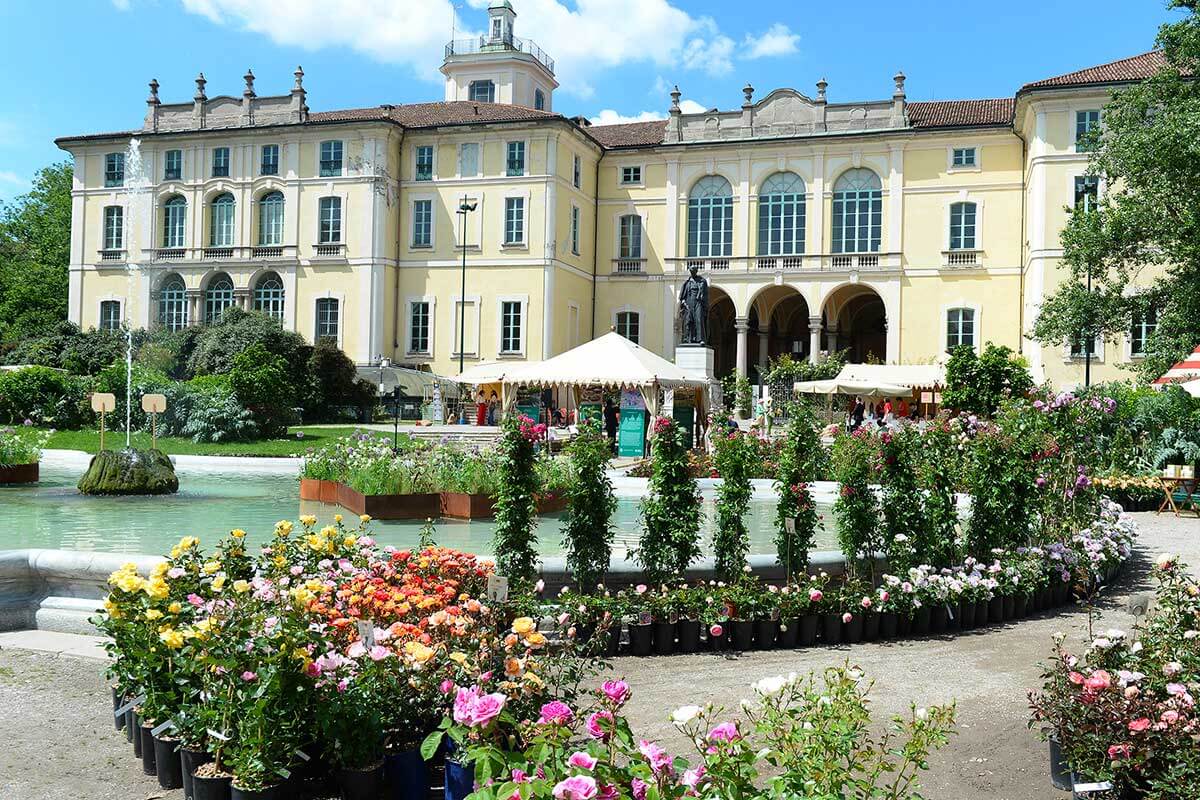
Milan’s oldest public park (opened 1888) covers approximately 17 hectares in the Porta Venezia area, east of the historic center.
It was originally designed by the same landscape architect (Emilio Alemagna) who designed Parco Sempione, and shares its English-style informality with mature trees, winding paths, and ornamental features.
Character
The Giardini Pubblici has a more intimate character than Parco Sempione — smaller, more shaded, and historically more of a residential neighborhood park than a city-center destination.
Ancient trees (some over a century old) provide dense shade in summer.
The park has a children’s play area, a small lake with ducks, and a riding track on one side.
The park is named after Indro Montanelli, a prominent Italian journalist who lived in the neighborhood and was a regular presence there until his death in 2001.
His statue, erected in the park in 2006, is a local landmark and a common meeting point — it sits in the central lawn area near the main Corso Venezia entrance.
What’s in the Park
- Museo Civico di Storia Naturale (Natural History Museum): Milan’s oldest civic museum, located at the park’s edge at Corso Venezia 55, with 23 rooms of exhibits covering dinosaur skeletons, mineralogy, botany, and ecology. Admission: €5 full price, €3 reduced (over 65, university students, EU citizens aged 18–25); free for visitors aged 0–17, disabled persons with companion, ICOM members, and teachers. Additional free-entry days: first Sunday of each month (all visitors, no online booking available — go directly to ticket office), first and third Tuesday of the month from 2:00 p.m. (all visitors), and second Tuesday of the month (visitors aged 0–25). Note: From May 10, 2026, ticket prices are scheduled to increase to €10 full / €5 reduced / €11 open-dated full / €6 open-dated reduced — verify current pricing at museicivicimilano.it before your visit. Open Tuesday–Sunday, 10:00 a.m.–5:30 p.m. (last entry 4:30 p.m.); closed Mondays.
- Planetarium (Civico Planetario Ulrico Hoepli): The largest planetarium in Italy, housed in a neoclassical building at Corso Venezia 57, adjacent to the park. The planetarium operates on a show-based schedule rather than fixed daily opening hours — there are no standard walk-in times. Public shows run on Tuesday and Thursday evenings and Saturday and Sunday afternoons, with additional sessions during school holidays. Admission: €5 full price, €3 reduced; shows are in Italian only (no English-language regular programming). Check the current schedule and book tickets in advance at the official program site (lofficina.eu or the planetarium’s own calendar) as popular shows sell out. Phone: +39 02 88463340.
- Padiglione d’Arte Contemporanea (PAC): A contemporary art kunsthalle at Via Palestro 14 — one of Milan’s most important spaces for rotating contemporary art exhibitions. There is no permanent collection; the PAC is only open during active exhibitions. Admission: €8 full price, €6.50 reduced (ages 6–26, over 65, and select card holders); €4 after 7:00 p.m. on Thursdays; free for children under 6. A family ticket is also available. Open Tuesday–Sunday, 10:00 a.m.–7:30 p.m. (Thursday until 10:30 p.m.); closed Mondays. Check pac.milano.it for the current exhibition before visiting.
Getting There
Metro M1 to Porta Venezia (park entrance directly adjacent to the station exit on Corso Buenos Aires).
Alternatively, Metro M1 to Palestro for direct access to the PAC and Natural History Museum entrances on Via Palestro and Corso Venezia.
The neighborhood around the park — Porta Venezia — is one of Milan’s most interesting and diverse residential areas, with good cafés, aperitivo bars, and independent shops within 5 minutes’ walk in any direction.
3. Parco Biblioteca degli Alberi: Modern Design in Porta Nuova
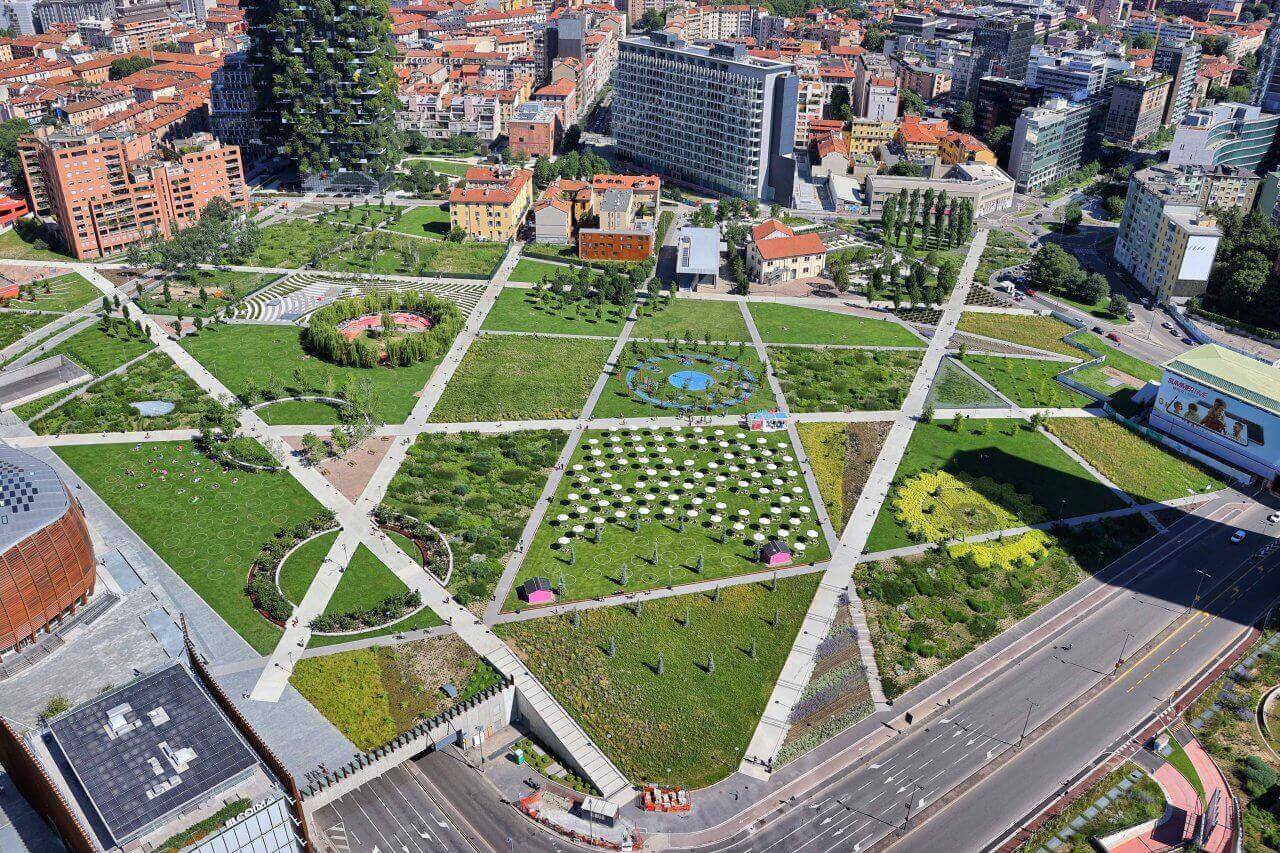
The Library of Trees (BAM — Biblioteca degli Alberi Milano) is Milan’s newest major park and one of the most thoughtfully designed urban spaces in Italy.
It opened in 2018 as part of the Porta Nuova development, occupying 90,000 square meters between the Bosco Verticale towers and the Piazza della Repubblica area, at Via Gaetano de Castillia 18–20.
Design and Character
The park’s design was by Dutch landscape architecture firm Inside Outside.
The structure is based on a series of concentric circular gardens, each planted with a different species across 23 tree varieties — larch, mulberry, magnolia, cherry, birch, and others — creating distinct visual zones within a unified landscape.
500 trees and approximately 135,000 plants make it one of the densest urban planting projects in Italy.
The park functions as a genuine public space rather than a decorative backdrop.
Managed by Fondazione Riccardo Catella, BAM runs one of the most active free cultural programs of any park in Europe — over 300 free events per year, open to everyone, with no ticket required for any programming.
The 2026 cultural season, themed “(Dis)Connessioni” (Dis)Connections, launched on March 29 with the Multi-Kulti BAM Spring Festival and continues through spring, summer, and into autumn.
The program includes free outdoor performances from morning to evening — contemporary dance, circus arts (the annual BAM Circus Festival ran in May), live music, theatre, children’s workshops, environmental education sessions, and film screenings.
The full event calendar is published and updated weekly at bam.milano.it/en/eventi.
What makes it distinctive: The views across the park to the Bosco Verticale towers (best from the central path area) are the most photogenic view in modern Milan.
The towers, with their 900 trees and 20,000 plants integrated into the residential facade, are visible from most parts of the park.
The park is also a working botanical demonstration — species labels identify each planting, and the design is intended to educate visitors about native and adapted species in an urban context.
It is free to enter at all times and open around the clock, with lighting along all main paths after dark.
Getting There
Metro M2 or M5 to Garibaldi (7–10 minute walk south into the Porta Nuova development), or Metro M5 to Isola (8-minute walk).
The park is also walkable from Piazza della Repubblica via Viale della Liberazione in approximately 10 minutes.
Address: Via Gaetano de Castillia 18–20.
4. Giardini della Guastalla: Milan’s Hidden Historic Garden
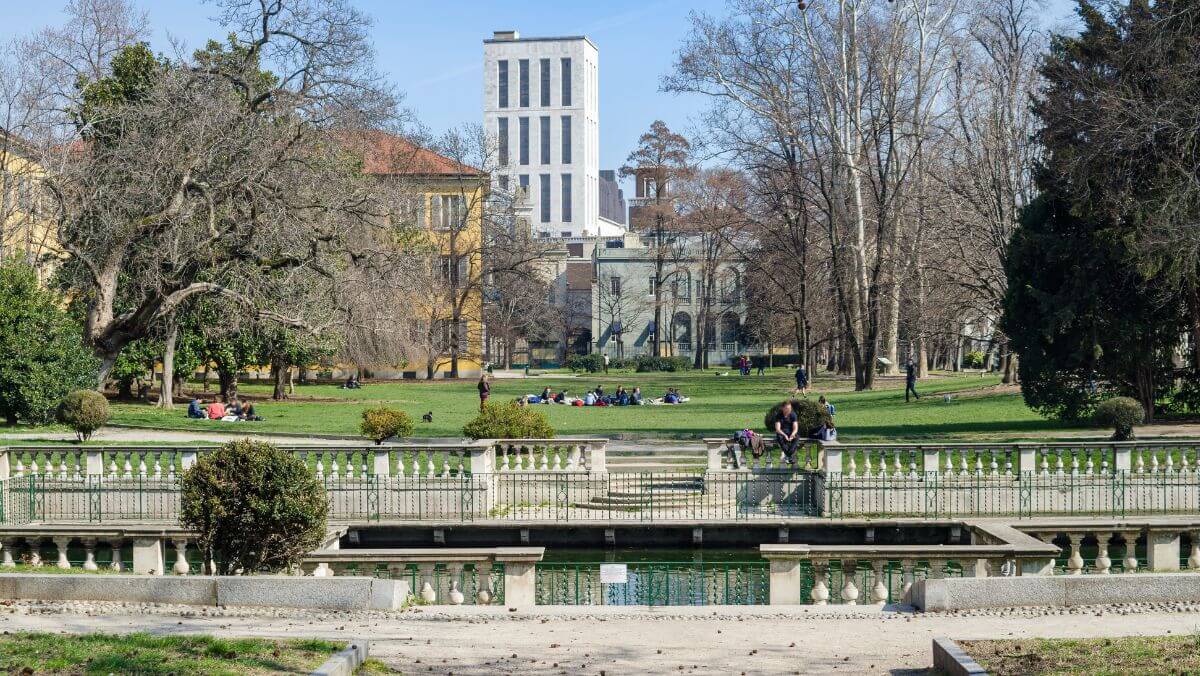
The Giardini della Guastalla is one of the least-visited significant gardens in central Milan, and one of the most rewarding for visitors who find it.
Originally laid out in 1555 by Countess Paola Ludovica Torelli — Marchioness of Guastalla — as a private garden for a convent housing young noble women, it is in fact the oldest surviving garden in the city, predating Parco Sempione by three centuries.
It became a public park in 1939.
Character
The garden covers approximately 5 hectares — small compared to Sempione, but with a concentrated elegance that larger parks don’t have.
Ancient trees provide dense shade.
An ornamental fish pond with an 18th-century baroque balustrade anchors the central area; formal flowerbeds and statuary run along the main axis, giving the garden a cloistered, enclosed atmosphere unlike any other public green space in Milan.
In spring (April–May), the flowerbeds produce some of the most photographically interesting scenes of any public garden in Milan.
The combination of formal planting and tall canopy trees creates a space that feels genuinely historic rather than recreated.
The garden is used primarily by locals — nearby residents, university students from the adjacent Law faculty, and lunchtime workers from the surrounding offices.
Tourists are rare.
What’s in the Garden
- 18th-century baroque fish pond with decorative balustrade
- A small neoclassical temple (Tempietto) at one end — a 19th-century addition
- Mature plane trees and hornbeams providing summer shade
- A bocce court alongside a children’s play area — a detail that makes it feel like a genuinely local space rather than a curated visitor attraction
Entry is free.
Opening hours are daily from 7:00 a.m. — closing time varies by season, generally at dusk (around 7:00–8:00 p.m.
in winter and up to 9:00–10:00 p.m.
in summer).
The garden is managed by the City of Milan; during occasional civic events it may be partially closed.
Getting There
Metro M3 to Missori (5-minute walk north along Via Francesco Sforza), or Metro M3 to Crocetta (8-minute walk).
Also reachable in approximately 15 minutes on foot south from the Duomo along Via Torino and Corso di Porta Romana.
Main entrance at Via Francesco Sforza, 20122 Milano.
5. Giardino della Villa Belgiojoso Bonaparte: Neo-Classical Gardens and a Modern Art Museum
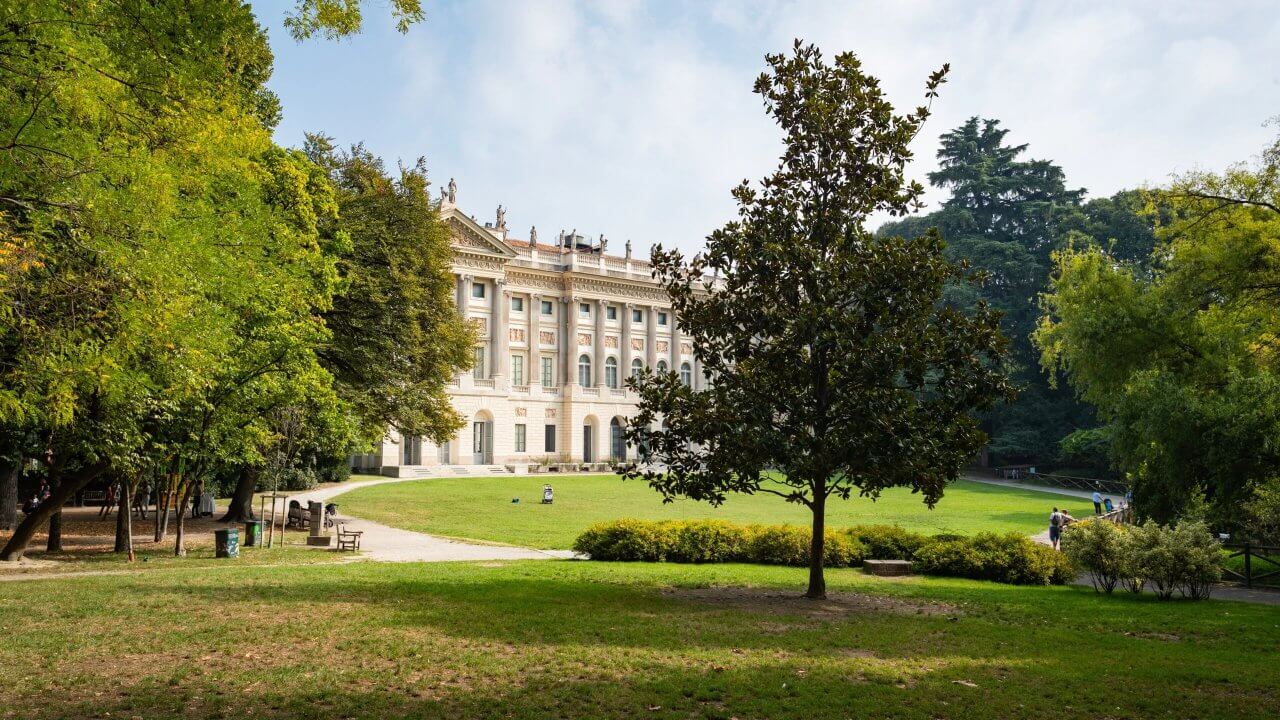
The garden of Villa Belgiojoso Bonaparte is directly connected to the Galleria d’Arte Moderna (GAM) and the Villa Reale — a neo-classical complex built in 1790 for a Napoleonic official and today one of the finest examples of late 18th-century architecture in Milan.
The garden itself is in the English landscape style, with mature trees, ornamental ponds, and statuary.
Character
The garden is smaller than Parco Sempione but more refined — designed as an extension of the villa’s private spaces.
The combination of neo-classical building facade and informal English garden creates an unusual visual contrast.
Duck ponds, stone bridges, and mature plane trees are the main features.
In spring, the garden is particularly attractive — the combination of ornamental planting and the villa’s classical white facade makes it one of the most photographed settings in the Brera neighborhood.
The Galleria d’Arte Moderna (GAM) inside the villa holds the city’s permanent collection of 18th- to 20th-century painting — works by Francesco Hayez, Gaetano Previati, and other Italian Romantic and Post-Impressionist painters, plus sculpture and decorative arts.
Admission: €5 full price, €3 reduced (students, EU citizens aged 18–25, over 65); free for visitors under 18.
Free entry for all visitors on the first Sunday of each month and on the third Tuesday of each month from 2:00 p.m. Free entry for visitors up to 25 years old on the second Tuesday of each month.
Open Tuesday–Sunday, 10:00 a.m.–5:30 p.m.; closed Mondays, January 1, May 1, and December 25.
Booking available via museicivicimilano.it.
The Padiglione d’Arte Contemporanea (PAC) at Via Palestro 14 — adjacent to the garden, not inside the villa — is one of Milan’s most important contemporary art kunsthalle spaces, open only during active exhibitions.
Admission: €8 full price, €6.50 reduced (ages 6–26, over 65, and select card holders); €4 on Thursdays after 7:00 p.m.; free for children under 6.
Open Tuesday–Sunday, 10:00 a.m.–7:30 p.m. (Thursday until 10:30 p.m.); closed Mondays.
Check pacmilano.it for the current exhibition before visiting.
Entry to the garden is free at all times.
Getting There
Metro M1 to Palestro (2-minute walk).
The garden entrance is on Via Palestro 16; the GAM villa entrance and PAC entrance are on the same street.
Trams 1 and 2 stop at Piazza Cavour, also within a 3-minute walk.
6. Monte Stella: Milan’s Artificial Hill
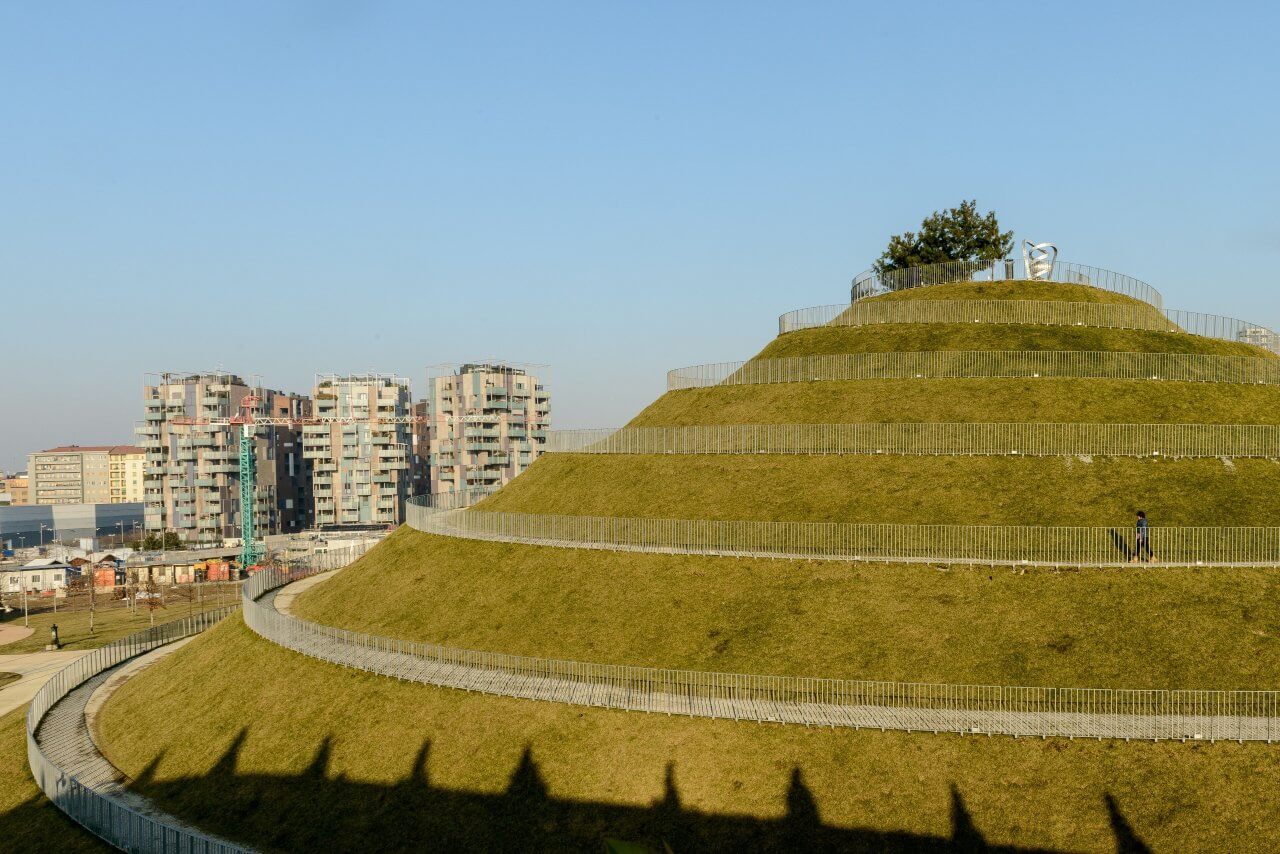
Monte Stella — nicknamed La Montagnetta di San Siro — is an artificial hill in the western Portello district, built from rubble cleared after World War II bombing.
It rises to approximately 113 meters above sea level, making it the highest point in Milan’s flat urban landscape.
Character
The hill is a genuine urban hiking destination, modest by any other standard but meaningful in a city where the terrain is uniformly flat.
The paths up the hill wind through trees and scrub vegetation; the summit is open with a 360-degree view of the city and — on clear days in winter and spring — the Alps.
The scale is accessible: walking to the top takes about 15–20 minutes at a comfortable pace.
There are benches at the summit and along the main paths.
The western side of the hill has a small ornamental garden.
Local residents use it for morning runs and dog walking; the summit is popular for sunset views, particularly in winter when the Alpine visibility is best.
The hill doesn’t have formal attractions beyond the views and the walk, but it’s an interesting alternative to the more formal parks and genuinely rewarding on clear days.
Getting There
Metro M1 to Lotto (10-minute walk), or Metro M5 to Portello (10-minute walk).
The main park entrance is on Via Monte Stella.
7. Parco Nord: Nature at the City’s Edge
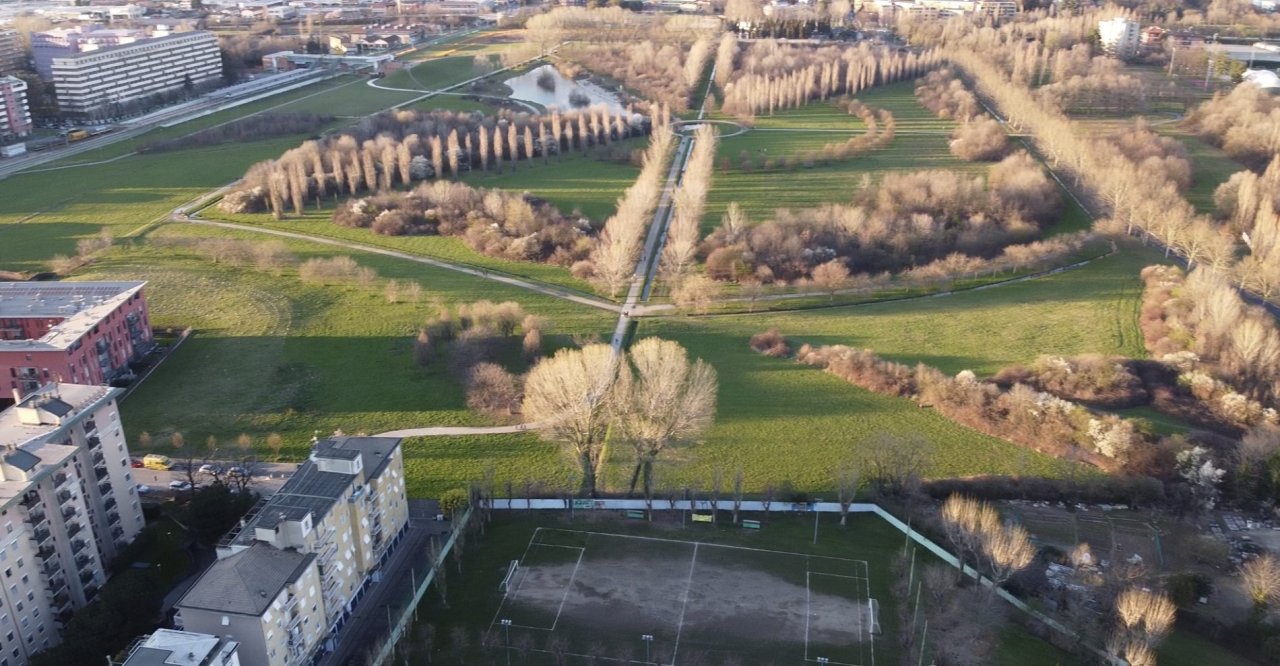
Parco Nord Milano is the largest nature park in the metropolitan area — 650 hectares (approximately 1,600 acres) of woodland, meadows, waterways, and agricultural land north of the city, straddling the municipalities of Milan, Sesto San Giovanni, Cinisello Balsamo, Bresso, Cormano, and Cusano Milanino.
It’s primarily a park for Milanese residents seeking genuine nature immersion rather than ornamental garden experience.
Character
The park has cycling trails, hiking paths, birdwatching areas, and picnic sites.
It was developed from a former industrial and peri-urban wasteland from the 1970s onward, which gives it a different character from designed historic parks — it is actively managed as a habitat corridor and green lung for the northern metropolitan area.
The woodland corridors, meadows, and waterways create habitat for over 100 bird species documented in the park, with the wetland areas particularly productive during spring and autumn migration along the Po Valley flyway.
There are no major historical features or visitor attractions in the conventional sense — the park’s value is in scale, nature, and recreational infrastructure.
Dedicated cycling paths link it to urban bike routes, making it accessible by bicycle from several northern Milan neighborhoods.
What to do:
- Cycling: A circular cycling ring of approximately 10 km winds between the Cinisello Balsamo and Bresso sections of the park; additional shared paths extend the total rideable distance considerably. Bike hire is available seasonally at designated points within the park.
- Birdwatching: The wetland areas around the park’s internal waterways and the sections bordering Sesto San Giovanni are particularly productive during spring (April–May) and autumn (September–October) migration
- Picnicking: Large designated meadow areas throughout the park, with barbecue facilities in specific zones
- Walking: Multiple waymarked trails including a circular themed route covering four distinct landscape types within the park
- Children’s areas and sports facilities: Football pitches, volleyball courts, and children’s play areas at several points within the park
Entry is free.
The park is open year-round, with no time restrictions — entrances remain accessible around the clock.
Seasonal cafés and refreshment kiosks operate in spring and summer, concentrated near the main entrances off Viale Fulvio Testi and Viale Enrico Fermi; most close or operate reduced hours from October through March.
Getting There
Multiple public transport routes serve the park — the main approaches from central Milan are:
- Metro M3 (yellow) to Zara, then bus line 31 (stops inside the park along the southern edge)
- Metro M5 (violet) to Bignami, then bus line 708 toward Bresso (northern approach)
- Metro M1 (red) to Sesto Rondò, then bus line 708
- By bicycle: The park connects directly to the urban cycling network; BikeMi bike-sharing docking stations are available near several metro stops within reasonable cycling distance
Main entrances are on Viale Fulvio Testi, Viale Enrico Fermi, and Via Giancarlo Clerici.
8. Idroscalo: The City’s Artificial Lake Park
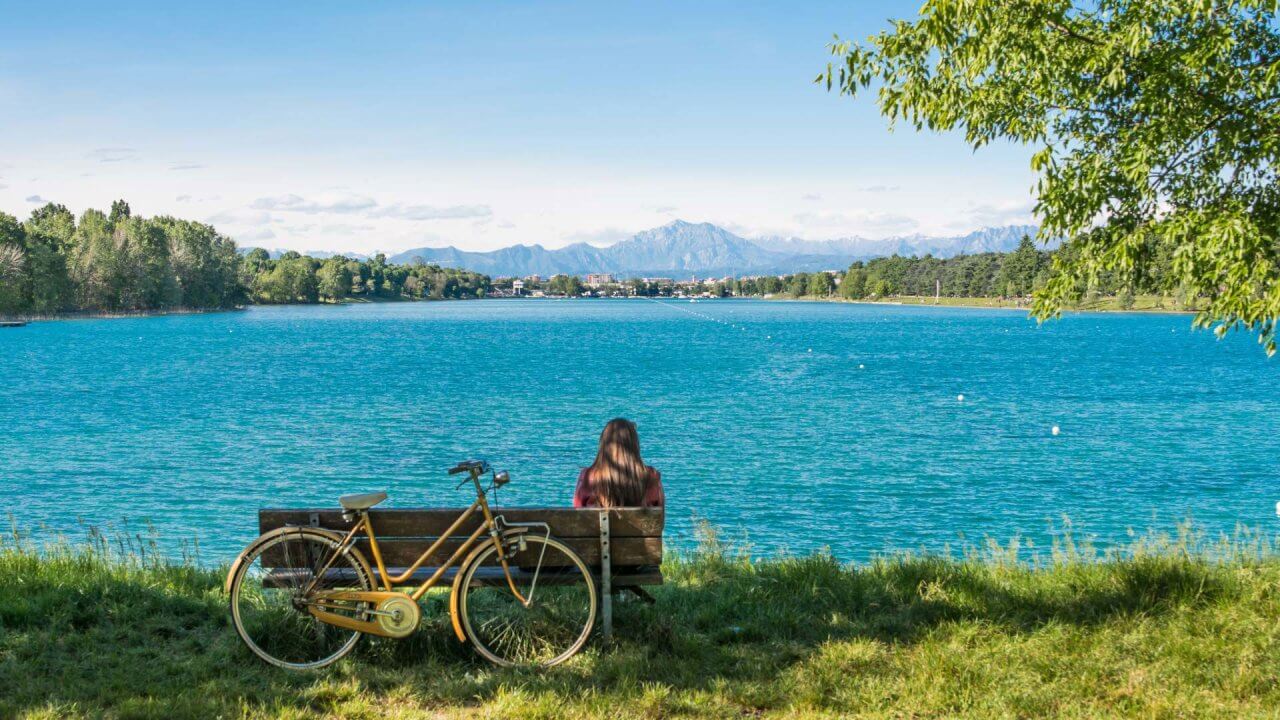
Idroscalo — literally “water airfield,” as it was originally built as a seaplane landing basin in the 1930s — is a large artificial lake park in the eastern suburbs, near Linate Airport.
The lake is approximately 2.5 km long; the surrounding park covers 100 hectares.
Character
Idroscalo functions as a summer leisure destination — swimming, water sports (kayaking, paddleboarding, windsurfing, wakeboarding, canoeing), lakeside cycling, and outdoor concerts.
It draws large crowds from the city on summer weekends and is one of Milan’s best-known warm-weather destinations for families.
In contrast to the historic central parks, Idroscalo has a more resort-like atmosphere — facilities-oriented, with changing rooms, food stalls, and organized activities.
The park perimeter and walking paths are free to access at all times; the park opens daily at 7:00 a.m. and closes at 9:00 p.m. in summer (hours vary by season).
Designated swimming areas are ticketed separately: €10 for a full day (standard adult), €8 for children aged 4–10 and visitors over 65, and €6 for the afternoon session (from 4:30 p.m.) — children under 3 enter the beach areas free.
Water sports hire and activity facilities have their own independent pricing.
As of the current season, the official Idroscalo website (idroscalo.org) confirms water quality as Eccellente (Excellent) in all designated swimming zones.
The park hosts several large outdoor concerts and summer events — it is one of Milan’s main outdoor concert venues in June through August, with touring international acts.
Check the program at idroscalo.org for current events during your visit.
Getting There
The easiest route from central Milan is Metro M4 (blue line) to Linate Aeroporto (the eastern terminus), then bus line 73 or a short walk of approximately 15–20 minutes along the perimeter road to the main park entrance.
The M4 runs the full length of the city from San Cristoforo to Linate Airport in around 28 minutes, stopping at San Babila (city center).
Alternatively, bus line 73 runs directly from the city center (Piazza San Babila) to Linate and continues to the Idroscalo area.
By bicycle, the park is reachable via the city’s eastern cycling routes from the Città Studi or Lambrate neighborhoods.
Main entrance at Via Circonvallazione Idroscalo, Segrate (MI).
Which Milan Parks Are Best for Families?
Parco Sempione and Giardini Pubblici Indro Montanelli are the two best parks for families. Both are central, have dedicated children’s play areas, and have museum or educational attractions attached.
Parco Sempione for families:
- Large enough for children to run without crowding concerns
- Castle courtyard adjacent (free) for exploring
- Acquario Civico on the park’s edge
- A dedicated playground area is located in the central-eastern section of the park, roughly between the ornamental lake and the Arena Civica — one of the easier spots to find on a first visit. A separate, fenced dog area is also marked on park maps for those visiting with pets
- Easily reached by multiple metro lines (M1 Cairoli, M2 Lanza, M1/M2 Cadorna)
- The park has free Wi-Fi coverage throughout and public toilets at several points
Giardini Pubblici for families:
- Natural History Museum with dinosaur skeletons
- Planetarium for older children
- Duck pond and small lake
- Play areas throughout
- Located in a neighborhood with good cafés for adult recovery time
Biblioteca degli Alberi for families:
- Frequent free children’s programming in spring and summer — workshops, circus arts, storytelling, and environmental education events (check bam.milano.it for current schedule)
- Open, flat terrain easy for running
- Clear visual interest (views of Bosco Verticale)
- Less crowded than Sempione on weekends
Parco Sempione specific note: The lawns and main paths are accessible for prams/strollers — the park’s terrain is gently undulating but manageable.
The cobblestone areas around the castle entrance and the Arco della Pace end are less stroller-friendly.
For refreshments inside the park, Bar Bianco (near the ornamental lake, open in spring and summer) is the main in-park option for drinks and snacks and has outdoor terrace seating and toilet facilities.
A second bar operates near the pond.
Both tend to be open March through October; outside those months, the park has no on-site food service, so bring supplies in autumn and winter.
The streets surrounding the park — particularly along Corso Sempione and Largo Cairoli — have plenty of cafés and bars within a 5-minute walk of any entrance.
For additional family-oriented activities beyond the parks, the AI Family Travel Planner combines park visits with age-appropriate indoor activities based on your children’s ages.
Are Any Milan Parks Good for Picnics and Open-Air Events?
- Parco Sempione, Biblioteca degli Alberi, and Parco Nord are the best for picnicking. Sempione has large lawns explicitly used for this; BAM has good sitting areas and organized events; Parco Nord has dedicated picnic areas with barbecue facilities.
- For spontaneous picnics near good food shops: Giardini della Guastalla is close to several good delis and alimentari along Corso di Porta Romana. Giardini Pubblici is close to the Porta Venezia neighborhood’s café culture and the large Esselunga supermarket on Viale Piave. Parco Sempione is walkable from the Brera area’s food shops and the Mercato Comunale at Via S. Marco.
Recurring free outdoor events:
- Biblioteca degli Alberi (BAM): The 2026 cultural season, themed “(Dis)Connessioni”, runs from March through autumn with over 300 free events — yoga, contemporary dance, circus (the BAM Circus Festival concluded in May 2026 and returns annually), live music, children’s workshops, film, and theatre. Events run throughout the week, with heavier programming on weekends. The full rolling calendar is at bam.milano.it/en/eventi and updates weekly — check it before your visit for what’s on during your stay.
- Estate Sforzesca (Estate al Castello): Milan’s flagship summer cultural festival runs annually at Castello Sforzesco from late June through September. In 2026 the program runs from June 30 through September, using the castle courtyards and the Arena Civica in Parco Sempione as stages for live music concerts, jazz performances, cinema under the stars, theatre productions, dance, and family events. Most events are free or low-cost. The official program is published on the Comune di Milano website — search “Estate al Castello 2026“ for the full schedule.
- Outdoor cinema in Milan’s parks: Several outdoor cinema programs operate across Milan’s parks during summer. The Milano Film Festival and Milano è Viva program typically bring open-air screenings to various park venues in June through August, including Giardini Pubblici and the Castello Sforzesco courtyards. Check yesmilano.it for the current season’s outdoor cinema calendar, as programs and venues are confirmed year by year.
The best neighborhoods near Milan’s parks guide covers which residential areas are closest to each park — useful for choosing where to stay if parks are a priority.
Getting to Milan’s Parks by Metro
| Park | Nearest Metro Stop | Journey from Duomo | Notes |
|---|---|---|---|
| Parco Sempione | M1 Cairoli or M1/M2 Cadorna–Triennale | 5–10 min, both stops adjacent | Cairoli is closest to the castle entrance; Cadorna–Triennale is closest to the park’s southern (Triennale) entrance |
| Giardini Pubblici | M1 Porta Venezia or M1 Palestro | Directly adjacent (Porta Venezia); 3 min walk (Palestro) | Porta Venezia for the main park; Palestro for the Natural History Museum and PAC entrances |
| Parco Biblioteca degli Alberi | M2/M5 Garibaldi or M5 Isola | 7–10 min walk (Garibaldi); 8 min walk (Isola) | Garibaldi is the standard approach from the center; follow Porta Nuova signage |
| Giardini della Guastalla | M3 Missori or M3 Crocetta | 5 min walk (Missori, approach from Via Sforza); 8 min walk (Crocetta) | M3 Missori is the most direct |
| Villa Belgiojoso / GAM | M1 Palestro | 2 min walk | Same stop serves PAC and the park entrance on Via Palestro |
| Monte Stella | M1 QT8 | 6 min walk | Formerly listed as M1 Lotto/M5 Portello in older guides; QT8 is the correct and closest stop — both exits are approximately 6 min walk from the park perimeter |
| Parco Nord | M3 Zara + bus 31, or M5 Bignami + bus 708 | 25–35 min total from Duomo | Requires a bus connection from the metro — no metro stop at the park; M5 Bignami approach is convenient from the north |
| Idroscalo | M4 Linate Aeroporto (eastern terminus) | 25–30 min from Duomo (San Babila M4 + 15 min walk) | From M4 Linate Aeroporto, the main park entrance at Via Circonvallazione Idroscalo is approximately 15–20 min on foot; bus line 73 from Piazza San Babila also stops near the entrance without requiring a metro transfer |
For a full guide to the metro system and cycling connections to parks, how to reach Milan’s parks by public transit covers the ATM network in detail.
For museums near Milan’s parks — the Triennale and Acquario Civico near Sempione, the Natural History Museum in Giardini Pubblici, and the Galleria d’Arte Moderna at Villa Belgiojoso — museums near Milan’s parks has the full admission and opening hours breakdown.
Frequently Asked Questions (FAQs)
All parks listed in this guide are free to enter — no admission charge applies to any of the park grounds themselves.
Several have paid attractions attached: Torre Branca (€9, Parco Sempione), the Museo Civico di Storia Naturale and Planetarium (Giardini Pubblici), the Galleria d’Arte Moderna and PAC (Villa Belgiojoso), the Acquario Civico (Parco Sempione perimeter), and designated swimming areas at Idroscalo.
In all cases the park itself remains free; admission is only charged for specific facilities or venues within or adjacent to the park.
The exceptions are the Acquario Civico’s free days (first and third Tuesday afternoons of the month) and the first-Sunday free policy that applies to civic museums connected to several parks.
Dogs are generally allowed in Milan’s parks on a lead (leash required at all times) in public areas — this is standard under Italian municipal regulations and applies to all the parks in this guide.
Parco Sempione has a dedicated fenced off-lead dog area within the park (marked on park maps near the central area); Parco Nord has open meadow zones that are widely used by dog owners and is one of the most dog-friendly spaces in the metropolitan area.
Giardini della Guastalla and the Villa Belgiojoso garden have more ornamental character and stricter enforcement of the lead rule; dogs are permitted but must remain leashed at all times, and are excluded from the areas immediately around the ornamental fish ponds.
Biblioteca degli Alberi and Giardini Pubblici permit leashed dogs on all paths.
Clean-up bags are required by law throughout Milan’s public parks — municipal inspectors actively enforce this in central parks.
Parco Sempione is the most popular running park in the city.
Its perimeter path runs approximately 3.4–3.5 km around the park’s outer circuit — a clean, well-lit, mostly flat loop with no traffic crossings.
The path around the Arena Civica adds a shorter inner variant of around 1 km for those wanting intervals.
The park is good for two-lap sessions of 6–7 km, and is particularly well-used by runners on weekday mornings before 9:00 a.m. and evenings after 6:00 p.m.
Parco Nord has longer routes for those who want 10+ km without backtracking, including a 10 km circular cycling and running ring through varied terrain.
For urban runners who want to combine road and park running, the Financial Times ranks the Sempione–Brera combined loop at approximately 3.5–7 km as one of Milan’s best city running routes.

A lifestyle and OOTD blogger, Kannaya Nareswari enjoys the small pleasures of cooking, traveling, and documenting ordinary events. She uses genuine storytelling to communicate her love of fashion, culinary explorations, and wanderlust. She is based between Bali and Bandung. She enjoys enjoying coffee at a secret café or experimenting with recipes in the kitchen when she's not traveling to new places or styling her most recent ensemble.