


Best Day Trips From Bangkok: Ancient Ruins, Floating Markets, and More – Make unforgettable memories exploring ancient ruins, floating markets, and hidden waterfalls just hours from Bangkok’s chaos.
Bangkok’s temples and street food justify days of exploration on their own, but the destinations within two to three hours are often the stronger memories.
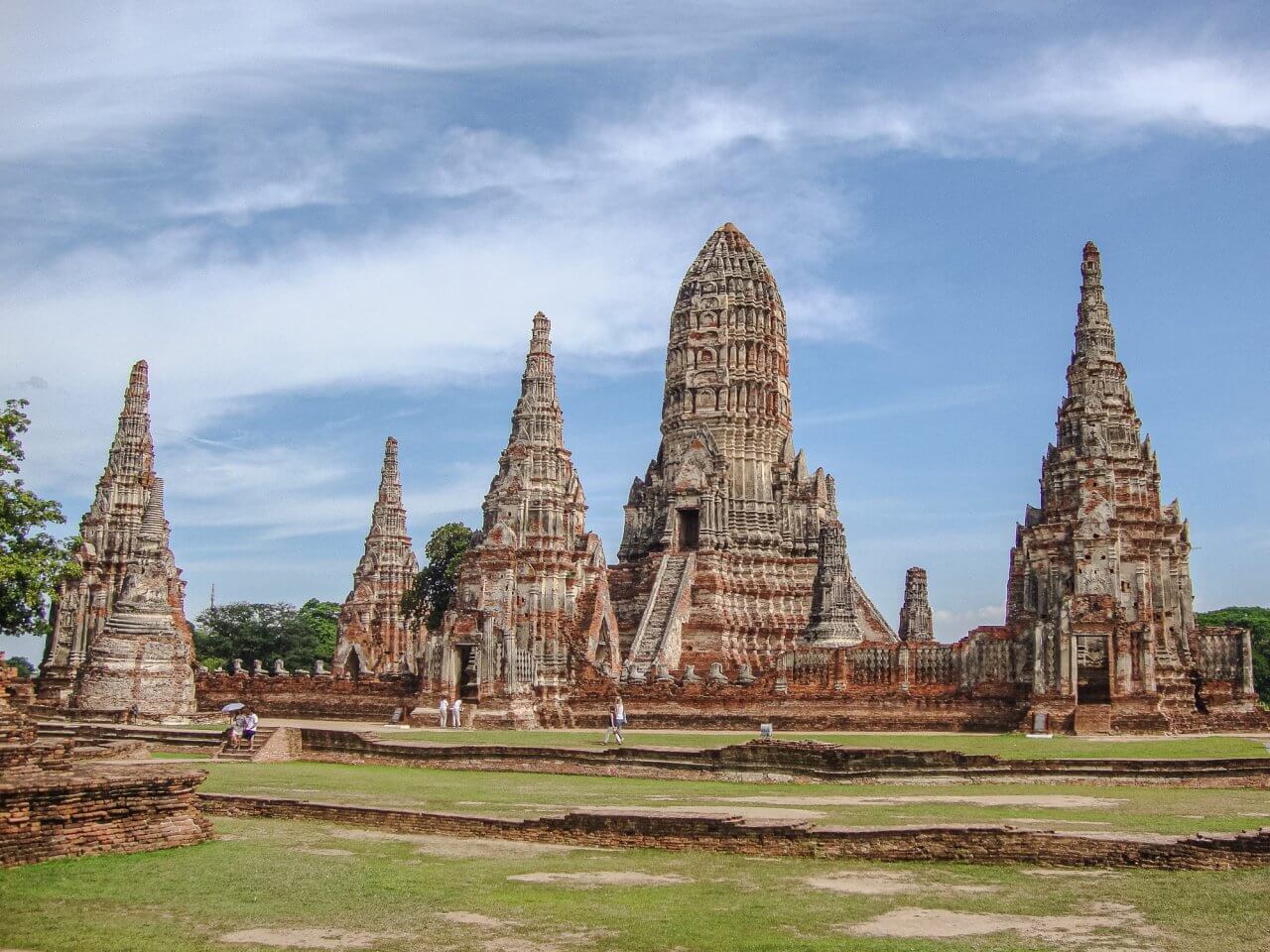
Ayutthaya’s ruined temples sit quieter than the Grand Palace and hold more visual weight.
Kanchanaburi pairs WWII history with emerald waterfall pools.
Amphawa’s floating market operates on weekends with vendors cooking fresh seafood directly from their boats.
Khao Yai has wild elephants in a national park, not a zoo.
None of these require more than a single day, and most are reachable on local trains or public buses for under 100 baht.
Bangkok Day Trip Overview
- Ayutthaya (90 minutes north by train) holds UNESCO-listed temple ruins from Thailand's former royal capital, destroyed by Burmese forces in 1767.
- Kanchanaburi (2 hours west) combines the Bridge Over the River Kwai and Death Railway history with Erawan National Park's seven-tiered waterfalls.
- Amphawa Floating Market (90 minutes southwest) operates Friday–Sunday evenings — canal-side vendors in wooden boats; notably more local than Damnoen Saduak.
- Maeklong Railway Market lets vendors pack their stalls eight times daily as an active train passes through; timing your arrival to the schedule is the whole point.
- Khao Yai National Park (2 hours northeast) is Thailand's oldest national park — wild elephants, hornbills, and hiking trails without safari-park infrastructure.
- Beaches within reach: Hua Hin (3 hours south), Pattaya (1.5 hours southeast), Cha-Am and Bang Saen for shorter day trips.
Which Bangkok Day Trip Is Worth Adding to Your Itinerary?
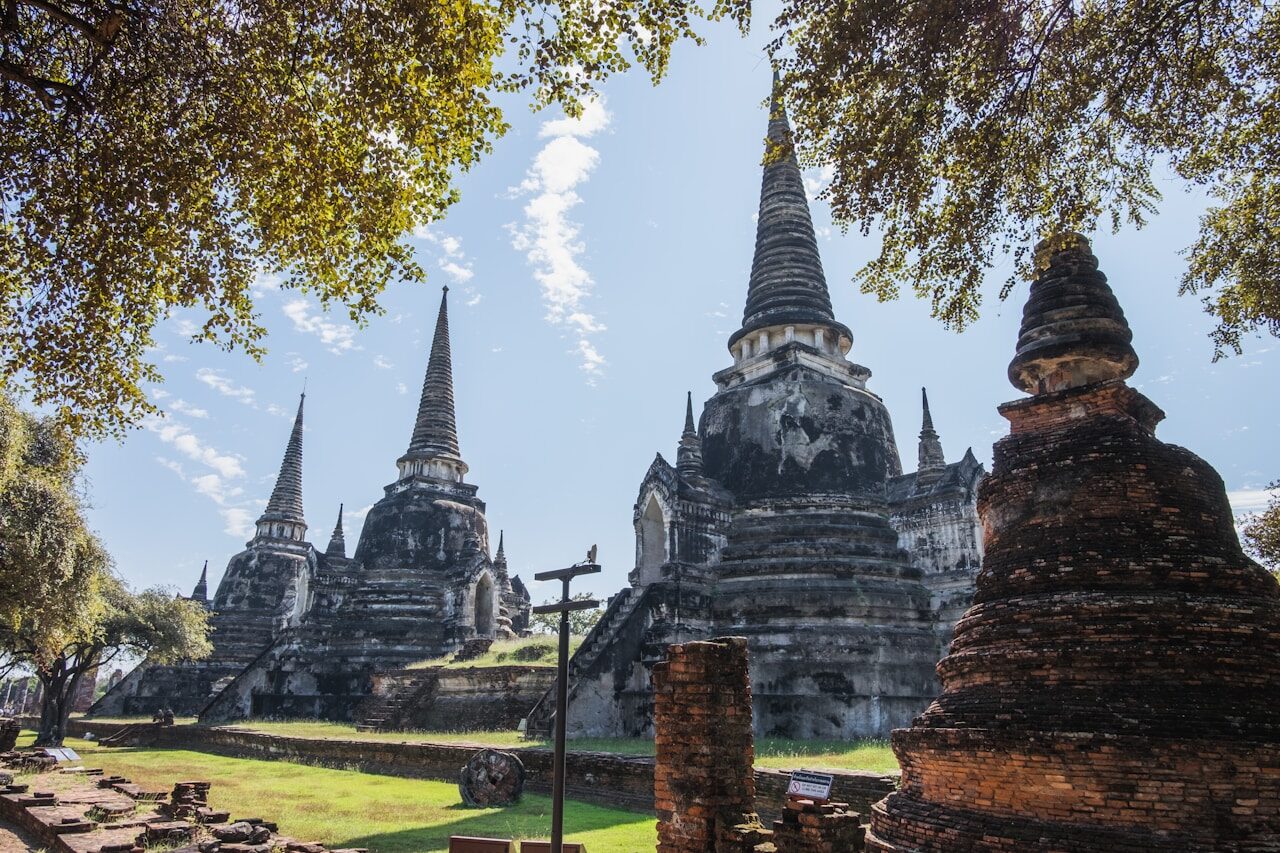
Ayutthaya makes the strongest case — about 1 hour by train from Krung Thep Aphiwat (KTW) station (or up to 1.5–2 hours from Hua Lamphong), with 3rd-class fares starting at just ฿15–20 each way, and more UNESCO-listed temples per square kilometer than anywhere else in Thailand.
It’s the only destination that combines ease of access with a scale of historic site that genuinely justifies the travel time.
For a practical comparison:
| Destination | Travel time from Bangkok | Best transport | Approx. cost (incl. entry) |
|---|---|---|---|
| Ayutthaya | ~1 hr (KTW) / 1.5–2 hrs (Hua Lamphong) | Train | ฿300–฿600 |
| Floating Markets | 1.5–2 hours | Tour minivan or public bus | ฿700–฿1,500 |
| Kanchanaburi | 2–3 hours | Train or minivan | ฿700–฿1,500 |
| Khao Yai | 2.5–3.5 hours | Tour or car | ฿2,000–฿3,500 |
| Hua Hin | 3–4 hours | Bus or train | ฿700–฿1,200 |
| Pattaya | 2–2.5 hours | Bus | ฿400–฿800 + activities |
The biggest gap between the best things to do in Bangkok and day trips is simply that day trips require committing a full day to travel plus a destination.
Any site under 90 minutes is comfortably manageable; anything over 2.5 hours tends to work better as an overnight.
Ayutthaya Ancient Capital: UNESCO World Heritage Site
Ayutthaya served as the Siamese capital from 1351 to 1767, when Burmese forces sacked the city and left the temple complexes in the state visitors see today — partially collapsed towers, headless Buddhas, and brick structures reclaimed by tree roots.
The site covers several square kilometers and is best navigated by rented bicycle (฿50 for a city bike, ฿100 for a mountain bike per day) or tuk-tuk for longer stretches between temple groups.
Historic Temple Ruins
Key temples to visit:
- Wat Mahathat — The famous Buddha head in tree roots. The head sits near the ground and is heavily photographed; arrive early to get shots without queues. Entry ฿50
- Wat Phra Si Sanphet — Three restored chedis that once held the ashes of Ayutthaya’s kings. No Buddha images remain, but the chedis are visually clean and well-preserved. Entry ฿50
- Wat Chaiwatthanaram — Khmer-style prang complex on the west bank of the Chao Phraya; best seen at sunset. Entry ฿50
- Wat Ratchaburana — Less visited than Wat Mahathat, with tall remaining prangs; vault below the main prang was found intact with royal relics in 1957. Entry ฿50
Budget 4–5 hours minimum if you’re visiting the main four sites by bicycle.
The heat — which peaks between 11 AM and 2 PM — is the main limiting factor.
Morning arrivals are significantly more comfortable.
Royal Palace Complex
The Wang Luang (Grand Palace) complex at Ayutthaya is now largely foundations.
What remains shows the scale of the original structure: over 200,000 square meters, once connected to three major temples within the palace walls.
The adjacent Wiharn Phra Mongkol Bophit holds one of Thailand’s largest bronze Buddha images, restored after Burmese looting.
Bang Pa-In Summer Palace, about 20 km south of Ayutthaya’s main temple zone, is often included on combined tours.
The 17th-century palace was rebuilt by King Chulalongkorn and shows European, Chinese, and Thai architectural styles across the lake and garden grounds. Entry ฿100 for foreigners
(open daily 8:00 AM–4:00 PM, ticket office closes 3:30 PM).
It can be visited as a separate stop on the way back to Bangkok.
Long-Tail Boat Tours Along the Rivers
Long-tail boat tours navigate the Chao Phraya and Pa Sak rivers that surround Ayutthaya’s central island, approaching temples from the water and passing riverside villages that don’t feature in the standard bicycle route.
| Tour duration | Approximate price | What’s covered |
|---|---|---|
| 1–2 hours | ฿400–฿800 per person (shared) / ฿800–฿1,500 per boat (private hire) | Wat Chaiwatthanaram, riverside ruins |
| 3–4 hours | ฿800–฿1,200 per person (shared) / ฿1,500–฿2,500 per boat (private hire) | Multiple temples, local villages |
| Full day | ฿1,500–฿2,000 per person (shared) / ฿2,500–฿4,000 per boat (private hire) | Complete circuit, lunch included |
Tours depart from the main pier near Chao Phrom Market.
Private hire gives flexibility; shared boats cost less but run on fixed routes.
Local Food and Markets
Chao Phrom Market, near the main river pier, has a good selection of Ayutthaya-specific dishes: boat noodles in small ceramic bowls, roti sai mai (cotton candy roti), and grilled river fish.
Prices are low by Bangkok standards.
Ayutthaya has several floating restaurants along the river that cater to both Thai and foreign visitors — worth noting if you’re arriving late afternoon and want to eat before the return train.
Getting to Ayutthaya: Train vs. Bus
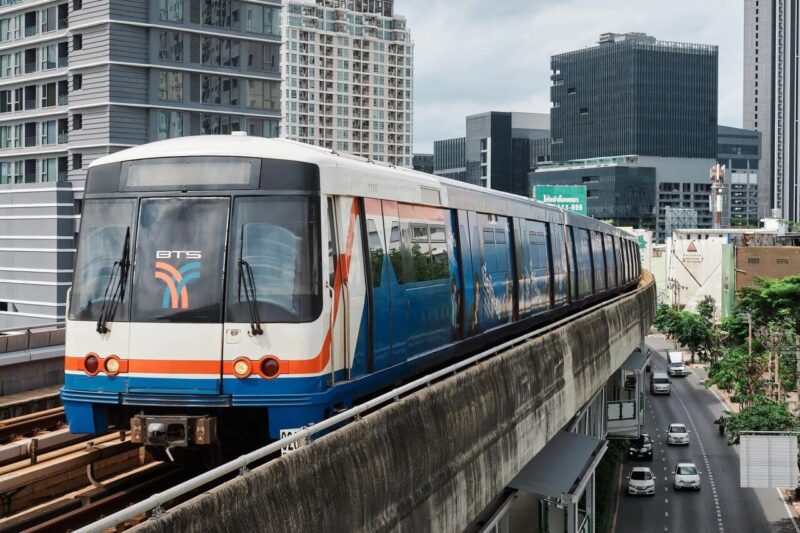
There are 27+ daily train services connecting Bangkok to Ayutthaya, departing from two stations. Krung Thep Aphiwat Central Terminal (KTW)
runs 16–19 services per day, covering the journey in 55–75 minutes on express and rapid trains (seats from ฿60–฿245). Hua Lamphong
runs 11 Ordinary (3rd class) trains daily, taking 1.5–2 hours with seats from ฿15 — no advance booking required or possible; tickets are sold at the window on the day of travel only.
KTW trains can be booked in advance online.
Note: the Thai–Chinese High-Speed Rail line, which will include an Ayutthaya stop, is currently under construction (approximately 53% complete as of mid-2026) and is not expected to begin operations before 2027 at the earliest — current rail services are unaffected. Getting to day trip destinations from Bangkok
covers bus routes, minivan services, and all transport options out of Bangkok in detail.
Buses (from Mo Chit Bus Terminal) and minivans also serve Ayutthaya.
Travel time is similar but road conditions and traffic can add 30–45 minutes.
Sunset Photography
Wat Chaiwatthanaram on the western riverbank faces east, which means afternoon sun hits the towers from behind — sunset there creates silhouettes rather than lit facades.
For light on the structures, arrive in the late morning (9–11 AM) or early evening when western light catches the prangs.
Wat Phra Si Sanphet’s chedis face north-south and receive good light throughout the day.
Guided Tour vs. Independent Exploration
Guided day tours typically bundle transport, an English-speaking guide, lunch, and boat tour for ฿1,200–฿2,500 per person depending on group size and operator (budget operators from Khao San Road start around ฿800–฿1,200 but usually exclude lunch and boat).
For first-time visitors unfamiliar with the history, a guide adds context that makes the ruins more meaningful.
Independent travel (train + bicycle) costs half as much and gives full flexibility on timing.
The temples are self-navigable with a basic map.
Are Bangkok’s Floating Markets Worth the Day Trip?
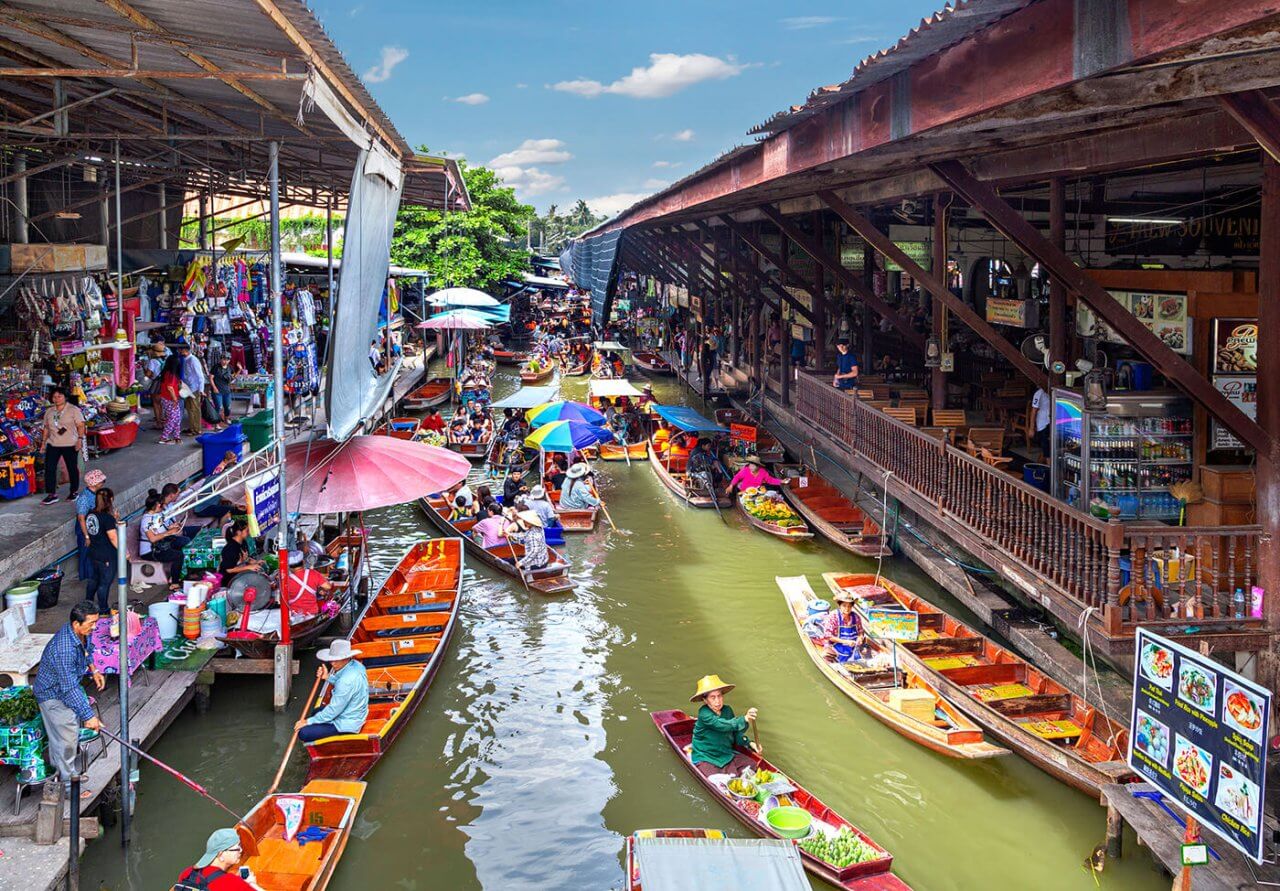
Yes — with caveats. Damnoen Saduak is heavily commercialized and better approached via organized tour.
Amphawa (weekends and public holidays only) and Taling Chan are smaller, more local, and easily accessible by public transport — Taling Chan by city bus No. 79 or 83 for under ฿20, and Amphawa by bus from Pinklao Bus Terminal for around ฿70 each way.
“Floating market” covers a wide range — from Damnoen Saduak, which draws large tour buses and has more souvenir stalls than actual produce trading, to Amphawa, where canal-side restaurants sell grilled seafood to Bangkok residents on weekend evenings.
Knowing the difference changes what you’re choosing.
Damnoen Saduak Floating Market
Located about 100 km southwest of Bangkok in Ratchaburi Province (1.5–2 hours by tour van or private car; allow 2–2.5 hours by public transport), Damnoen Saduak is the most photographed floating market in Thailand.
Vendor boats in traditional hats sell tropical fruits, ready-made food, and handcraft souvenirs along a network of canals.
The tourist footprint here is significant — boat tour operators push along the same canal routes, and souvenir stalls line the banks.
Early arrival (7–9 AM) before the tour buses arrive makes the experience more manageable.
The canals themselves, with morning light and wooden boats, are visually worth the trip for photography.
Most visitors reach Damnoen Saduak via organized tours from Bangkok hotels or Khao San Road.
Independent travel by public bus is possible but involves two legs: take the BTS Silom Line to Bang Wa, then a taxi to Bangkok Southern Bus Terminal (Sai Tai Mai), then board Bus No. 78 (departing from 6:00 AM, every ~40 minutes, ~฿50–80 one way, ~2 hours).
From the bus stop, it’s a 1 km walk or short taxi ride to the market entrance.
Total door-to-door time from central Bangkok is 2.5–3.5 hours each way, so early departure is essential.
For a budget day trips from Bangkok approach, the public bus option saves significant money compared to tour pricing.
Amphawa Weekend Floating Market
Amphawa operates Friday through Sunday, 10:00 AM–9:30 PM, with boat vendors and food stalls hitting peak activity from around 3:00 PM onwards.
Unlike Damnoen Saduak, the main commerce here is grilled seafood — vendors on boats cook prawns, squid, and crab to order; canal-side restaurants supplement.
The market has a genuine Thai-domestic character: Bangkok residents come here specifically for the food.
Firefly watching by boat on the Mae Klong River is often paired with an Amphawa visit — operators run flat-bottomed boats along the river after dark to see bioluminescent fireflies in the riverside vegetation.
At the market pier, boats are hired per boat at ฿1,500 for up to 6 people (~฿250–฿500 per person in a group).
Combined full-day tours from Bangkok including transport, market time, and firefly boat typically run ฿1,500–฿2,300 per person.
Fireflies are present year-round but most active during the rainy season (May–October); moonless nights give the best viewing.
Staying overnight in one of the guesthouse rooms above the canal shophouses makes Amphawa more comfortable than a rushed day trip.
Maeklong Railway Market
Maeklong Railway Market (also called Talad Rom Hoop — “umbrella pulldown market”) sits about 70–80 km southwest of Bangkok (1.5–2 hours by road), and just 7 km from Amphawa — roughly 15 minutes by songthaew or taxi.
The market is built along the active train tracks; vendors sell produce and food with their stalls hanging over and onto the rails.
When a train approaches, vendors pull their awnings back and customers step aside; after the train passes, everything extends back into place within minutes.
Trains pass through eight times daily, on a fixed schedule: trains arrive at Maeklong Station at 8:30 AM, 11:10 AM, 2:30 PM, and 5:40 PM; trains depart Maeklong Station at 6:20 AM, 9:00 AM, 11:30 AM, and 3:30 PM.
The mid-morning arrivals (8:30 AM, 11:10 AM) are the best to target — the market is at peak activity and vendor pullback is most dramatic.
Note that most stalls begin closing after 3:00 PM.
The market itself is a genuine local produce market, not primarily a tourist attraction.
The train spectacle is the reason visitors come, but the produce and street food stalls between train arrivals are worth browsing.
Boat Rides and Vendor Interactions
Long-tail boat rides at Damnoen Saduak and Amphawa provide access to the narrower canal sections not reachable on foot.
Pricing for boat hire is negotiable; fixed-price boat tours are available through operators at the main market pier.
Vendors at all three markets accept negotiation on non-food items.
Food prices are typically fixed and posted.
Fresh tropical fruit — rambutans, rose apples, mangosteens, and dragon fruit depending on season — is significantly cheaper here than in Bangkok’s tourist areas.
Organized Tours: What’s Typically Included
Standard day tours covering both Damnoen Saduak and Maeklong Railway Market include: round-trip air-conditioned transport from Bangkok, English-speaking guide, long-tail boat at Damnoen Saduak, and lunch.
Prices vary widely based on operator; compare 3–4 operators before booking and check what meals are included versus additional cost.
Street Food and Fresh Fruit
The floating markets’ food is the most reliable value: fresh-cooked dishes priced for local buyers, not tourists.
Boat noodles, green papaya salad, coconut ice cream, and grilled meats are common across all three markets.
Mango sticky rice is available at permanent stalls alongside the markets.
Eat before the tour buses arrive (before 10 AM at Damnoen Saduak) and prices and crowds are both more manageable.
Photography Tips
For floating market photography, a wide-angle lens handles the narrow canal scenes better than telephoto.
Request vendor permission before photographing individuals — most are accustomed to tourists but appreciate being asked.
Morning light (7–9 AM) is better than midday; afternoon (3–5 PM at Amphawa) has the warmest light of the day.
A waterproof bag for camera equipment is worth considering — boat rides occasionally involve splashing.
What Can You See in Kanchanaburi on a Day Trip from Bangkok?
Most visitors cover the Bridge Over the River Kwai, the JEATH War Museum, and Kanchanaburi War Cemetery in a half-day, then spend the afternoon at Erawan National Park’s tiered waterfalls — but the two sites are about 65–70 km apart by road, so timing matters.
Kanchanaburi province is about 130 km west of Bangkok.
Transport options: train from Thonburi Station (2 daily departures at 7:45 AM and 1:55 PM, journey 2.5–3.5 hours, fixed fare of ฿100 for foreigners — scenic and straightforward, but the schedule is restrictive); bus or minivan from Bangkok Southern Bus Terminal (Sai Tai Mai) (2.5–3 hours, ฿140–฿350); or private car.
Day tours from Bangkok covering both the historical sites and Erawan are available but make for a long day.
Bridge Over the River Kwai
The current bridge over the Mae Klong River (locally and historically called the Khwae Yai) is a post-war reconstruction — the original steel spans were bombed by Allied aircraft in 1945.
Two of the current bridge’s spans are original curved bow-truss sections that survived the bombing; the other spans are replacement rectangular sections.
Historical context:
- Construction began in October 1942 and was completed in October 1943, as part of the 415 km Thailand-Burma Railway
- The railway was built under Japanese command using Allied prisoners of war and Asian laborers in conditions that killed thousands
- Estimates of Allied POW deaths during construction stand at approximately 12,000–13,000, alongside an estimated 80,000–90,000 Asian laborers — the largest single group being rōmusha (forced laborers) from Burma
- The bridge’s cultural profile comes from Pierre Boulle’s 1952 novel and the subsequent 1957 film; the actual filming location was in Ceylon (now Sri Lanka), not Thailand
The bridge is walkable and regularly used by local motorcycle traffic and pedestrians. Two regular trains cross daily
(departing Thonburi at 7:45 AM and 1:55 PM; the bridge stop is approximately 2.5–3 hours into the journey); a third tourist train runs on weekends and public holidays and must be booked in advance.
Standing on the bridge while a train passes requires stepping to the small side alcoves built into the structure — this is the photo opportunity most visitors come for.
Death Railway Museum and War Cemeteries
The JEATH War Museum (JEATH = Japan, England, Australia/America, Thailand, Holland) displays POW artwork, photographs, personal documents, and physical artifacts from the railway construction period. Entry ฿50 per person; open daily 8:30 AM–4:30 PM.
The Thailand-Burma Railway Centre nearby is a more modern museum with better-organized displays and English-language exhibits that explain the full railway history.
More comprehensive than the JEATH museum and generally considered the more informative of the two. Entry ฿160 for adults, ฿80 for children (ages 7–12); open daily 9:00 AM–4:00 PM.
Located on the western side of the main Kanchanaburi War Cemetery.
| Cemetery | Location | Recorded graves | Notes |
|---|---|---|---|
| Kanchanaburi War Cemetery | Town center, Saeng Chuto Rd | 6,982 (5,085 Commonwealth + 1,896 Dutch) | Maintained by Commonwealth War Graves Commission; free entry, open daily 8:00 AM–6:00 PM |
| Chong-Kai War Cemetery | ~3 km from town (Tha Ma Kham) | 1,739 (1,426 British + 313 Dutch) | Riverside location; originally a POW camp site |
| Hellfire Pass Memorial | ~80 km north on Hwy 323 | Memorial only | Includes walking section of original railway cutting |
Hellfire Pass requires a separate trip further along the railway — it’s the best-preserved section of the original cutting and the attached museum (run by the Australian government) is the most contextually detailed.
Budget a full additional half-day if including it.
Erawan National Park Waterfall Hiking
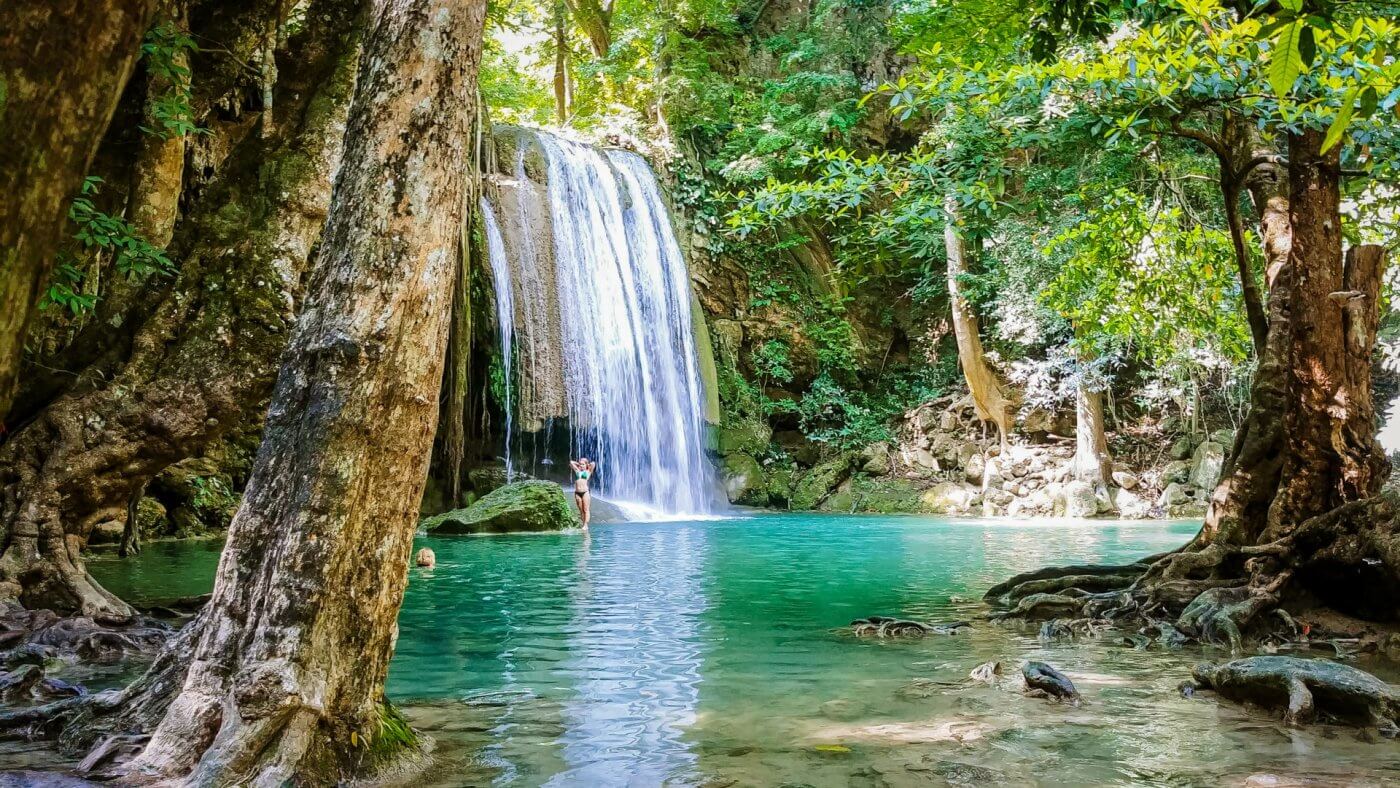
Erawan Falls — seven tiers of turquoise limestone pools connected by jungle trails — sits about 65 km north of Kanchanaburi town, roughly 1.5 hours by bus or car.
From Kanchanaburi Bus Terminal, take Bus No. 8170 (Kanchanaburi–Erawan), departing hourly from 8:00 AM, fare ฿60 one way.
Entry fee: ฿300 for foreign adults, ฿150 for children (ages 3–14); open daily 8:00 AM–4:30 PM (ticket sales close at 3:30 PM; upper tiers begin clearing from around 3:00 PM).
Trail notes:
- Tiers 1–3: Easy walk, wide paths, swimming permitted; the most crowded sections
- Tier 4 (“Butterfly Tier”): Moderate terrain; fewer visitors; small cave entrance nearby
- Tiers 5–6: Steeper trail requiring decent footwear; significantly fewer visitors
- Tier 7: The longest climb; often requires wading across shallow streams; the least visited
Swimming is permitted at most tiers.
Bring water shoes — the rocks are slippery.
Fish in the pools are protected and will nibble at exposed skin, which is harmless.
The park is busier on weekends, particularly during cool season (November–February).
Weekday visits in the morning are the quietest. Ticket sales close at 3:30 PM
— if you want to reach Tier 7, start hiking no later than 3:00 PM; allow 2–3 hours minimum to reach Tier 3–4 comfortably.
River Activities and Alternatives
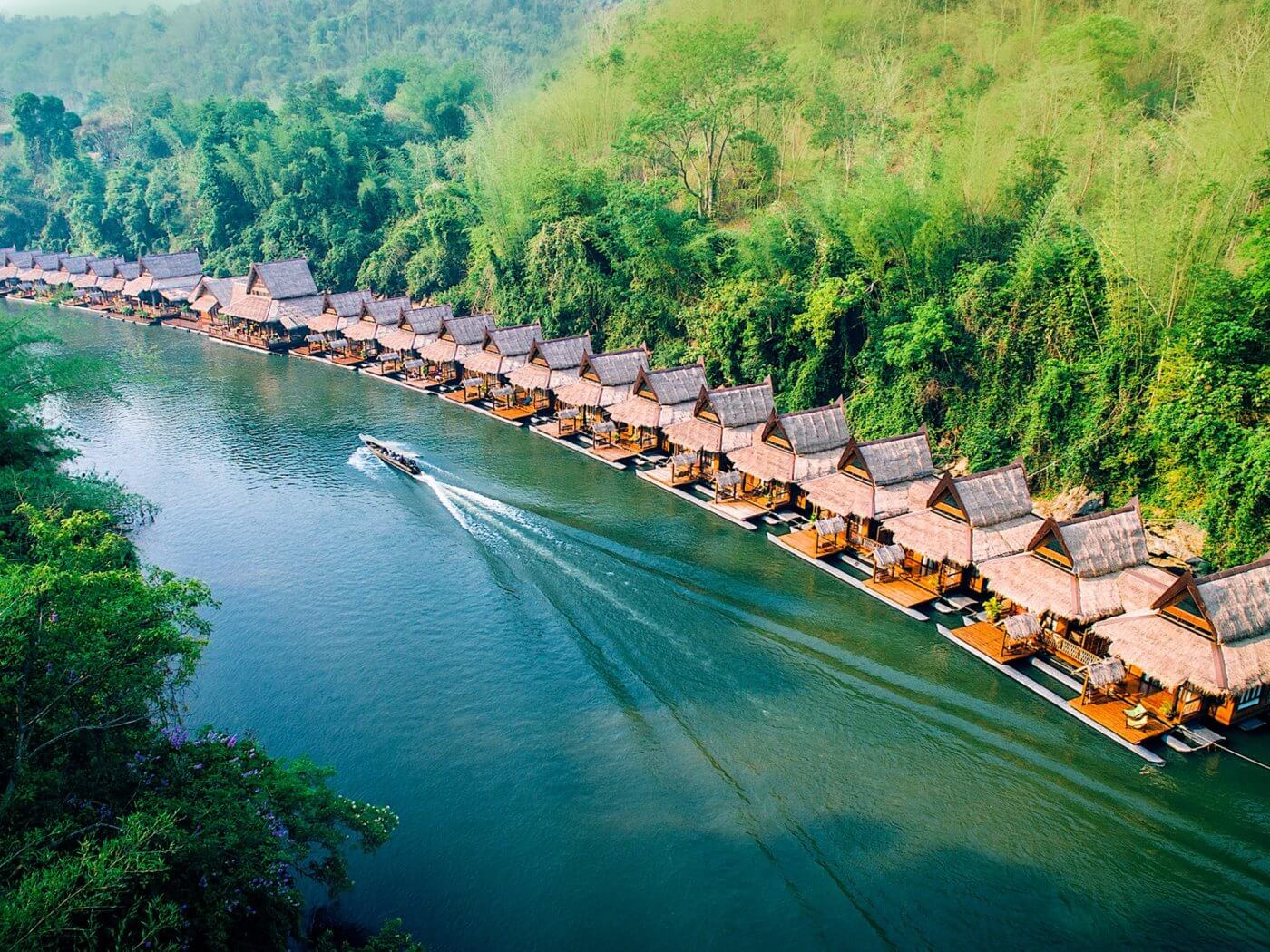
Bamboo rafting on the Kwai Noi River is offered by local operators — typically ฿600–฿1,000 per person for a 1–2 hour float on basic shared bamboo rafts; resort-based rafting experiences run higher.
Several riverside resorts and floating hotels offer day use of their facilities and boat trips.
Other attractions in the Kanchanaburi area include Sai Yok Yai Waterfall (smaller than Erawan, easier to reach), Huai Mae Khamin Waterfall in Si Nakharin Dam National Park (more remote, worth a dedicated trip), and several tiger temples and elephant sanctuaries [note: quality and ethical standards at animal attractions in this area vary significantly — research specific operators before visiting].
Kanchanaburi as an Overnight Trip
The historical sites and Erawan Falls cannot both be visited thoroughly in a single day without rushing one significantly.
Staying overnight allows the bridge area in the evening (quieter after day-trippers leave), the war cemeteries in the morning, and Erawan for a full afternoon.
Riverside guesthouses and bungalows in town start from ฿800–฿1,500 per night; the area’s well-known floating raft resorts (River Kwai Jungle Rafts, Binlha Raft Resort) typically run ฿2,000–฿3,500 per night including meals, while boutique floating villa resorts like The FloatHouse are premium-tier at ฿5,000+.
Memorial Sites and Historical Context
The war cemeteries are maintained by the Commonwealth War Graves Commission and are open daily, free to enter.
They function as active memorial sites — behavior appropriate to that context is expected.
The experience is markedly different from touring a battlefield — well-maintained grounds, individual headstones, and the scale of the graves make the history concrete in a way that museum displays cannot.
Natural Swimming and Jungle Trails
Beyond Erawan, Kanchanaburi province has several lesser-known waterfall destinations: Khao Phang Waterfall in Pha Phum district, and several smaller falls along the River Kwai valley accessible by boat.
Local guesthouses can organize day or half-day trips to sites not covered by the standard tour circuit.
Closest Beaches to Bangkok: Coastal Escapes Within Reach
Bangkok sits inland, but the Gulf of Thailand coast is accessible for day trips to the nearest beaches.
Travel time is the main constraint — the best beaches that justify a day trip are 1.5 to 3 hours away, depending on traffic.
Hua Hin: Royal Beach Town
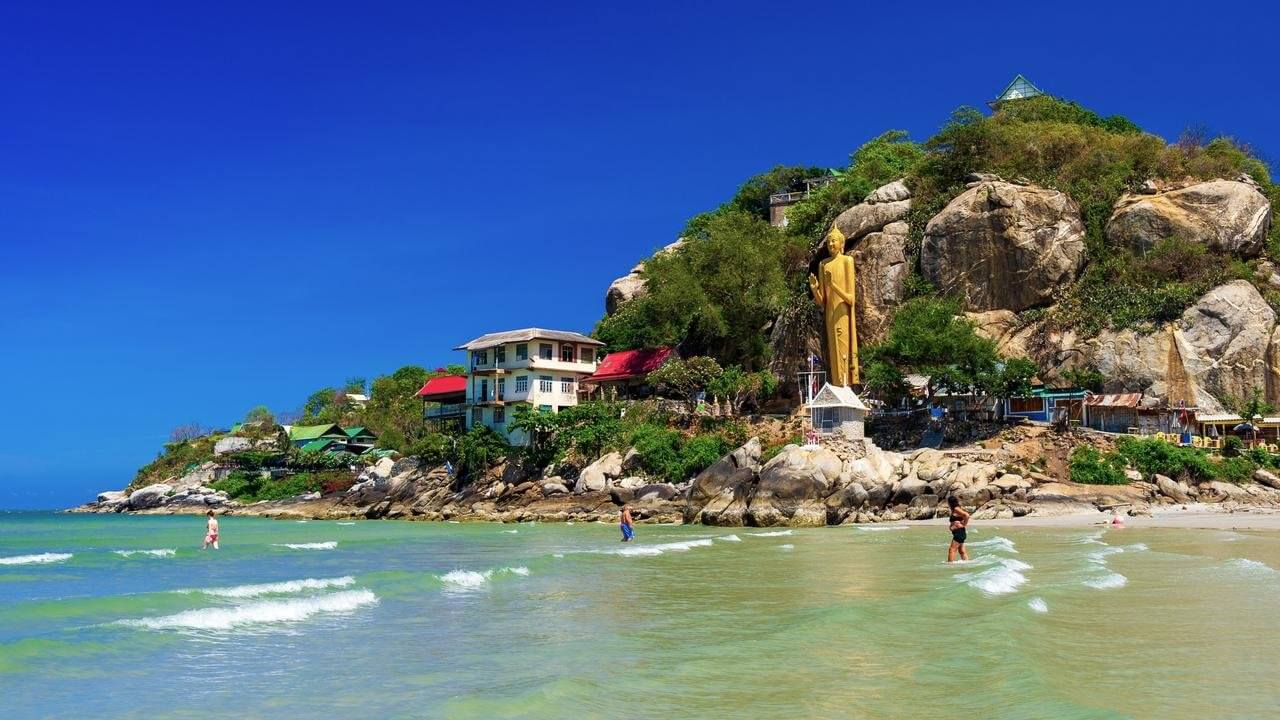
Hua Hin is about 200 km south of Bangkok — roughly 3–4 hours by train (Special Express No.
43 from Krung Thep Aphiwat is the fastest at exactly 3 hours; most services take 3.5–4 hours) or 2.5–3.5 hours by bus or minivan from Bangkok Southern Bus Terminal.
The town has been a royal beach retreat since the 1920s, when King Rama VII built the Klai Kangwon Palace here — the palace is still in use and not open to the public, but its history explains the town’s more refined character compared to Pattaya.
The beach runs along a wide sandy bay; horseback riding on the beach remains one of Hua Hin’s specific draws — operators near Khao Takiap offer beach and forest trail rides from ฿300 for 20 minutes to ฿800 for one hour.
The night market and Cicada Weekend Market (arts and crafts, food stalls, live music; open Friday–Sunday, 4:00 PM–11:00 PM, closing at 10:00 PM on Sundays) draw Bangkok visitors specifically on weekends.
Distance makes Hua Hin more comfortable as an overnight trip than a day trip.
A 3–4 hour travel time each way leaves less than 5–6 hours at the destination, which is tight.
Pattaya: Water Sports and Islands
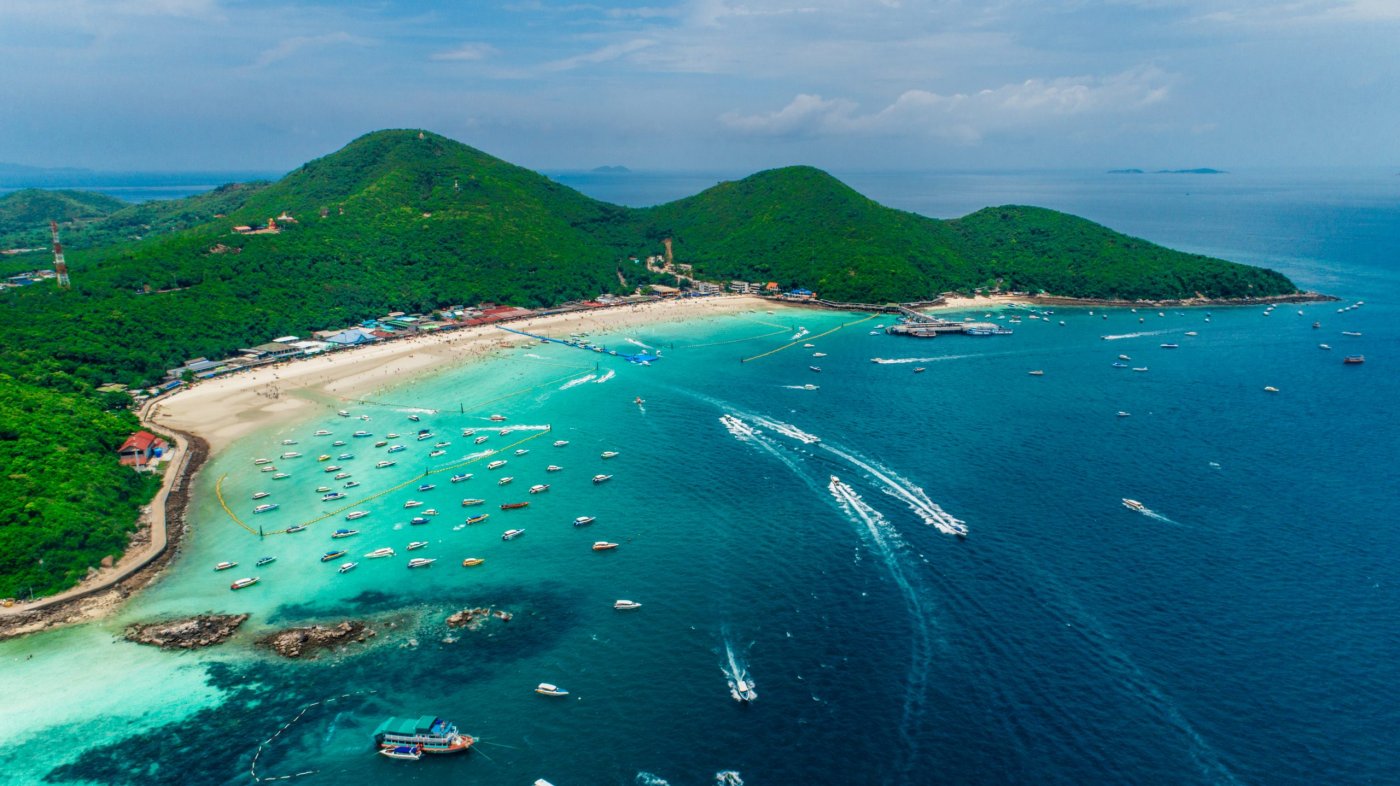
Pattaya is about 140–150 km southeast of Bangkok — roughly 2.5–3 hours by bus from Ekkamai Bus Terminal (฿130–฿200 per ticket), or 1.5–2.5 hours by private car or taxi depending on traffic.
The city has a mixed reputation largely driven by its nightlife, but the beaches themselves — particularly Jomtien Beach, south of the main strip — are functional for a day swim.
Water sports (jet skiing, parasailing, speedboat tours) are available along the main beach.
Koh Larn Island, reachable by public ferry from Bali Hai Pier in ~40–45 minutes for ฿30 each way (or speedboat in 15–20 minutes for ฿150–฿200 per person shared), has clearer water than the main bay and several small beaches.
This is the main reason most tourists visit Pattaya on a day trip — the island rather than the city beach.
| Activity | Approximate cost |
|---|---|
| Jet skiing | ฿1,200–฿1,500 / 30 min |
| Parasailing | ฿700–฿900 |
| Koh Larn public ferry | ฿30 each way |
| Koh Larn speedboat (shared) | ฿150–฿200 each way |
| Speedboat island tour (shared group) | ฿480–฿600 |
Cha-Am: Quieter Alternative
Cha-Am sits 40 km north of Hua Hin and about 125 km from Bangkok — roughly 2.5–3.5 hours by minivan or bus from Bangkok Southern Bus Terminal (Sai Tai Mai) or Mo Chit New Van Terminal (fares from ฿160).
The beach is wide and relatively uncrowded compared to Pattaya.
The town caters primarily to Bangkok weekenders rather than international tourists, so pricing and atmosphere are more local.
Accommodation ranges from beachfront budget guesthouses to mid-range seafront hotels.
Bang Saen: Closest Local Beach
Bang Saen, about 80 km southeast of Bangkok (approximately 1.5–2 hours by car or bus), is the closest beach popular with Bangkok residents — accessible by bus and minivan from Ekkamai (Eastern) Bus Terminal, departing every hour from 5:00 AM, fare around ฿110 one way.
It operates as a day-use beach — busy with Thai families on weekends, quiet on weekdays.
The beach itself is not remarkable by Thai standards, but Khao Sam Muk hill at the southern end of the bay has an active temple and views across the bay.
The seafood along the Bang Saen beachfront road is fresh and inexpensive.
Getting to Bang Saen
Public buses from Bangkok’s Eastern Bus Terminal (Ekkamai BTS station) run to Bang Saen and to Pattaya.
For Pattaya, buses also run from the Northern Bus Terminal and from several central Bangkok stops.
Travel time by bus is typically longer than private transport due to multiple stops.
Seafood Dining
Bang Saen’s beachfront restaurants specialize in fresh Gulf seafood: grilled whole fish, steamed crab, spicy prawn salads.
These restaurants cater to Thai day-trippers and price accordingly — significantly cheaper than equivalent seafood in Bangkok’s tourist areas or at beach restaurants in Phuket or Koh Samui.
Water Activities
Bang Saen and Pattaya both offer standard beach activity hire (kayaks, pedal boats, inflatable toys) at the main beach areas.
Conditions in the Gulf of Thailand are calm enough for swimming most of the year, though visibility for snorkeling is better around the offshore islands than on the mainland beaches.
Khao Yai National Park: Wildlife and Hiking
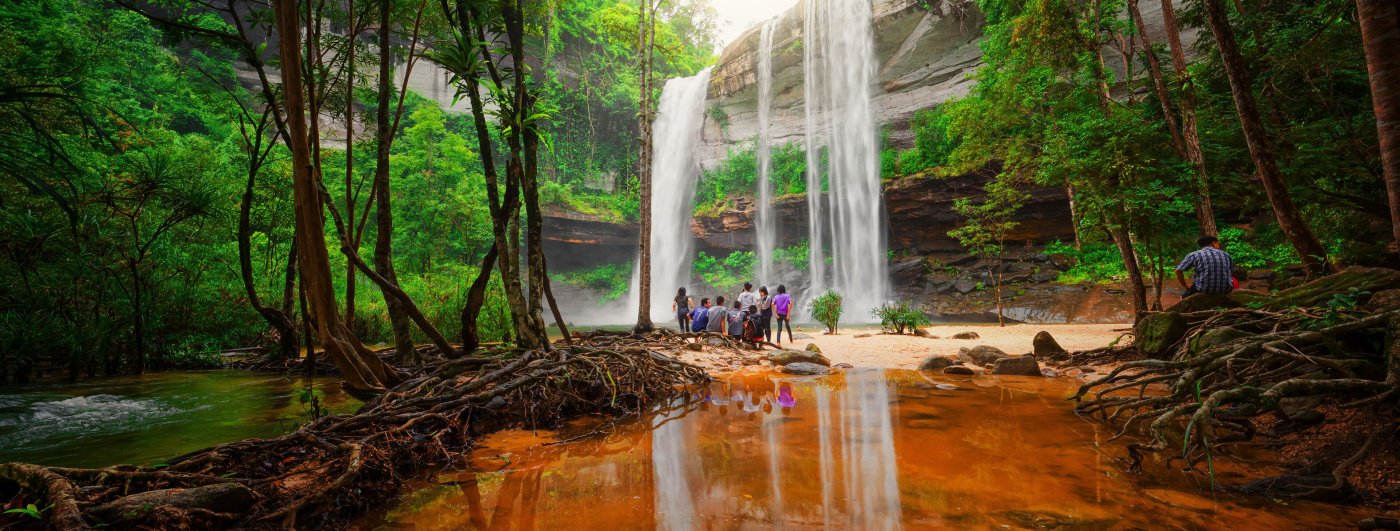
Khao Yai, about 175–200 km northeast of Bangkok (2.5–3.5 hours by road, depending on traffic and route), was Thailand’s first national park, established in 1962, and holds UNESCO World Heritage designation as part of the Dong Phayayen–Khao Yai Forest Complex.
It covers around 2,168 square kilometers and has documented populations of wild Asian elephants, gibbons, hornbills, and over 300 bird species — Siamese crocodiles are present but extremely rarely sighted.
Wildlife Spotting and Photography
Wild elephants are resident in Khao Yai and regularly seen at dawn and dusk near the park’s open grassland areas and at salt licks. This is not a managed wildlife experience
— sightings are not guaranteed and the animals behave unpredictably when approached.
The park’s official safety rule requires stopping at least 30 meters from any elephant (keep your engine running for a quick reverse); this is an actual safety threshold, not a formality.
Best conditions: arrive at park opening (6:00 AM), move quietly, and use the designated viewpoints and known wildlife roads near the Haew Narok area and salt lick zones.
A telephoto lens is worthwhile.
A park-run Night Safari operates in two slots (7–8 PM and 8–9 PM) along a 10 km route for those wanting nocturnal wildlife encounters — this must be joined with a ranger, as private vehicles are not permitted in the park after dark.
Other reliable sightings: hornbills (particularly near fruit trees in fruiting season), macaques, monitor lizards, and various deer species.
Gaur (wild bovine, very large) occasionally appear on road shoulders at dawn.
Hiking Trails and Viewpoints
The park has several marked trails:
- Haew Narok Waterfall trail — moderate, ~2 km one way; leads to a 3-tiered waterfall with a combined drop of approximately 150–180 meters — the largest and most powerful waterfall in Khao Yai. Only the top 60-meter tier is accessible on foot
- Haew Na Khom — shorter, accessible falls closer to the visitor center; easier terrain, good for wildlife spotting on the approach trail
- Khao Laem — steep ascent; sunrise views over the park
- Pha Kluai Mai — good canopy views; orchids flowering in wet season
Most trails require registering at the park visitor center. Entry fee: ฿400 for foreign adult visitors at the main Pak Chong (Nakhon Ratchasima) entrance; ฿200 at the Noen Hom (Prachinburi) entrance.
Plus ฿30 vehicle fee.
The park is open daily 6:00 AM–6:00 PM.
Vineyard Tours Near Khao Yai
The Khao Yai area (specifically in Pak Chong district) has developed a wine tourism industry over the past 30 years — somewhat unexpected in a tropical climate, made possible by altitude and the area’s cooler dry season.
Established wineries with tours and tastings:
- PB Valley Khao Yai — Thailand’s oldest commercial winery; guided tours and tastings at ฿450 per adult; tours run 4 times daily at 9:15 AM, 11:15 AM, 1:15 PM, and 3:15 PM; open daily (Mon–Thu 9:00 AM–8:00 PM, Fri–Sat until 10:00 PM, Sun until 8:00 PM)
- GranMonte Vineyard — Family-owned; known for Syrah and Chenin Blanc production; vineyard tours available (best to book in advance via their website)
- Alcidini Winery — Smaller operation with vineyard views; verify current opening hours and tour availability directly before visiting
Wine tourism here is genuinely developed — these aren’t novelty attractions but functioning wineries producing wines sold in Bangkok restaurants.
Combining Khao Yai wildlife (morning) with a vineyard lunch and tasting (afternoon) works well as a day structure.
Waterfalls and Natural Swimming
Haew Narok Falls has a viewing platform but swimming is not permitted — the current and drop height make it dangerous.
The closest swimming option within the park is at Haew Suwat Waterfall, which has a natural pool at the base; outside the park boundary, Tha Chang Spring Pool offers clear spring water swimming and kayaking (฿100–฿170 per person depending on route), best visited from October to April.
The park accommodation at Khao Yai is operated by the park authority and booked entirely online through the Khao Yai National Park official website — walk-in bookings are only possible if availability remains unsold.
Reservations open up to 60 days in advance for stays of up to 3 consecutive nights; payment is made in advance via Krung Thai Bank.
Lodge prices range from ฿1,680 per night (weekdays) to ฿7,500 per night (weekends/holidays) depending on zone and lodge size, with a 30% weekday discount applied automatically.
Peak demand periods requiring the earliest possible booking are November–February (cool season) and Thai school holidays (mid-October and March).
Day Trip vs. Overnight at Khao Yai
A day trip from Bangkok to Khao Yai leaves 4–6 hours at the park after travel time — enough for one or two trails and wildlife spotting.
Staying overnight gives access to dawn wildlife conditions (the most productive time) and allows visiting a vineyard the same day without rushing.
Most visitors who go once return for an overnight stay.
Safari Guidelines
The park’s rules on wildlife interaction — no feeding, no leaving vehicles near large animals, no loud noise near wildlife — exist because Khao Yai has a history of elephant-human conflict incidents.
Follow guide instructions during wildlife encounters; maintain distance from elephant herds regardless of how habituated they appear.
Park Accommodation
The National Park Service operates bungalows and camping within Khao Yai.
Outside the park, Pak Chong town has many mid-range hotels and resorts, often more comfortable than park facilities.
Several luxury resorts operate in the surrounding area, targeting Bangkok weekenders.
Ancient Temples and Religious Sites Around Bangkok
Beyond Ayutthaya, several other temple destinations within a 2–3 hour radius are worth a day trip for visitors with a specific interest in Thai religious architecture or Buddhist practice.
Wat Phra Phutthabat Sacred Footprint Temple
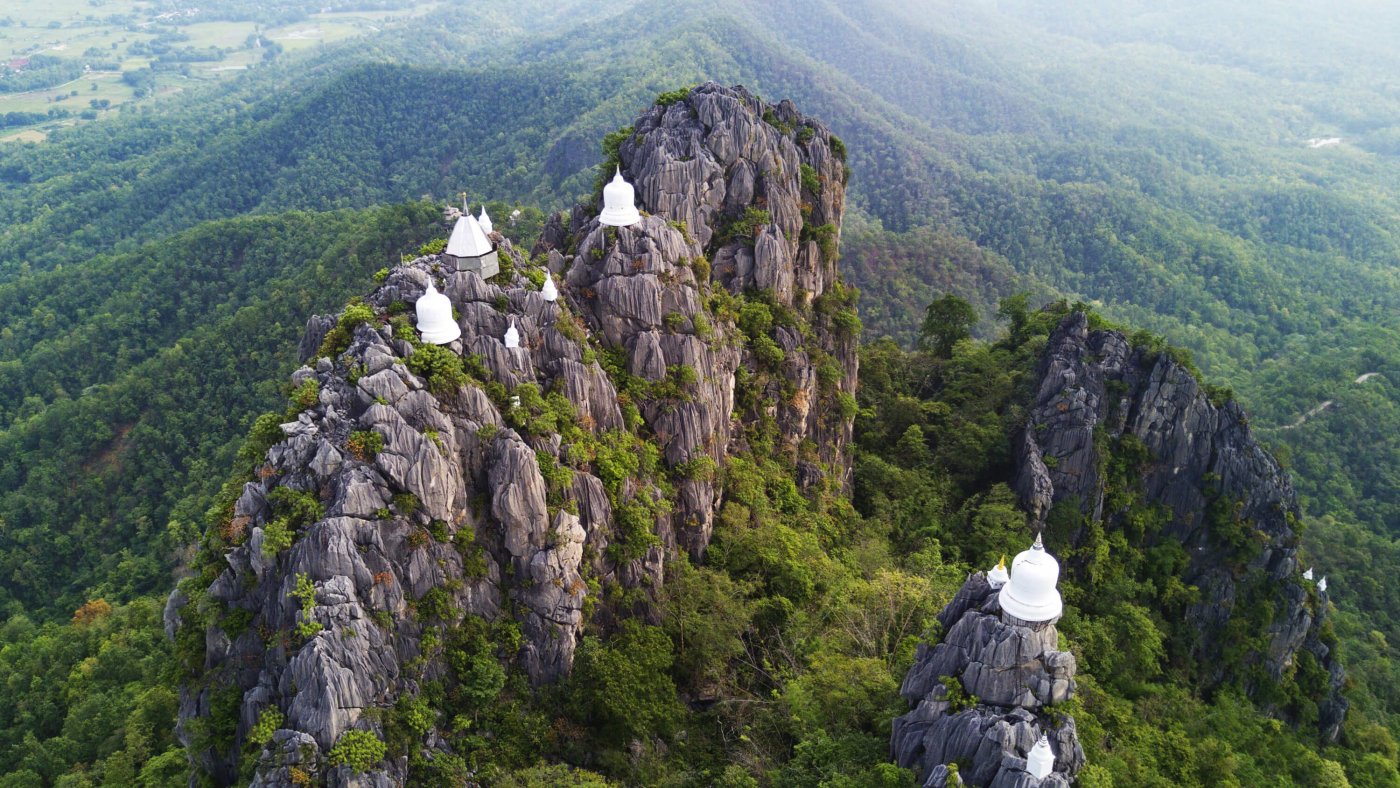
About 120–130 km north of Bangkok in Saraburi province (approximately 1h 45m by car or just under 2 hours by train from Krung Thep Aphiwat), Wat Phra Phutthabat houses a revered sacred footprint believed by Theravada Buddhists to be an impression left by the historical Buddha.
The footprint — approximately 152 cm long, 53 cm wide, and 28 cm deep — is covered by a golden case and sheltered under a tiered mondop decorated with gold and mirror mosaics.
The temple is primarily a domestic pilgrimage site rather than a major international tourist attraction — most visitors are Thai Buddhists making a religious journey.
The temple is set on a forested hillside and accessible via walking paths and stairs up to the main mondop (no cable car). Entry fee: ฿30 for foreign visitors; open daily 7:30 AM–5:00 PM.
The surrounding grounds include viewpoints across the valley.
Wat Mahathat Meditation Center
Note: Wat Mahathat in Bangkok (near Sanam Luang, next to the Grand Palace complex) offers English-language meditation instruction to visitors — this is an in-city experience, not a day trip destination.
The temple’s International Meditation Practice Centre (IMPC) runs English meditation sessions on Tuesday, Wednesday, Thursday, and Saturday from 1:30–4:30 PM; sessions are open to all, free of charge (donation expected).
General Thai-language sessions begin at 7:00 AM daily for those comfortable following along by observation.
For meditation-focused day trips from Bangkok, Wat Dhammamongkol (on Sukhumvit Soi 101 in Bangkok) runs English-language meditation courses every second Saturday of select months, 9:00 AM–4:00 PM — no advance experience required.
Several monasteries in Nakhon Pathom and surrounding provinces also accept foreign visitors for day programs; current schedules are best verified directly with individual centers before visiting.
Bang Pa-In Summer Palace
Bang Pa-In is about 60 km north of Bangkok and 20 km south of Ayutthaya, making it a natural stop on combined Ayutthaya day tours. Entry: ฿100 for foreign visitors; open daily 8:00 AM–4:30 PM (ticket office closes 3:30 PM).
Note: a Bangkok Grand Palace ticket includes free entry here — worth checking if you’ve already visited the Grand Palace.
Golf cart rental is available on the grounds at ฿400 for the first hour for those who prefer not to walk the full circuit.
The palace grounds cover several architectural styles: a Thai-style pavilion floating on a lake (Aisawan Thipya-Art), a Chinese-influenced mansion (Wehart Chamrunt), a Gothic observation tower, and a neoclassical throne hall with Italian marble.
The architectural mix reflects King Chulalongkorn’s engagement with European building styles while maintaining Thai pavilion traditions.
The grounds are manicured and pleasant for walking.
The palace is occasionally used for royal events; some sections may be temporarily closed or under renovation during visits — confirmed current status at the entrance.
Lopburi Monkey Temple and Historic Ruins
Lopburi is about 130 km north of Bangkok (under 2 hours by train from Krung Thep Aphiwat — 13+ daily services, some as fast as 1h 36m; or 2.5–3 hours by minivan from Mo Chit).
The city has Khmer ruins dating to the 13th century alongside structures from the Ayutthaya period when Lopburi served as a second capital.
Phra Prang Sam Yot — three connected Khmer-style prangs originally built as a Hindu shrine — is the most photographed site, partly because long-tailed macaques (crab-eating macaques) treat the structure as their territory. Entry ฿50 for foreigners; open daily 8:30 AM–6:00 PM.
The monkeys are wild and moderately habituated to humans; they steal food and sometimes behave aggressively, particularly near the ruins.
Don’t bring visible food; watch bags and sunglasses.
A local guide with a stick is standard practice and keeps the monkeys at a distance.
Wat Phra Si Rattana Mahathat (Lopburi’s principal Buddhist temple) has a Khmer prang alongside Ayutthaya-period structures.
King Narai’s palace complex (Narai Ratchaniwet) nearby is partially accessible and the grounds include the King Narai National Museum.
Combining Temple Visits in One Day
Lopburi and Bang Pa-In can be combined with Ayutthaya on a single route north from Bangkok, though covering all three is rushed.
Ayutthaya + Bang Pa-In is the more common pairing; Lopburi is better as a standalone day trip given its distance.
Buddhist Ceremonies and Practice
Active worship occurs at Lopburi’s temples on Buddhist holidays and during morning alms rounds.
Visitors are welcome to observe ceremonies at a respectful distance; photography during active rituals is usually acceptable if done quietly and without flash.
Architecture Across Dynasties
Lopburi’s architectural range — from Khmer prangs to Ayutthaya-style chedis to the European-influenced structures added during King Narai’s reign (17th century) — makes it one of Thailand’s more historically layered destinations.
The Khmer-style construction predates the Ayutthaya kingdom by several centuries and shows cultural influence from the Angkor empire.
Cultural Villages and Traditional Craft Centers
The areas around Bangkok hold several working craft centers and cultural demonstration venues — ranging from genuine working farms to more tourist-facing cultural shows.
The quality and authenticity vary considerably.
Jim Thompson Farm Silk Production
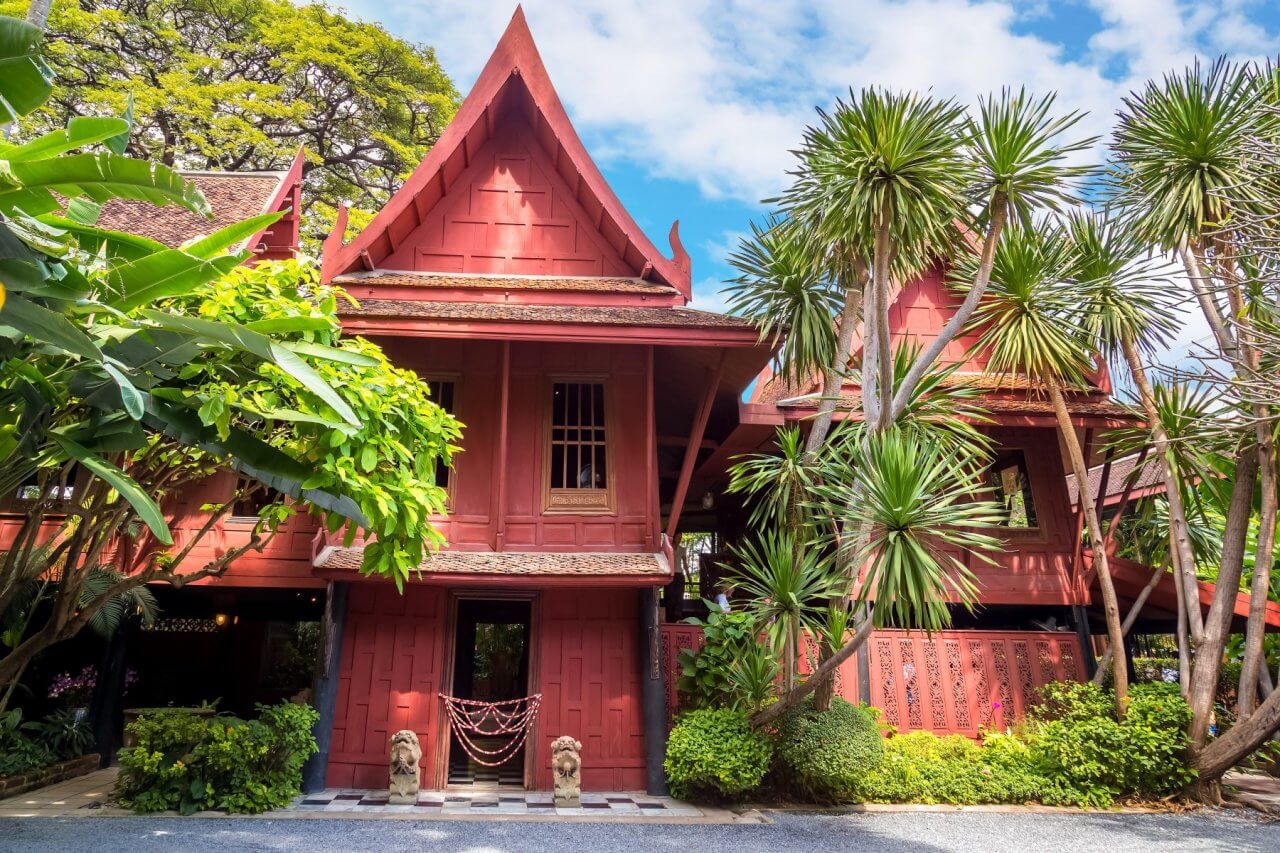
The Jim Thompson Farm in Pak Thong Chai, Nakhon Ratchasima province, is 255 km from Bangkok — approximately 3 hours by road. Critical planning note: the farm only opens once a year, typically from December through early January
— it is closed for the rest of the year.
During this annual opening, guided tours cover silkworm cultivation, mulberry farming, hand-weaving, and natural dyeing.
Entry: ฿230–฿250 for adults (weekday/weekend), ฿120 for children and seniors; presale tickets at Jim Thompson retail stores in Bangkok cost ฿20–฿40 less.
The farm is not accessible by public transport — a private car or tour is required.
For visitors specifically interested in Thai silk production, it’s a genuine working facility rather than a demonstration, but the narrow seasonal window and 3-hour distance put it firmly beyond a casual day trip from Bangkok.
Rose Garden Cultural Show (Sampran Riverside / Suan Sampran)
Suan Sampran (formerly Rose Garden, also known as Sampran Riverside) is located at km 32 on Petchkasem Road in Nakhon Pathom — about 38 km west of Bangkok and roughly 45–60 minutes by car.
The property is open daily 8:00 AM–6:00 PM.
The Thai Village cultural show runs daily and covers traditional Thai classical dance, Muay Thai demonstrations, and cultural ceremony scenes. Note: the formal elephant performance component ended in 2018
; some tour packages offer separate ethical elephant encounters through nearby facilities.
Show times are subject to seasonal schedule changes — verify current performance times directly at suansampran.com before visiting.
This is an explicitly touristy production — professionally staged and well-executed as tourist entertainment, but not a representation of living Thai culture.
Beyond the cultural show, the property has organic farm workshops (pottery, silk dyeing, fruit carving), manicured gardens, a riverside hotel, and a weekend farmers’ market.
Thai Handicraft Villages and Artisan Workshops
Several craft destinations within easy reach of Bangkok offer direct access to traditional production:
- Bang Sai Royal Folk Arts and Crafts Centre — Government-sponsored center on the Chao Phraya River, about 60 km north of Bangkok in Ayutthaya province, under the SUPPORT Foundation of Queen Sirikit. Workshops cover weaving, wood carving, pottery, and lacquerware with demonstrations by craftspeople from all four Thai regions. Entry ฿100 for foreign adults, ฿50 for children; open Mon–Fri 8:30 AM–5:00 PM, Sat–Sun and holidays 8:30 AM–6:00 PM. Traditional regional dance performed at 4:30 PM on weekends and public holidays. An annual Bang Sai Folk Arts & Crafts Fair takes place every January with expanded exhibits and stalls.
- Ko Kret Island (Nonthaburi) — A car-free river island ~20 km north of Bangkok in the Chao Phraya River, home to Mon people whose signature craft is unglazed terra cotta pottery with carved geometric patterns. Pottery workshops are available from local artisans; the island takes about 2 hours to circumnavigate by bicycle. Public ferry runs on Sundays from Nonthaburi Pier (easiest independent access). The Kwan Aman Pottery Museum on the island holds fine examples of traditional Mon ware.
- Silk weaving centers in Nakhon Pathom and Suphanburi provinces — smaller workshops closer to Bangkok; best combined with other stops in the area
These craft centers serve a dual function: commercial production for domestic and tourist markets, and preservation of techniques that are less economically viable than factory production.
Buying directly from artisans supports the workshop economically.
Traditional Thai Dance and Music
Classical Thai dance (Khon) and music performance in authentic contexts requires timing: formal performances by the Fine Arts Department and at national museums occasionally occur, but they’re not daily events.
The National Theatre in Bangkok and temple fair performances are more accessible, though irregular.
For guaranteed performance access, Suan Sampran (above) or similar cultural centers offer a reliable schedule. Sala Rim Naam
at the Mandarin Oriental Bangkok presents classical Thai dance during dinner service — performances from the ancient royal courts of Sukhothai and Ayutthaya are staged on dual platforms with traditional orchestra accompaniment.
Current schedule and pricing (direct from Mandarin Oriental):
- Operating nights: Wednesday–Sunday only
- Dinner service: 7:00 PM–11:00 PM (last seating 9:00 PM)
- Thai cultural performances: 7:30 PM–9:30 PM
- Set dinner pricing: ฿2,800 per person (4-course) or ฿3,400 per person (5-course) — subject to 10% service charge and government tax (~VAT 7%); budget ฿3,400–฿4,100 all-in per person
- A show-only option (no dinner) is also available: approximately one round, 7:00–8:00 PM
- Access via hotel shuttle boat from the Mandarin Oriental, or directly from Charoen Nakhon Road
This is firmly high-end: total cost per person including tax and service charge puts it at ฿3,400–฿4,100 minimum for dinner with show.
For visitors wanting the most polished classical Thai dance experience in Bangkok with riverside atmosphere, it’s genuinely the benchmark.
Cultural Center Highlights
- Rose Garden cultural show: best for a structured overview of Thai performing arts in a single session
- Bang Sai crafts center: best for hands-on interaction with artisans
- Jim Thompson Farm: best for silk production specifically (requires longer travel)
- Damnoen Saduak + Nakhon Pathom combination: floating market + temple town in a single western day trip
Craft Workshops and Practical Souvenirs
Hands-on workshops at artisan centers like Bang Sai and Ko Kret produce items you can take home: woven silk or cotton pieces, hand-painted ceramics, and carved wooden items.
Workshop fees at these community and government-run centers are typically ฿200–฿800 depending on the medium and duration; organized tour-package workshops booked through third-party operators run higher (฿600–฿1,500).
The results are functional souvenirs with genuine craft value rather than mass-produced imports — and purchasing directly at the production site means the full price goes to the artisan or workshop, not a retail middleman.
Community Visits
Some craft villages welcome visitors to family workshops and homes with advance arrangement, typically through a guesthouse or guide with a community relationship.
These aren’t formatted tourist experiences — they require appropriate behavior and should not be treated as performances.
Adventure Parks and Outdoor Activities Near Bangkok
Several large-scale entertainment facilities and adventure venues operate within 30–60 km of Bangkok, primarily targeting Bangkok residents and families rather than international tourists.
Safari World and Marine Park
Safari World is located at 99 Panya Indra Road, Khlong Sam Wa — about 40 km northeast of central Bangkok (45–60 minutes by taxi).
The safari section operates as a drive-through experience with large African and Asian animals; the Marine Park section has orangutan, dolphin, sea lion, and bird shows. Closed on Mondays.
Current pricing (2026):
- Safari + Marine Park combo: ฿1,200–฿1,500 (online) / ฿1,800 walk-in counter
- Full package with buffet lunch: ฿1,500–฿2,200
- Children under 100 cm: free; children 100–140 cm: ฿350
- Open Tue–Fri 9:00 AM–4:30 PM (Safari) / 5:00 PM (Marine); Sat–Sun until 5:00 PM / 5:30 PM
Safari World operates on a large scale — the 200-acre (500 rai) park offers multiple shows throughout the day.
It’s explicitly a theme park rather than a conservation facility.
Dream World Amusement Park
Dream World is located at 62 Moo 1, Rangsit-Ongkarak Road, Thanyaburi, Pathum Thani — about 30–35 km north of Bangkok (30–40 minutes by car).
The park covers multiple zones: Adventure Land, Fantasy Land, Dream Garden, and Dream World Plaza, with over 40 rides in total.
Current pricing (2026): The Super Visa all-inclusive ticket covering unlimited rides, Snow Town, and Go-Kart starts at ฿1,000–฿1,300 per person online (approximately ฿1,400–฿1,700 at the walk-in counter).
Snow Town is included in the Super Visa ticket — no separate purchase required, though warm clothing is recommended (the facility supplies some gear).
The park functions as a domestic family destination; the rides and facilities are modest by international theme park standards but well-maintained.
Go-Kart and Adventure Sports
EasyKart Bangkok is the city’s main indoor karting venue, located at RCA Plaza, 2nd floor, 31/11 Rama 9 Road, Huai Khwang — approximately 15–20 minutes from central Bangkok by MRT to Phetchaburi Station then a short taxi.
The track is indoor, air-conditioned, and open daily (Mon–Thu 1:00 PM–9:00 PM; Fri–Sun 1:00 PM–11:00 PM).
Race packages start at ฿499 for kids’ karts and from ฿689 per adult race; multi-race packages offer better per-race value.
Adventure sports centers offering rock climbing walls, zip-lining, and paintball operate in and around Bangkok, though specific venues open and close frequently — checking recent reviews before booking is worthwhile. Mega Bangna
shopping center has a climbing wall; the Bang Na and eastern lakeside areas have outdoor activity operators.
Rock Climbing and Outdoor Recreation
The limestone hills closest to Bangkok for sport climbing are Khao Yoi (Phetchaburi province) and Khao Iko — approximately 2–2.5 hours south of Bangkok; guided day trips from Bangkok start at around ฿1,500–฿2,500 per person including transport.
Note that sport climbing inside Khao Yai National Park itself is not publicly established. Kanchanaburi province
has karst topography with climbing routes used by local clubs around Sai Yok and the western range.
Adventure Options Near Bangkok
- Go-kart: EasyKart at RCA Plaza — indoor, ~15–20 min from center, from ฿689/adult race
- Rock climbing: Khao Yoi or Khao Iko (Phetchaburi), ~2–2.5 hrs south; guided day trips available
- Cycling/mountain biking: Guided cycling tours operate around the edges of Khao Yai National Park (SpiceRoads and similar operators); no independent rental confirmed at park entrance
- Bamboo rafting and river activities: Kwai Noi River in Kanchanaburi; best conditions during June–December when river levels are higher; operators in Sai Yok district from ~฿450/person
Family Day Trips
For families with children, the most practical combinations: Safari World (half day) + Chatuchak Weekend Market (afternoon), or Dream World (full day).
Both are easier to reach than Kanchanaburi or Khao Yai and better calibrated for younger children.
Extreme Sports
Bungee jumping operates at several Bangkok-area venues; quality and safety records should be researched before booking.
White-water rafting on the Kwai Noi in Kanchanaburi is best during June–October (peak wet season) when river levels are high enough for rapids; bamboo rafting on the same river runs year-round at lower water levels.
Food Tours and Culinary Experiences Outside Bangkok
Several provinces within 1–2 hours of Bangkok are associated with specific regional food traditions worth a dedicated trip.
Nakhon Pathom Markets and Local Specialties
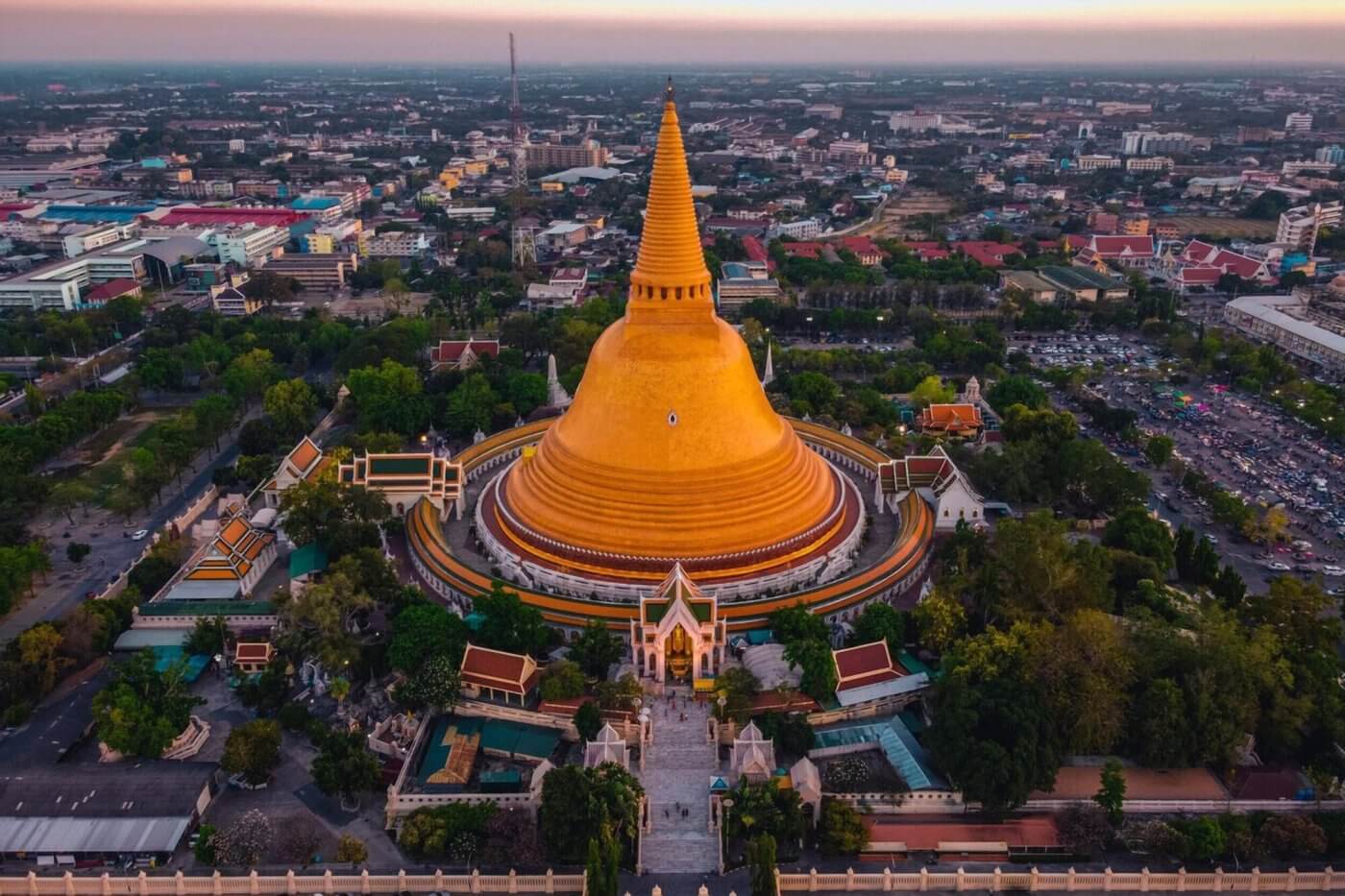
Nakhon Pathom is about 50–56 km west of Bangkok — roughly 45–55 minutes by train from Bang Bamru Station (3rd class fares from ฿14) or 50–90 minutes by bus depending on traffic.
The province is known for:
- Khao lam — sticky rice cooked in bamboo tubes over charcoal; sold at roadside vendors throughout the province
- Som tam (green papaya salad) in the regional style with varying heat levels
- Kanom jeen (fermented rice noodles) with various curry sauces; served from morning at local markets
- The area around Phra Pathom Chedi — one of the world’s tallest stupas at 127 meters — has an active temple fair market on weekends, particularly during the annual fair in November. Entry to the temple grounds: ฿20 per person for foreigners; open daily 7:00 AM–8:00 PM
Sanam Chan Park in Nakhon Pathom, adjacent to the palace ruins of King Vajiravudh (Rama VI), has food vendors and is a popular weekend destination for Bangkok residents.
Samut Songkhram Seafood and Canal Villages
Samut Songkhram province is about 80–100 km southwest of Bangkok (Amphawa floating market area is ~100 km; the province town ~80 km).
The area is known for Gulf seafood and canal-side communities. Don Hoi Lot
is a natural sandbar at the mouth of the Mae Klong River famous for razor clams (hoi lot) and roadside seafood restaurants; open daily 8:00 AM–7:00 PM, no entrance fee.
| Location | Specialty | Approximate price per dish |
|---|---|---|
| Amphawa | Grilled river prawns | ฿150–฿400 |
| Bang Khonthi | Fresh crab curry | ฿150–฿400 |
| Don Hoi Lot | Razor clam dishes | ฿80–฿250 |
| Laem Yai | Salt-crusted whole fish | ฿200–฿500 |
Combining a morning at Amphawa Floating Market (active Thursday–Sunday, most vibrant Friday and Saturday evenings with firefly boat tours along the canals after 7 PM) with lunch at a Don Hoi Lot seafood restaurant makes a coherent food-focused day trip.
The two locations are about 15 minutes apart by road.
Fruit Orchards and Farm Visits
The provinces of Ratchaburi, Samut Songkhram, and Nakhon Pathom have working fruit orchards that accept visitors, particularly during peak harvest seasons:
- Durian and Mangosteen: Rayong and Chanthaburi provinces, peak June–July; at 2.5–3 hours from Bangkok, these are better suited as overnight trips than day excursions
- Mango orchards: Ratchaburi and Nakhon Pathom provinces, peak March–June — more accessible as a day trip; The Orchard at Mahasawat Canal, Nakhon Pathom is a confirmed farm visit option near Bangkok
- Coconut plantations: Samut Songkhram province (Paisan Farm and others), year-round; traditional coconut products and fresh coconut available; most farms accessible on weekdays and weekends
Farm visit programs vary from informal drop-in to scheduled guided tours.
Local tourism offices in each province maintain updated information on which farms accept visitors and when.
Cooking Classes in Traditional Settings
Day cooking classes operating out of Bangkok are numerous; classes held in provincial settings — often in the home kitchen or community hall of someone who teaches regional techniques — offer food that reflects actual local cooking rather than the tourist-adjusted Bangkok standard.
Classes in Nakhon Pathom and Ayutthaya province include market shopping and cooking in a traditional kitchen. Hands-On Thai Day Trips
(operating out of Nakhon Pathom) is one confirmed operator running day programs approximately 1 hour from Bangkok.
Prices typically run ฿1,500–฿2,800 per person for a half-day class including ingredients, market tour, and the meal.
Full-day programs with transport from Bangkok run slightly higher.
Farm-to-Table Experiences
Farm visits that include cooking are the most complete version of agricultural food tourism — you harvest, prepare, and eat within the same location.
This format is available at some of the orchard operations in Samut Songkhram and Ratchaburi provinces, though the offering changes seasonally.
Food Festivals and Seasonal Events
Regional food festivals coincide with harvest peaks: durian festivals in Chanthaburi (July), fruit festivals in Rayong, and temple fair food during Buddhist holy days throughout the year.
Connecting regional day trips to these events adds a layer of authentic local celebration — temple fair markets around major wat complexes are particularly active on public holidays and Buddhist observances.
Notable festivals near Bangkok worth coordinating with:
- River Kwai Bridge Week, Kanchanaburi — late November/early December; sound-and-light show, historical reenactments, and regional market; dates confirmed closer to the event
- Monkey Buffet Festival, Lopburi — last Sunday of November; local ceremony offering fruit to the town’s macaque population (the unusual spectacle draws visitors)
- Loy Krathong — 24 November 2026; celebrated nationwide but especially vibrant along the waterways of Samut Songkhram, Sukhothai, and Chiang Mai
The Tourism Authority of Thailand (TAT) publishes a searchable event calendar at tourismthailand.org/Search-result/event and monthly festival roundups at tatnews.org — checking before planning trips around seasonal events is worthwhile, as exact dates for lunar-calendar festivals are often confirmed only a few months in advance.
Market Shopping and Cooking Tours
Several Bangkok-based operators organize dawn market tours to local Bangkok wet markets or provincial markets, combining ingredient shopping with a cooking lesson.
Or Tor Kor Market in Chatuchak (Bangkok) is the most accessible starting point for this type of experience — it doesn’t require travel out of the city and represents genuine professional-grade produce.
River and Canal Tours Around Bangkok Province
Bangkok’s waterway network extends well beyond the Chao Phraya’s main channel.
Smaller khlong (canal) systems in the surrounding provinces support traditional stilt-house communities, mangrove forests, and fishing villages that see far fewer visitors than the city’s main riverside attractions.
Chao Phraya River Exploration
The upper Chao Phraya, formed by the confluence of several rivers in Nakhon Sawan province (several hours north), is not practical for Bangkok-based day trips.
The more accessible river exploration involves the delta area south of Bangkok and the smaller tributaries in the inner provinces.
Day tours following the Chao Phraya south from central Bangkok pass through increasingly rural terrain: traditional wooden houses on stilts, spirit shrines at waterline, and fishing villages.
Tours typically run 6–8 hours from riverside piers.
Canal Communities and Stilt Houses
Thonburi’s canal network (covered in more detail in the neighborhoods guide) remains the most accessible example of traditional water-based living near Bangkok.
For more intact communities requiring less tourist infrastructure, the khlongs of Nonthaburi, Pathum Thani, and Samut Prakan provinces offer a less-developed version of the same lifestyle.
The stilt houses in these communities are occupied residences — treating them as photo subjects rather than inhabited homes is the appropriate approach.
Boat tours that approach too closely or linger for photography are not well-received.
Longtail Boat Adventures Through Mangroves
Mangrove ecosystems in the Samut Prakan province, at the mouth of the Chao Phraya south of Bangkok, can be reached on half-day tours.
Longtail boats navigate narrow channels through the mangrove forest where the density blocks direct sunlight.
Monitor lizards, kingfishers, and occasionally sea eagles are reliable sightings.
Bang Krachao (the “Green Lung” — a large meander of the Chao Phraya in Samut Prakan) is accessible by ferry from Klong Toei pier and has extensive cycle paths through preserved vegetation, community gardens, and local food stalls.
This is Bangkok’s closest nature day trip — 20 minutes by ferry and no entry fee.
Fishing Villages and Riverside Life
Don Hoi Lot in Samut Songkhram and the fishing communities along the Bang Pakong River in Chachoengsao province give the clearest picture of working fishing village life accessible from Bangkok.
These villages are not set up for tourism but welcome respectful visitors.
The focus is the working waterfront — fishing boat maintenance, net repair, morning catch auctions — rather than staged demonstrations.
Water-Based Activities in Bangkok Province
- Bang Krachao: cycling through mangrove preserve, no tour needed (20-minute ferry from Klong Toei)
- Longtail boat hire on the Chao Phraya: departures from Tha Chang, Maharaj, and Phra Arthit piers
- Canal tours in Thonburi: private hire or scheduled boat services from Sathorn Pier area
- Mangrove tours in Samut Prakan: organized half-day tours, some departing from BTS Bang Na area
Boat Building Traditions
Traditional wooden boat construction continues in several riverside communities in Thonburi and Nonthaburi.
A few workshops accept visitor observation — typically by arrangement with a local guide rather than spontaneous visits.
The craft involves hand-fitting of teak and hardwood with traditional joinery; larger vessels take months to complete.
Bird Watching Along Waterways
The wetlands at the mouth of the Chao Phraya and the canal margins of Bang Krachao are productive for waterbirds: great egrets, purple herons, lesser adjutant storks, various kingfisher species, and mudskippers.
Early morning visits (before 8 AM) are most active.
A basic field guide to Thai birds is worthwhile for identification; several cover the Bangkok area specifically.
How Do You Plan a Day Trip From Bangkok?
Choose your destination first, then your transport. Trains suit Ayutthaya and Kanchanaburi; minivan tours work for floating markets and beaches. Most trips need a 6–7 AM departure to reach destinations before peak heat and afternoon traffic.
Day trips require more planning than in-city activities primarily because of Bangkok’s traffic — departures after 8 AM on weekdays can add 30–60 minutes to road journeys.
Trains sidestep this problem and are the most reliable option for destinations served by rail.
Transport Options and Travel Times
| Transport | Destinations served | Notes |
|---|---|---|
| Train | Ayutthaya, Kanchanaburi (Thonburi station), Hua Hin, Bang Pa-In | Most reliable for schedule; limited to rail-connected destinations |
| Public minivan | Floating markets, Pattaya, Cha-Am, Khao Yai (shared tours) | Faster than bus for some routes; depart when full |
| Bus | Kanchanaburi, Pattaya, Hua Hin, Khao Yai | Multiple Bangkok terminals; cheaper than minivan |
| Organized tour | Any destination | All logistics handled; less flexibility |
| Private car/taxi | Any destination | Expensive but most convenient for groups |
Morning departures from Bangkok are essential for all day trips.
Aiming for 6:30–7:30 AM departure covers most destinations.
Best Season for Day Trips
The cool dry season (November–February) is the most comfortable period for outdoor day trips — heat peaks around 28–32°C rather than the 38–40°C of March–May.
Erawan Falls and Khao Yai trails are significantly more pleasant in cool season.
Hot season (March–May) makes outdoor sites genuinely difficult by midday.
Early arrival (at site before 9 AM) and finishing outdoor activities before noon are the practical adjustments.
Air-conditioned sites (museums, cultural centers, indoor markets) become more valuable in this period.
Wet season (June–October) — the impact varies by destination.
Ayutthaya and historical sites are fine in rain; hiking trails at Erawan and Khao Yai are muddy and slippery; beaches in the Gulf are often rough.
Khao Yai is greener and has more waterfall flow in wet season, which some visitors prefer.
The best time for Bangkok day trips covers seasonal conditions across destinations in detail.
Budget Planning and Cost Comparison
Day trip costs have three components: transport, entry fees, and food.
Transport is usually the largest variable.
| Trip Type | Independent Estimate | Organized Tour |
|---|---|---|
| Ayutthaya by train | ฿450–฿800/person (3rd class train ฿20; 2nd class ฿200–฿300; temples ฿80 each; bicycle ฿50; street food ฿100–฿150) | ฿1,000–฿1,500 incl. transport + guide |
| Kanchanaburi by bus + Erawan | ฿560–฿800/person (bus ฿60; entry ฿300; food ฿200–฿440) | ฿1,000–฿1,500 |
| Khao Yai (private car/tour) | ฿1,400–฿2,000/person (car rental or taxi share ~฿800–฿1,200; entry ฿400; food ฿200–฿400) | ฿2,300–฿3,000 incl. guide, transport, entry |
| Organized tours (general) | — | ฿1,000–฿2,500 depending on destination and group size |
The cost difference between independent travel and organized tours is substantial for some destinations. Ayutthaya by train is by far the cheapest day trip from Bangkok
— a full day with 4–5 temples, bicycle rental, and street food lunch comes in well under ฿1,000 per person on the local train. Khao Yai benefits more from an organized tour
: no public transport runs inside the park, wildlife spotting is easier with a knowledgeable guide and driver, and sharing the cost across a small group brings the per-person price close to what a solo private car hire would cost anyway.
Group Tour vs. Independent Travel
Group tours are worth considering when: the destination has no practical public transport (Damnoen Saduak), language barriers make navigation genuinely difficult (rural temples), or activities require organized logistics (white-water rafting, multi-site combinations).
They cost more but remove logistics entirely.
Independent travel works well for: Ayutthaya (excellent rail connection, bicycle rental on arrival), Bang Saen and Pattaya (straightforward bus routes), and Bang Krachao (ferry only, no road needed).
Multi-Day Combinations Worth Considering
- Ayutthaya + Bang Pa-In Summer Palace: 1 full day, comfortable by train
- Kanchanaburi town + Erawan Falls: 1 full day but rushed; better as overnight
- Khao Yai + vineyard: requires very early departure to fit wildlife morning and afternoon wine tasting
- Amphawa + Maeklong: both fit in one afternoon-to-evening trip (start at Maeklong for the train, move to Amphawa for the evening market)
Booking and Advance Reservation
| Destination | Advance booking needed? | Notes |
|---|---|---|
| Ayutthaya | No | Ordinary trains (3rd class, ฿15–฿20) depart daily from both Krung Thep Aphiwat (KTW) and Hua Lamphong — same-day tickets only, cannot sell out. Faster Express/Rapid trains from KTW from ฿60–฿240 can be booked 1–30 days ahead |
| Floating markets | No (unless organized tour) | Self-guided possible; tours can be booked same day |
| Kanchanaburi | 1–2 days on weekends | Popular weekend tours fill up; independent travel by Bus No. 8170 needs no booking |
| Khao Yai | 3–5 days (tours); up to 60 days (park accommodation) | Organized day tours fill quickly on weekends; park bungalows book online-only at the official park website, open 60 days ahead |
| Maeklong | No | Time arrival around the train schedule |
Khao Yai park accommodation must be reserved through the official Khao Yai National Park website (khaoyainationalpark.com) — walk-in bookings are not accepted for guesthouses unless unsold capacity remains.
Payment is processed in advance via Krung Thai Bank, and a 30% weekday discount applies automatically.
Safety and Practical Preparation
- Travel insurance covering outdoor activities (hiking, water sports) is worth carrying for Erawan Falls and Khao Yai
- Carry small bills for market shopping and local transport
- Download offline Google Maps for the destination area before departing — connectivity can be limited outside Bangkok
- Confirm operating hours before visiting — temple and market hours sometimes change; closures during Buddhist holidays affect some sites
- Sun protection (hat, sunscreen, light long sleeves) is essential for outdoor day trips March through May
Frequently Asked Questions (FAQs)
Independently, for most visitors.
The train from Hua Lamphong is straightforward, bicycle rental is available at the station arrival, and the four main temple complexes are self-navigable with a map.
Guided tours add historical context but roughly triple the cost.
The exception is if you want a boat tour included — arranging that independently on arrival is slightly more effort.
Amphawa for food and atmosphere; Damnoen Saduak for photography.
Amphawa is more genuinely local and the grilled seafood is the point.
Damnoen Saduak is more photogenic in the morning light but more commercial.
Maeklong Railway Market (different category — it’s a produce market, not a canal market) is worth 1–2 hours if you time the train pass correctly.
Yes, but it requires an early departure (6–7 AM) and moving efficiently between the two areas.
The historical sites in town take 3–4 hours; Erawan is 65 km away and closes to new visitors at 3 PM.
A day tour that covers both is the easiest approach.
Staying overnight is more comfortable and gives more time at Erawan.
Bang Krachao — Bangkok’s “Green Lung,” a mangrove-covered oxbow peninsula in the Chao Phraya River — is technically in Samut Prakan province but feels minutes from the city.
Take a taxi or bus (#47) to Wat Klong Toey Nok Pier (Khlong Toei area, ~5 minutes from Asoke BTS/MRT) and cross by local ferry for ฿6–฿20 per person — the boat crossing itself takes only about 5 minutes.
Bicycle rental is available right off the ferry at multiple pier-side shops for ฿50–฿100 per day; no entry fee for the area itself.
The flat paths through the vegetation are suitable for all fitness levels.
Key stops include Sri Nakhon Khuean Khan Park and Botanical Garden (open 5:00 AM–7:00 PM daily) and Bang Nam Phueng Floating Market (weekends only, 8:00 AM–4:00 PM).
Plan 3–5 hours for a relaxed cycle with café stops; combine with the weekend floating market for a fuller half-day.
It’s not wildlife-watching at Khao Yai scale, but it requires almost no planning and can fill a morning beautifully.
For a full reference on pre-trip preparation, see things to know before your Bangkok trip.
A lifestyle and OOTD blogger, Kannaya Nareswari enjoys the small pleasures of cooking, traveling, and documenting ordinary events. She uses genuine storytelling to communicate her love of fashion, culinary explorations, and wanderlust. She is based between Bali and Bandung. She enjoys enjoying coffee at a secret café or experimenting with recipes in the kitchen when she's not traveling to new places or styling her most recent ensemble.