



Getting Around Bangkok: BTS, MRT, Boats, Taxis & More – Bangkok has one of Southeast Asia’s most useful public transport networks — once you understand which system covers which part of the city, getting around stops feeling complicated.
Bangkok’s transport network works well for visitors, but it requires a bit of upfront orientation.
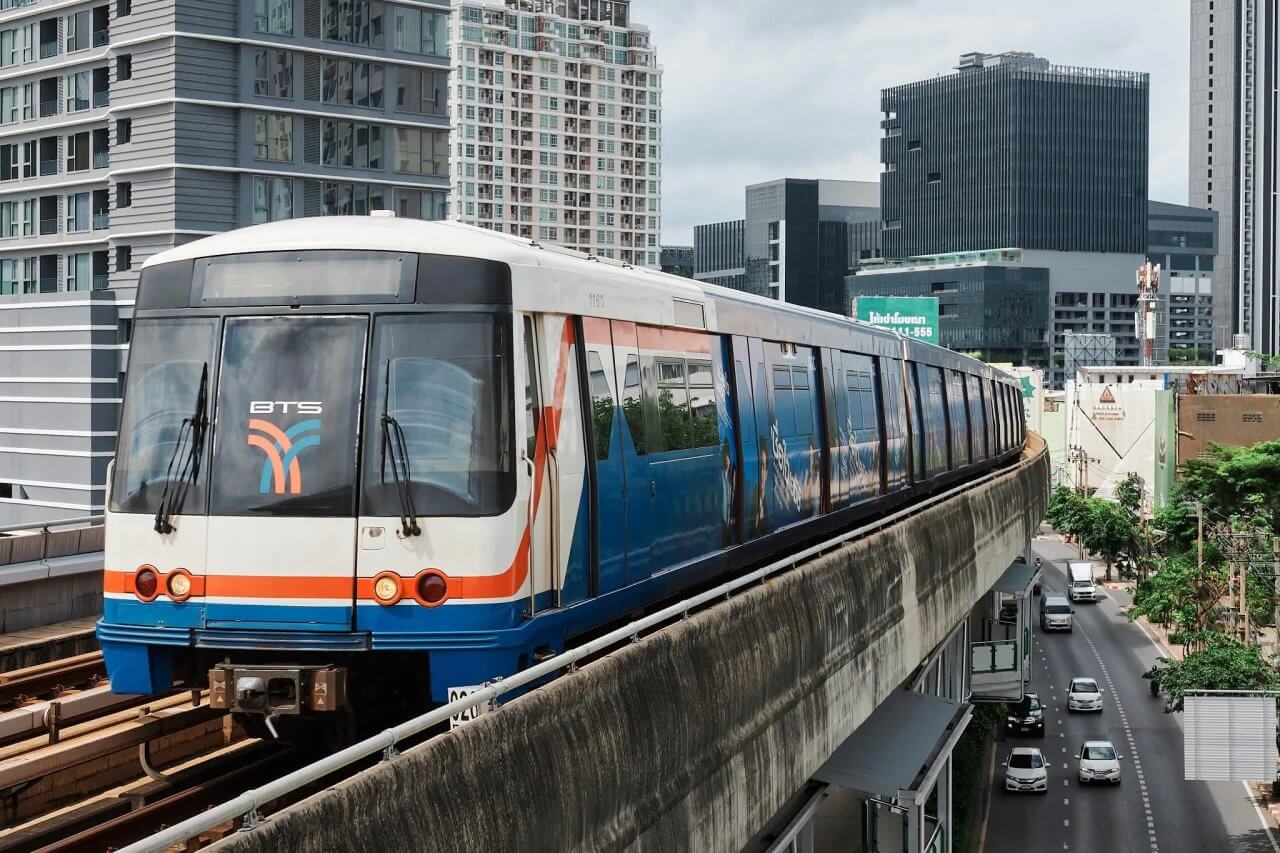
The BTS Skytrain and MRT subway cover the commercial and tourist-heavy parts of the city.
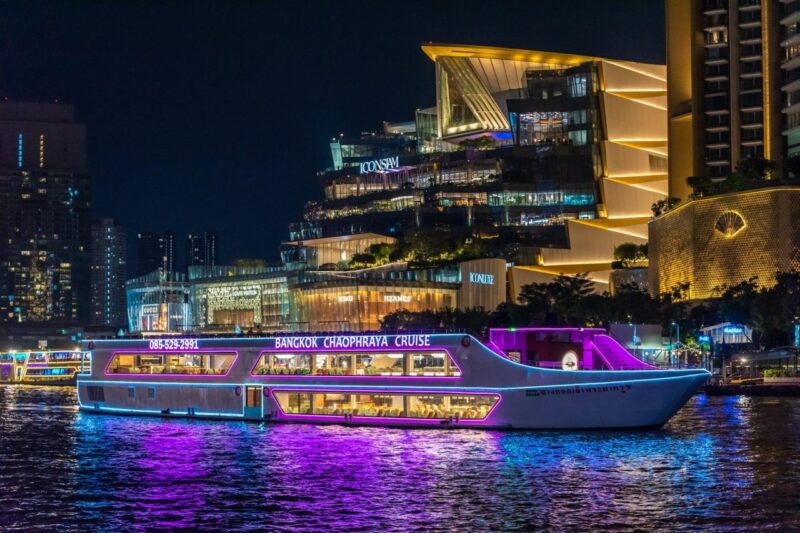
The Chao Phraya River boats handle the historic riverside areas efficiently.
Grab fills in the gaps.
Tuk-tuks are fun for short hops but carry a well-known scam risk near major temples.
The city’s legendary traffic jams are real, and they make taxis slow and unreliable during peak hours on any route a BTS line covers.
The trains are almost always faster between 7-9 AM and 5-8 PM.
Understanding transport unlocks everything else Bangkok has to offer — from street food markets to ancient temples.
The best things to do in Bangkok guide is a useful companion once you’ve sorted how you’ll move around.
Bangkok Transport at a Glance
- The BTS Skytrain covers Sukhumvit, Silom, and the main commercial corridor; fares run 17–59 baht per trip with a Rabbit Card.
- The MRT subway extends BTS coverage into Chinatown (Hua Lamphong station), Chatuchak, and several residential neighborhoods.
- Grab (ride-hailing) is the reliable default for areas not served by rail; it shows the fixed fare before you confirm.
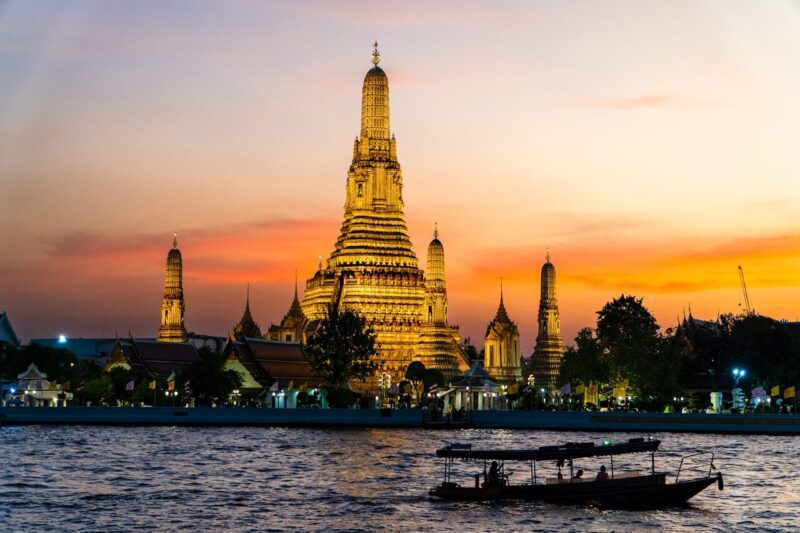
- Chao Phraya Express Boats (Orange Flag service) connect BTS Saphan Taksin to riverside temples including the Grand Palace pier and Wat Arun.
- Avoid metered taxis for any journey covered by the BTS or MRT during morning and evening rush hours — road traffic makes them significantly slower and more expensive than rail.
- The Airport Rail Link connects Suvarnabhumi Airport to Phaya Thai BTS station in approximately 27 minutes for 45 baht.
What Is the Best Way to Get Around Bangkok?
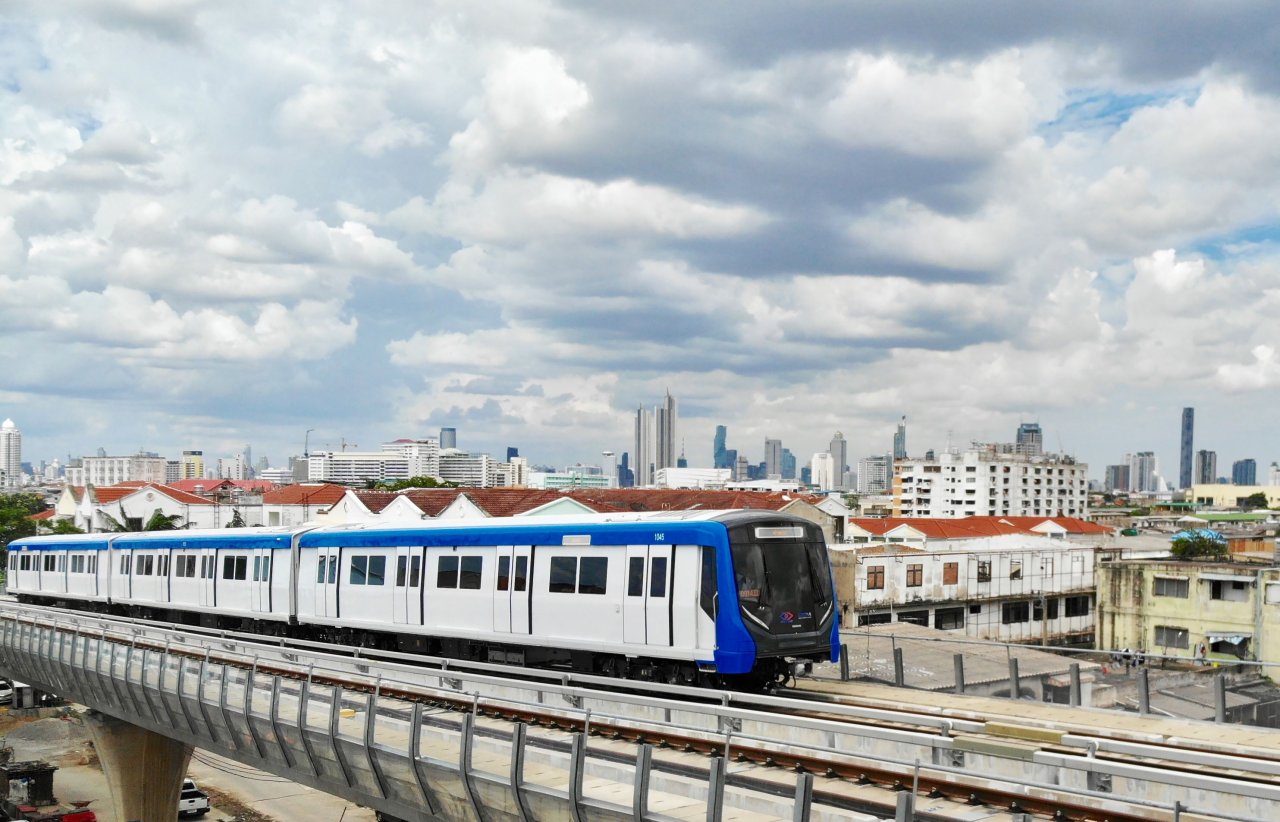
For most visitors, the BTS Skytrain is the single most useful transport option in Bangkok.
It’s fast, air-conditioned, runs on a fixed schedule, and covers the majority of attractions and hotels most travelers use.
Pair it with Grab for areas the BTS doesn’t reach, and the Chao Phraya river boats for temple visits on the riverside.
The short version of the strategy: BTS for the city’s commercial core, river boats for Old City temples, Grab everywhere else.
The BTS Skytrain
The BTS runs two main lines.
The Sukhumvit Line runs northeast from National Stadium through Siam, Asok, and up to Mo Chit (near Chatuchak Market) and Bearing in the east.
The Silom Line runs west from National Stadium through Sala Daeng (near Lumphini Park), crossing to the Chao Phraya River at Saphan Taksin, then south toward Bang Wa.
Siam station is the central interchange between the two lines and the best reference point for navigating BTS routes.
The system runs approximately 6 AM to midnight.
Key stations for visitors:
- Siam: BTS interchange hub; near MBK, Siam Paragon, and Bangkok Art and Culture Centre
- Asok/E4: Interchange with MRT Sukhumvit station; good base for Sukhumvit restaurants and nightlife
- Mo Chit/N8: Closest BTS to Chatuchak Weekend Market (also served by MRT Chatuchak Park)
- Saphan Taksin/S6: End of Silom Line; pier for Chao Phraya boats to Old City temples
- Sala Daeng/S2: Interchange with MRT Silom station; near Lumphini Park and Silom nightlife
Fares are distance-based: ฿17–65 per trip.
Buy a Rabbit Card (reloadable stored-value card, available at any BTS station) to avoid purchasing single-use tokens for each trip.
The card costs a small initial fee plus deposit, and the balance never expires.
The Chao Phraya River Boats
The Chao Phraya Express Boats run north-south along the river and are the most practical way to reach Bangkok’s Old City temples from the BTS network.
How to use it: Take BTS to Saphan Taksin station, exit to the river pier, and board an Orange Flag express boat heading north.
The journey takes 15-20 minutes to reach Tha Chang pier (Grand Palace) or Tha Tien pier (Wat Pho).
Wat Arun is directly across the river from Tha Tien — a 5-minute cross-river ferry connects them.
Boat types:
- Orange Flag boats: Express service hitting the main tourist piers; cheapest and fastest for sightseeing
- Blue Flag boats: Local service with more stops; useful if you’re heading to a specific pier not on the express route
- Tourist Boat: Hop-on/hop-off service with English commentary at a higher fare; convenient but not necessary if you know the route
Canal boats (Khlong Saen Saep): A separate network of express boats running along Bangkok’s main canal, connecting Pratunam/Victory Monument to the eastern parts of the city.
Useful for reaching Jim Thompson House and Pratunam market areas from the Old City side.
Bangkok’s Bus Network
Bangkok has an extensive bus network covering areas the BTS and MRT don’t reach.
For most short-term visitors, buses are slower and more complex to use than rail — routes are not always marked clearly in English, and real-time tracking has historically been unreliable.
For visitors willing to figure it out, ViaBus and Google Maps both provide bus route information.
Google Maps routing now includes bus options for most Bangkok journeys.
The fare is typically ฿8–10 (flat rate) for non-air-conditioned buses and ฿12–30 (distance-based) for air-conditioned buses.
Bangkok’s Train and Rail Networks
Bangkok’s rail systems — BTS and MRT — run separate ticketing and card systems but are physically connected at key interchange stations.
Understanding how to move between them is the core skill for efficient rail travel in the city.
The BTS covers the central commercial corridor efficiently; the MRT fills in the neighborhoods the BTS misses.
Knowing which areas each network serves also helps with accommodation decisions — BTS and MRT access varies significantly by neighborhood.
The best neighborhoods in Bangkok guide maps out which areas have direct rail access and what that means for getting to the sites you want.
The MRT Subway Lines
MRT Blue Line: The most useful line for visitors.
It runs in a large loop from Hua Lamphong through the city center and back, with key stations including:
- Hua Lamphong: Gateway to Chinatown (Yaowarat Road) and the main railway station for long-distance trains
- Silom: Interchange with BTS Sala Daeng; 5-minute covered walkway connects the two systems
- Sukhumvit: Interchange with BTS Asok; underground passages link both networks
- Chatuchak Park: One of two MRT stations near Chatuchak Weekend Market (BTS Mo Chit is the other)
- Thailand Cultural Centre: Near Bangkok’s main arts complex
MRT Purple Line: Connects Bang Yai (northwest of city) to Tao Poon, where it interchanges with the Blue Line.
Limited relevance for most tourists unless staying in the Nonthaburi area.
MRT fares are comparable to BTS rates.
Buy an MRT Card at any MRT station for stored-value travel; the system does not currently accept Rabbit Cards, so if you’re using both networks regularly, you’ll carry two separate cards.
Using the BTS and MRT Together
BTS and MRT interchange stations require you to exit one system and re-enter the other — this means paying a new fare each time you switch.
Budget for this when planning multi-leg journeys.
| BTS Station | MRT Station | Connection |
|---|---|---|
| Asok (E4) | Sukhumvit | Short underground walkway |
| Sala Daeng (S2) | Silom | 5-minute covered walkway |
| Mo Chit (N8) | Chatuchak Park | Street-level walk, ~5 minutes |
Peak Hours
Rush hours on both systems are 7-9 AM and 5-7 PM.
Trains run frequently but platforms fill quickly.
At Siam, Asok, and Mo Chit stations during these windows, expect to let 1-2 trains pass before boarding.
Outside peak hours, wait times are 2-3 minutes on both networks and boarding is comfortable.
| Time Period | Wait Time (approx.) | Crowd Level |
|---|---|---|
| 7-9 AM | 3-4 minutes | Heavy — plan extra time |
| 9 AM–4 PM | 2-3 minutes | Light — normal timing works |
| 5-7 PM | 3-5 minutes | Heavy — skip full trains |
| 7-10 PM | 2-4 minutes | Moderate |
Taxis, Grab, Tuk-Tuks, and Road Travel
Road-based transport covers the gaps in Bangkok’s rail network and is often the only option for specific neighborhoods, late-night travel, and journeys with luggage.
The right choice depends on the situation.
Metered Taxis vs. Grab
- Metered taxis are everywhere in Bangkok and are cheap when the meter is running. Starting fare is around ฿35. The problem is a subset of drivers — particularly near tourist areas and airports — who refuse to use the meter and quote inflated flat rates instead. The meter is legally required; if a driver won’t use it, get a different taxi. Note that metered taxis are almost entirely cash-only, so keep Thai baht on hand.
- Grab eliminates this friction entirely. The fare is shown before you confirm the ride, the driver’s route is GPS-tracked, and you can pay by card or cash. Grab rates are slightly higher than a metered taxi on a good day, but the predictability is worth it for many travelers. The app works reliably across Bangkok.
For visiting temples with a scam risk nearby, and for airport pickups where flat-rate quoting is common, Grab is the more straightforward choice.
For a full breakdown of the most common taxi-related scams, things to know before visiting Bangkok has a detailed rundown.
Tuk-Tuks and Motorbike Taxis
Tuk-tuks are the three-wheeled motorized vehicles found throughout Bangkok’s tourist areas.
They’re useful for short rides in neighborhoods where the BTS doesn’t reach, and the open-air experience on a quiet soi is genuinely enjoyable.
Negotiate the fare before you get in — there is no meter.
The specific risk: tuk-tuks near the Grand Palace and major temples sometimes offer tours at very low prices (or free).
These almost always involve stops at gem shops or tailors where the driver earns a commission.
If a tuk-tuk fare seems too low to make sense economically, the driver is earning the difference another way.
Motorbike taxis — drivers in orange vests waiting at the entrance to side streets (sois) — are the fastest option for short hops into areas where cars can’t easily go.
Rates are typically ฿10–60 for short distances, depending on how far down the soi you’re going.
Helmets are required by law and should be provided.
Useful for the last stretch of a journey the BTS can’t complete.
Long-Distance Buses and Trains
For day trips and longer excursions from Bangkok, two main departure points matter:
- Krung Thep Aphiwat Central Terminal (MRT Blue Line, Bang Sue station): The main railway hub since 2023 for express, rapid, and special express trains to Ayutthaya (~1 hour), Kanchanaburi, Chiang Mai, and southern Thailand. Fares from Bangkok to Ayutthaya start at around ฿20 for 3rd class on a rapid train. Trains depart regularly throughout the day.
- Hua Lamphong station (MRT Blue Line): Now serves ordinary/commuter trains only, including slower services to Ayutthaya (~1.5–2 hours) for as little as ฿15 for a 3rd class seat. Good for budget travelers who don’t mind a leisurely ride.
- Mochit Bus Terminal (near BTS Mo Chit/MRT Chatuchak Park): Long-distance buses heading north, including Ayutthaya and Chiang Mai.
- Ekkamai Bus Terminal (BTS Ekkamai): Eastern routes including Pattaya.
If you’re planning excursions from Bangkok, the best day trips from Bangkok guide covers transport times, costs, and logistics for the most popular destinations.
Renting Vehicles
Renting a scooter or car in Bangkok itself is not generally recommended for short-term visitors.
Traffic is genuinely dense, road rules operate differently from most Western countries, and parking is limited.
An international driving permit is required by law.
Renting a vehicle becomes more practical if you’re planning to leave Bangkok for day trips or regional travel where public transport coverage is thin.
Cards, Passes, and Payment Options
Bangkok’s transport systems use separate payment cards, though the city has been expanding contactless and QR payment options across multiple networks.
Rabbit Card and MRT Card
The Rabbit Card is a reloadable stored-value card for the BTS Skytrain.
Buy it at any BTS station counter — initial cost covers the card fee plus a minimum balance.
Top up at station machines or at 7-Eleven stores.
The card carries a slight per-ride discount compared to single-use tokens and eliminates ticket queues.
The MRT Card works the same way for the MRT subway.
Buy at any MRT station.
You’ll need both cards if you’re using both networks regularly — they are separate systems.
Both cards are worth buying even for short trips.
The time saved at ticket machines quickly justifies the small initial cost.
Tourist Day Passes
The BTS offers a one-day unlimited pass (฿150), available at any BTS ticket office, covering unlimited rides on the Sukhumvit and Silom lines from 6 AM to midnight.
At the current fare range of ฿17–65 per trip, the day pass breaks even after 3–5 rides depending on distances traveled.
Note that the pass covers only the BTS Green Line — the MRT, Airport Rail Link, and Gold Line require separate tickets.
For transport cost comparisons — when a day pass saves money versus loading a Rabbit Card — the traveling to Bangkok on a budget guide covers BTS day pass math alongside other transport savings strategies.
Contactless and QR Code Payments
Payment on Bangkok’s rail network has evolved quickly and now varies significantly by line.
Here’s the current picture:
- BTS Skytrain (Green/Gold Lines): International contactless credit/debit cards (Visa, Mastercard) are accepted via the Tang Rat app registration system, launched August 2025, at a flat fare of ฿20 per trip. Without registration, the Rabbit Card remains the standard option — no direct tap-and-go with a foreign card at the turnstile.
- MRT Blue and Purple Lines: As of June 2026, these lines require EMV contactless payment (Visa, Mastercard, UnionPay) — traditional stored-value MRT cards are no longer accepted. International visitors can tap in directly with a contactless bank card, no registration needed.
- MRT Yellow and Pink Lines: Accept the Rabbit Card and contactless bank cards at the gate.
For international visitors without access to the Tang Rat app, the Rabbit Card (for BTS) and a contactless bank card (for MRT Blue/Purple) is the most practical combination for covering the full network.
QR code payments via Thai banking apps (Bangkok Bank, SCB, Kasikorn) are also available at BTS ticket machines and on some boat services.
Top-up options for cards: Station machines (cash only at most), 7-Eleven and Family Mart stores (cash), and the BTS app or Bangkok Bank app (card top-up for Rabbit Card).
Planning Your Routes Efficiently
Efficient Bangkok routing is mostly about matching your transport mode to the specific leg of the journey.
Rail for anything the BTS/MRT covers, river boats for the Old City, Grab for everything else.
Route Planning by Attraction Zone
Grouping geographically close attractions together reduces unnecessary city-wide zigzagging:
- Riverside / Old City route: Take BTS Silom Line to Saphan Taksin → Orange Flag boat north to Tha Chang pier (Grand Palace) or Tha Tien pier (Wat Pho) → cross-river ferry to Wat Arun
- Central Bangkok / Shopping: BTS to Siam or Chidlom — Siam Paragon, Central World, MBK, and Jim Thompson House are all within short walking distance or one stop
- Chatuchak / North Bangkok: BTS to Mo Chit or MRT to Chatuchak Park — both work for the market; MRT continues to Hua Lamphong for Old City/Chinatown access
- Chinatown / Hua Lamphong: MRT Blue Line to Hua Lamphong station — Yaowarat Road begins a short walk from the station exit
Avoiding Peak Hours and Traffic
The practical rule: if the BTS or MRT covers your destination, use it regardless of the time.
If you need a taxi or Grab for a long-distance road journey, avoid departing between 7-9 AM and 5-8 PM.
A 20-minute Grab ride at 10 AM can easily become 45 minutes at 6 PM.
Morning temple visits work well specifically because the Old City (reached by boat from Saphan Taksin) is not heavily affected by road traffic — the boat route bypasses street congestion entirely.
Multi-Modal Routes in Practice
A route combining BTS, river boat, and Grab in a single day is genuinely practical in Bangkok.
Example:
- BTS to Saphan Taksin → Orange Flag boat to Grand Palace pier (Tha Chang)
- Walk to Wat Pho (10 minutes south of Grand Palace)
- Cross-river ferry to Wat Arun (5 minutes from Tha Tien pier, ฿5)
- Grab from Tha Tien/Wang Lang pier area to a Sukhumvit dinner restaurant
Each leg is efficient; no segment requires fighting road traffic.
This itinerary — Grand Palace + Wat Pho + Wat Arun — is one of the most commonly searched Bangkok one-day routes and the boat-based approach to it is significantly faster than trying to connect these temples by road.
Is Bangkok’s Public Transport Safe and Accessible?
Bangkok’s BTS and MRT are safe systems.
Serious crime targeting passengers on the trains is rare.
The main practical concerns are pickpockets in crowded carriages during rush hour and the standard taxi and tuk-tuk scams that operate at street level.
Standard awareness — keeping your bag in front of you, watching your pockets in dense crowds — is sufficient.
Safety on Public Transport
On the BTS and MRT, the routine risks are petty theft in tightly packed carriages and occasional bag snatching in the station areas.
Keep valuables — phone, wallet, passport — in a front pocket or zipped inner compartment rather than a back pocket or the outside pocket of a backpack.
For genuine emergencies, the tourist police line is 1155 and operates 24 hours with English-speaking staff.
The number 191 reaches regular police.
Lost items on BTS: contact the BTS Lost and Found at the station where the item was lost, or call the BTS hotline at 02-617-6000 (daily, 6 AM–midnight).
For MRT losses, reach the MRT Lost and Found Centre at 06-1410-8208 (Monday–Friday, 8 AM–5 PM, excluding public holidays).
Accessibility Features
Bangkok’s rail systems have improved accessibility significantly in recent years, though coverage is uneven by station age and line:
- MRT Blue Line: All stations include elevator access, tactile pathways, and accessible restrooms
- BTS Skytrain: Most stations on the newer extensions have elevators; some older Sukhumvit Line stations have limited access — check the BTS accessibility map before planning a route dependent on elevator availability
- Airport Rail Link: Fully accessible with elevators and wide platforms
For families with strollers, the MRT is more consistently accessible than the BTS.
Grab cars have air conditioning and space for a folding stroller; standard GrabCar does not guarantee child car seats. GrabFamily
(available in Bangkok) provides vehicles equipped with child booster seats for children up to 1.35m tall, while GrabCar Plus offers newer, more spacious premium vehicles — both bookable directly in the Grab app under the vehicle type selection.
For a comprehensive guide to traveling Bangkok with children — including transport-specific advice for families — the visiting Bangkok with kids guide covers everything from stroller-friendly routes to family-safe neighborhood options.
Frequently Asked Questions (FAQs)
No — the BTS does not directly reach the Grand Palace or the Rattanakosin Old City area.
The closest BTS station is Saphan Taksin (Silom Line), which connects to the Chao Phraya River pier.
From there, take an Orange Flag express boat north to Tha Chang pier (for the Grand Palace) or Tha Tien pier (for Wat Pho).
The boat journey takes about 15–20 minutes and costs ฿19 (flat rate, paid on the boat).
This river route is actually faster than a road taxi to the same destination during most of the day.
For regular trips within the BTS/MRT coverage area, the Rabbit Card and MRT Card with stored-value fares give a slight discount over single-use tickets.
The Chao Phraya Orange Flag boat to temple piers costs ฿19 per trip and is among the cheapest and most efficient ways to reach the Old City.
Buses are cheaper still — ฿8–10 flat rate for non-air-conditioned services, ฿12–30 for air-conditioned routes — but require more familiarity with routes.
Motorbike taxis at ฿10–60 cover short last-mile connections that trains don’t reach.
The combination of BTS/MRT plus river boats plus occasional motorbike taxi is both cheap and fast for most tourist itineraries.
The Airport Rail Link City Line is the most practical option: trains depart from the basement level of the airport arrivals hall to Phaya Thai station (BTS Sukhumvit Line), taking approximately 27 minutes and costing ฿45.
At Phaya Thai, transfer to the BTS to reach Sukhumvit, Silom, or any other BTS-connected neighborhood.
Metered taxis are available from the organized taxi queue on the first floor of arrivals — do not accept offers from drivers inside the terminal.
The fare to central Bangkok runs approximately ฿350–500 on the meter, plus a fixed ฿50 airport surcharge and expressway tolls of ฿75–100 paid separately by the passenger.
Budget roughly ฿500–650 all-in for a taxi to central Sukhumvit.
If your hotel is close to a BTS station, the Airport Rail Link is almost always faster and cheaper than a taxi.
If you have heavy luggage or are staying somewhere not served by BTS, a taxi or Grab is more practical.

A lifestyle and OOTD blogger, Kannaya Nareswari enjoys the small pleasures of cooking, traveling, and documenting ordinary events. She uses genuine storytelling to communicate her love of fashion, culinary explorations, and wanderlust. She is based between Bali and Bandung. She enjoys enjoying coffee at a secret café or experimenting with recipes in the kitchen when she's not traveling to new places or styling her most recent ensemble.