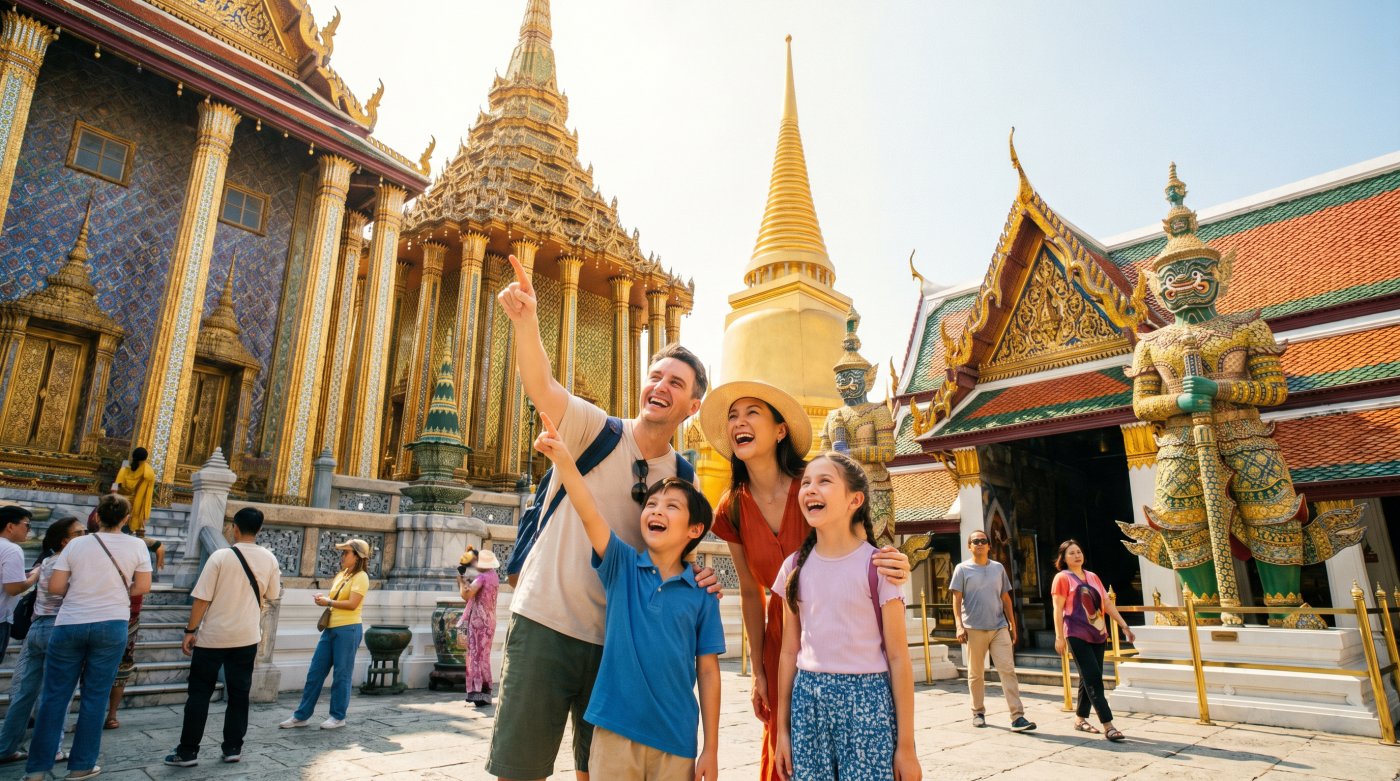



Visiting Bangkok with Kids and Family: The Complete Planning Guide – Planning a Bangkok family trip but not sure if the city actually works for children — or just for adults who want street food and temples?
Bangkok is more practical for families than most people expect.
The city has a well-established family tourism infrastructure: hotel kids’ clubs and family pools, malls with dedicated children’s entertainment, an aquarium inside a shopping center, and an amusement park with a genuine snow zone.
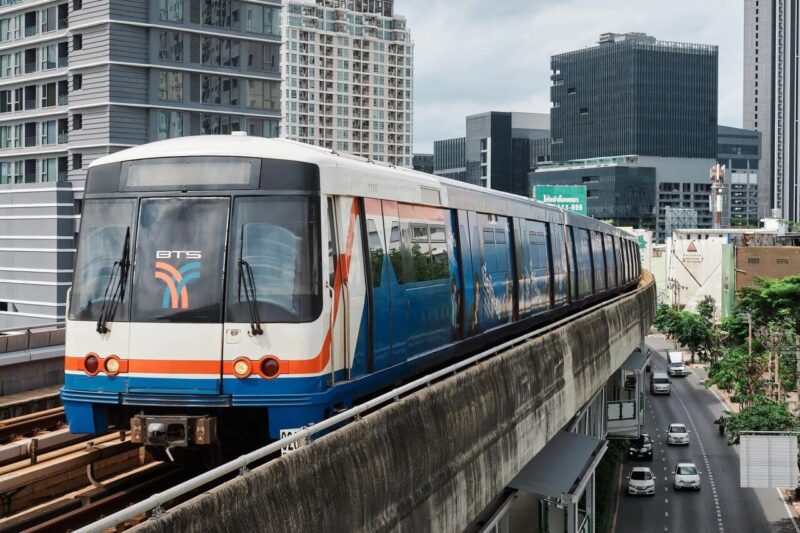
Getting around with children is manageable on the BTS Skytrain and Grab, both of which handle strollers and car seat requests.
The main variables to manage are heat (which makes midday activity scheduling important), food hygiene, and the pacing required when traveling with young children in a city that has no shortage of overwhelming stimuli.
Bangkok Family Travel at a Glance
- November through February is the best window for families — cool-season temperatures (23–32°C / 73–90°F) make full-day temple visits practical, especially for young children.
- Sukhumvit is the most functional neighborhood for families: BTS access, serviced apartments with kitchens, and Emporium/EmQuartier/Siam Paragon within easy reach.
- The BTS Skytrain has elevators at most stations across its two lines (Sukhumvit and Silom), with key accessible stops including Siam, Asok, On Nut, Bang Na, and Chong Nonsi; strollers fit comfortably on off-peak trains. The MRT subway goes further — every underground station is fully equipped with elevators.
- Safari World, Dream World, and SEA LIFE Bangkok Ocean World each require a half to full day and are best combined with a hotel rest break in the afternoon.
- Street food is generally safe for children if you choose high-turnover vendors and avoid raw or room-temperature preparations.
- For private transfers from the airport, arrange car seats in advance — standard taxis do not carry them.
Is Bangkok a Good Destination for Families?
Yes. Bangkok has dedicated family attractions, child-friendly transport, and affordable accommodation at every price point.
Timing matters most — November through February brings Bangkok’s cool, dry season with daily temperatures ranging from around 23–32°C (73–90°F), making full-day sightseeing practical for children. The city also works well for families staying two weeks or longer.
Bangkok’s best things to do in Bangkok span every age group, from temple visits and river boat rides to indoor aquariums and theme parks.
The difference between a smooth family trip and an exhausting one usually comes down to three decisions: when you go, where you stay (specifically, whether you’re near BTS transit), and how you build rest into the daily schedule.
What Bangkok is not: a relaxed beach resort city.
Noise, traffic, and heat are constant factors.
Families with very young toddlers (under 2) or children with sensory sensitivities may find the pace difficult.
The city rewards flexibility and realistic expectations more than careful optimization of every hour.
Planning Your Bangkok Family Trip
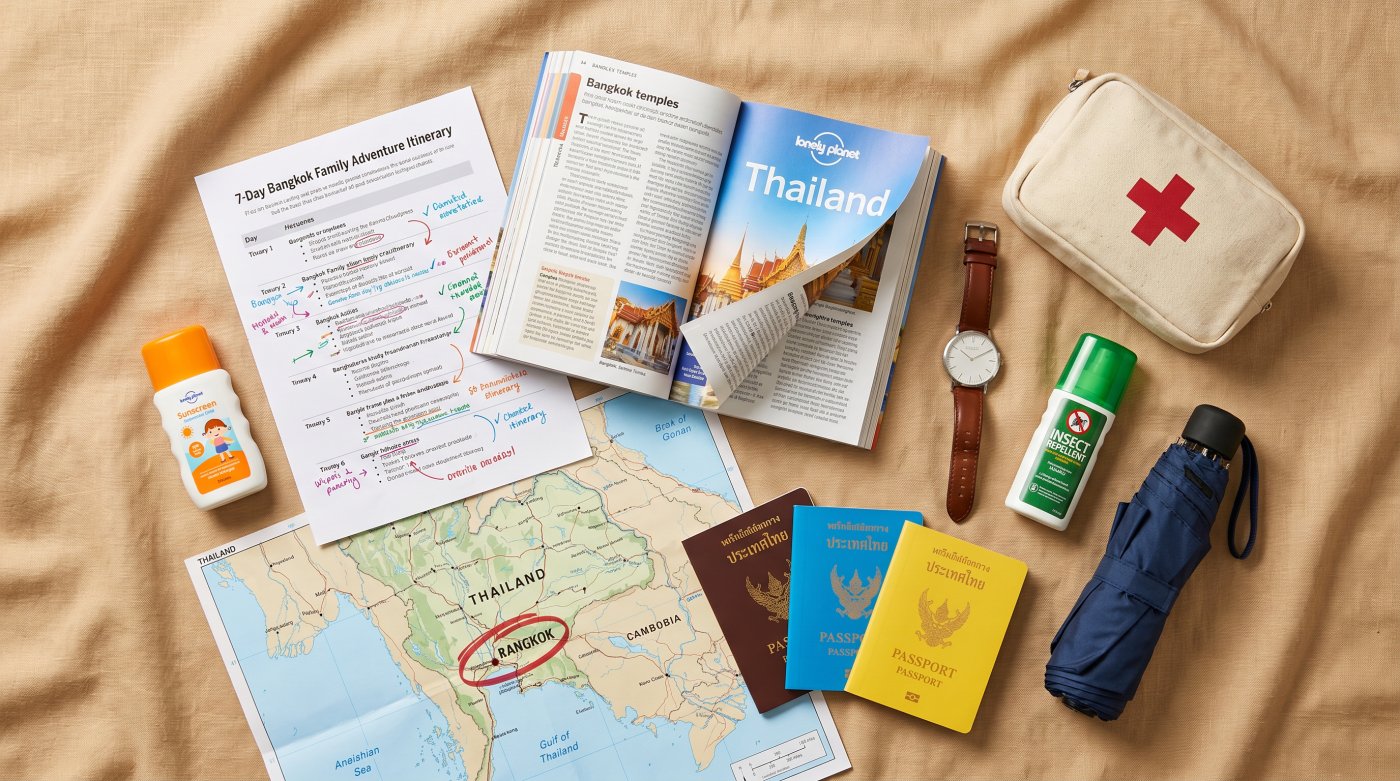
Getting the basics sorted before booking removes the largest sources of friction: heat management, health preparation, and the logistical reality of which activities actually work with children at different ages.
Best Times to Visit Bangkok with Children
The clearest planning factor for Bangkok families is temperature.
The cool season (November–February) averages 22–32°C with low humidity and minimal rain — mornings can dip to around 22°C in January, while afternoons stay in the comfortable 28–30°C range.
This is when full-day temple visits and outdoor attractions are practical without significant heat management.
The Grand Palace and Wat Pho in the morning are comfortable; afternoon outdoor time is feasible.
For best time to visit Bangkok with family — covering temperature ranges, rainfall patterns, and how each month affects specific family activities — the full seasonal guide has a detailed breakdown.
Hot season (March–May) averages 33–40°C, with April being the hottest month across the city.
Outdoor activities should be limited to early morning (before 10 AM) or late afternoon.
Indoor attractions (aquariums, malls, amusement parks with covered rides) become the primary activity.
This period is doable with children who have good heat tolerance, but requires more careful scheduling.
Rainy season (June–October) brings afternoon thunderstorms — typically 1–2 hours of heavy rain, then clear.
Mornings are usually dry, and families can continue sightseeing with a rain jacket or umbrella.
Hotel rates typically drop 30–50% compared to peak season prices, with the steepest discounts available July through October — which is meaningful if budget is a priority.
Avoid Songkran week (mid-April) for families with young children or children who dislike crowds and unpredictable soaking.
The water festival is genuinely engaging for older children and teenagers but can be overwhelming for toddlers.
Weather-Based Activity Planning
Each season calls for different scheduling:
| Season | Best outdoor timing | Indoor fallback options |
|---|---|---|
| Cool (Nov–Feb) | All day | Comfortable |
| Hot (Mar–May) | Before 10 AM / after 4 PM | Essential midday activity |
| Wet (Jun–Oct) | Morning; monitor forecast | Plan indoor options for afternoons |
Building a hotel pool break into the 1–3 PM slot on hot or wet days solves most scheduling problems.
Children cool down, parents rest, and the afternoon energy levels for dinner and evening activities improve significantly.
Visa Requirements and Documentation
Visa rules for Thailand changed in May 2026: most Western countries, Australia, and much of Asia are now back to 30-day visa-free entry after Thailand ended its temporary 60-day visa exemption program.
Citizens of the US, UK, Australia, most EU countries, Japan, South Korea, Singapore, and around 93 nationalities in total qualify for this visa-free entry.
Before you travel, double-check your country’s current status using our AI Travel Visa Requirements Checker — Thai visa rules have shifted multiple times in recent years and it pays to verify before you book.
Passports need at least 6 months validity beyond your planned departure date.
For stays over 30 days: a tourist visa (applied at a Thai consulate before travel) grants 60 days, extendable once at a Bangkok immigration office for ฿1,900 in cash — bring the exact amount, as most offices don’t accept cards.
The extension adds 30 days to your permitted stay.
The main Immigration Bureau has relocated to 904 Popular Road, Muang Thong Thani, Pak Kret, Nonthaburi (accessible via MRT to Muang Thong Thani), open Monday–Friday, 8:30 AM–4:30 PM with a lunch break from 12:00–1:00 PM.
Arrive early — processing typically takes 1–3 hours and afternoon queues at this office can be long.
Practical documentation habits: photograph passports, insurance cards, and children’s birth certificates; store copies in a cloud service accessible from your phone.
Hotel safes are suitable for originals; keep one clear photocopy in your day bag.
If extending a visa, also bring your TM30 receipt (the residence notification your hotel files when you check in — ask the front desk for a printed copy before you leave for the immigration office).
Health Preparation for Children
Standard vaccinations for Southeast Asia apply: Hepatitis A, Typhoid, and up-to-date routine vaccines.
Check with your doctor 4–6 weeks before departure for current recommendations.
Malaria risk in Bangkok is negligible; it’s relevant only in rural border regions.
Dengue fever is present in Bangkok year-round, including in urban parks.
DEET-based mosquito repellent (20–30% concentration) is the practical protection for children.
Apply before outdoor activity, particularly in parks and at dusk.
Children’s fever reducers, antihistamines, electrolyte sachets, and any prescription medications should be packed from home.
Most common formulations are available at Bangkok pharmacies (Boots, Watsons, Fascino), but familiar brands may not match exactly, and searching for specific products with a sick child is not the moment to discover local pharmacy stock.
Building a Practical Family Itinerary
A workable daily structure for families with children under 12:
- 7:30–10:30 AM: outdoor temple or cultural activity
- 10:30 AM–1 PM: indoor activity or shopping mall (air-conditioned)
- 1–3 PM: hotel pool, lunch, and rest
- 3–6 PM: second activity, shopping, or park visit in the cooler late afternoon
- Evening: night market or riverside dinner
Trying to run 5–6 sights in a day produces the same outcome regardless of planning quality: overtired children and frustrated parents.
Two or three properly paced activities per day, with the heat management built in, produces better results than optimized density.
Age-Appropriate Activities
| Age range | Works well | Worth skipping |
|---|---|---|
| Toddlers (2–4) | Lumpini Park, hotel pool, boat rides | Dream World thrill rides, multi-hour temple tours |
| Children (5–9) | SEA LIFE Aquarium, Chatuchak Market, cooking classes | Full Grand Palace circuit in peak heat |
| Tweens (10–12) | Safari World, floating market tours, street food exploration | Most attractions are suitable |
| Teens (13+) | Nearly everything; street food tours, cultural experiences, amusement parks | None — most options apply |
Budget Planning for Bangkok Family Trips
Realistic daily ranges (prices based on 2025–2026 exchange rates and mid-season travel):
- Family accommodation: $50–$200 per night depending on hotel tier and room type — budget guesthouses with family rooms start around $50, while mid-range serviced apartments run $80–$150/night, and 4-star Sukhumvit hotels average $130–$200/night
- Daily food (mixing street food and sit-down restaurants): $25–$60 per family of 4
- Transport (BTS + occasional Grab rides): $10–$25 per day
- Major attraction entry (1–2 per day): $60–$130 per family of 4 — SEA LIFE Bangkok walk-in tickets run approximately ฿799/child and ฿1,199/adult (around $105 total for two adults + two children); Safari World walk-in is ฿1,800/person (
$50/person); Dream World is around ฿1,150–1,200/person ($32/person). Booking online in advance cuts costs by 20–45%.
A mid-range Bangkok family trip for 4–5 days can run $1,500–$2,500 for a family of 4, significantly less than comparable trips to Singapore or Tokyo for similar activities.
Where Should Families Stay in Bangkok?
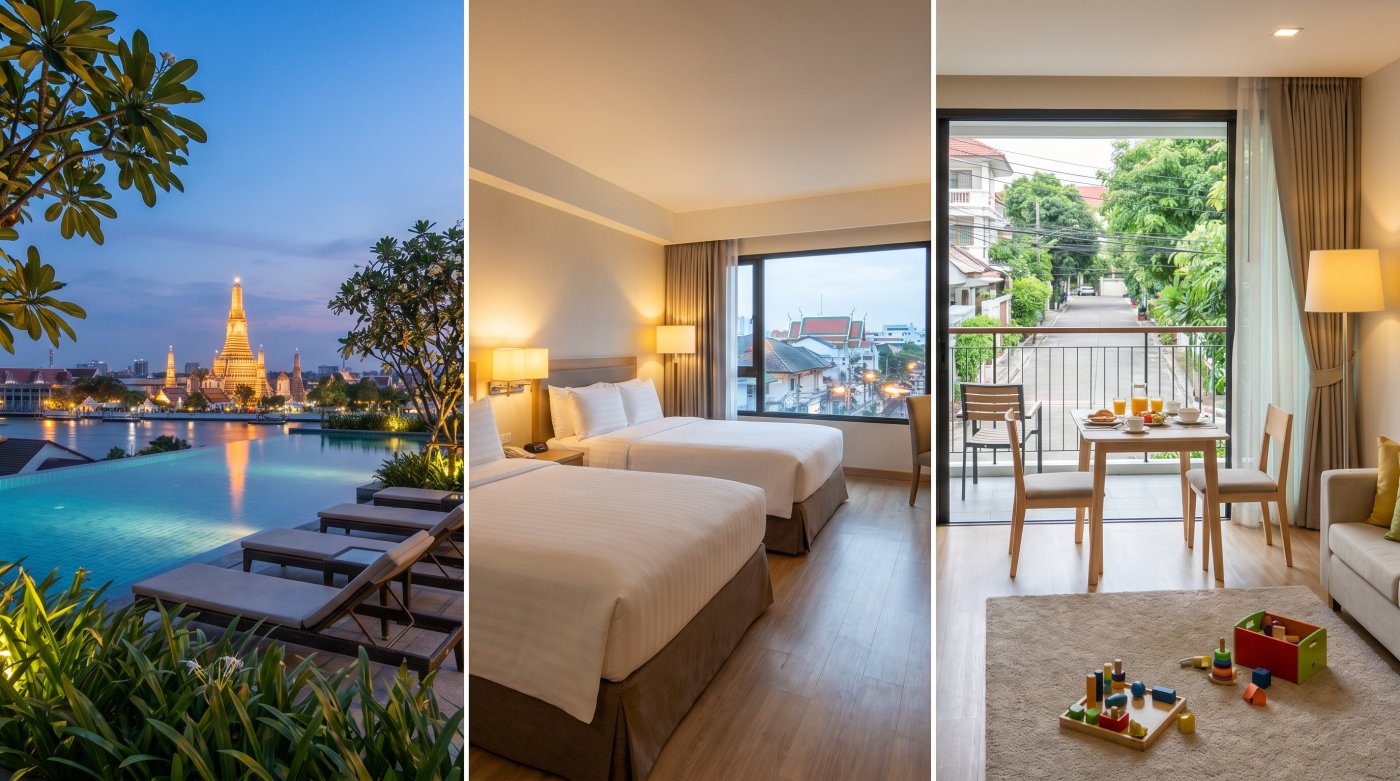
Sukhumvit, from Asok to On Nut, offers the most practical combination: BTS access, serviced apartments with kitchens, and malls with reliable child facilities nearby.
Riverside hotels suit families who prefer a quieter waterfront setting and don’t mind being further from the Skytrain — most riverside properties run free shuttle boats to Saphan Taksin BTS station, which partially compensates for the transit gap.
Choosing accommodation in Bangkok for families involves a specific trade-off: the neighborhoods with the most adult tourist infrastructure (Khao San Road, Rattanakosin) are not the ones with the best family amenities.
The neighborhoods with the best family amenities (Sukhumvit, Riverside) cost more.
For a full area-by-area comparison, the guide to family-friendly Bangkok neighborhoods covers this in detail.
Family Hotels: What to Look For
The specific amenities that meaningfully affect family travel quality in Bangkok:
- Dedicated children’s pool: Standard adult pools are too deep for younger children and too crowded to be a reliable rest option
- Kids’ club: Staffed programs for children aged 4–12; valuable for the afternoon rest window when parents may want to stay at the hotel rather than plan an activity
- Connecting rooms or family suites: Sleeping in the same room with young children for 5+ nights affects everyone’s quality of sleep
- BTS proximity or hotel shuttle: Without it, taxi costs for a family of 4 with luggage add up across the trip
Hotels with well-documented family programs:
| Hotel | Pool type | Kids’ club | BTS access | Notes |
|---|---|---|---|---|
| Shangri-La Bangkok | Dedicated children’s pool; riverside | Yes, CHI Kids’ Club | Hotel shuttle to Saphan Taksin BTS | Riverside; strong family reputation |
| Anantara Riverside | Pool with separate children’s section | Adventure camps and cooking for kids | Hotel boat to BTS/MRT | Quieter Thonburi side; scenic |
| Centara Grand at CentralWorld | Multiple pools | Yes | CentralWorld is at Siam BTS | Direct mall access; central |
| Marriott Sukhumvit | Pool | Yes | Asok BTS | Walking distance to Terminal 21 |
These are the properties most consistently cited by families.
Rates vary significantly by season and room type; all prices should be verified against current availability.
Serviced Apartments for Longer Stays
For stays of 7 days or more, serviced apartments offer practical advantages over hotels:
- Separate bedrooms for parents and children
- Full kitchen for breakfast preparation, familiar food for picky eaters, and baby food/formula storage
- In-unit laundry (critical for young children who change clothes multiple times daily)
- More living space for toys, strollers, and general family spread
Properties consistently used by families with children:
- Somerset Park Suanplu (Sathorn area): Family-focused serviced residence with pool, children’s playroom, tennis court, and 1–3 bedroom units ranging from approximately $97–$245/night — best suited for short-to-medium stays rather than budget monthly rentals
- Marriott Executive Apartments Bangkok (various locations): More hotel-like service with apartment amenities, aimed at longer-stay guests
- Citadines Sukhumvit series (Sukhumvit 11 and 16): Practical studios and one-bedroom units with strong BTS access; monthly rates run approximately ฿48,000–78,000 (~$1,350–$2,170/month) for 1-bedroom units
Monthly rates for serviced apartments in central Bangkok vary widely by property tier.
Budget options (local serviced buildings, outer Sukhumvit) start from around ฿18,000–25,000/month for a 1-bedroom, while branded mid-range properties (Citadines, Oakwood, Fraser) run ฿45,000–80,000/month for a 1-bedroom unit, and ฿80,000–120,000/month for a 2-bedroom.
The original estimate of ฿18,000–50,000 holds for budget-to-mid tier unbranded options, but families targeting well-known serviced residence brands in central Sukhumvit or Sathorn should budget closer to ฿50,000–100,000/month for a family-appropriate 1–2 bedroom unit.
Neighborhood Summary for Families
| Area | Why families choose it | Trade-off |
|---|---|---|
| Sukhumvit (Asok–On Nut) | BTS access; malls; serviced apartments; expat-facing restaurants | More expensive; tourist pricing on restaurants |
| Riverside (Charoen Krung) | Hotels with pools and gardens; quieter; water views | No BTS — reliant on hotel shuttles and Grab for most trips |
| Silom / Sala Daeng | BTS access; quieter than Sukhumvit; business hotel infrastructure | Fewer dedicated family hotel options |
| Chatuchak / Mo Chit | Cheaper; near Chatuchak market; BTS/MRT interchange | Farther from most tourist attractions |
Smart Accommodation Booking for Families
Contacting hotels directly before booking to confirm specific family amenities: children’s pool depth, kids’ club age range and hours, crib availability, and room configuration options.
Booking platforms list amenities inconsistently, and discovering a “kids’ club” is a weekend-only playroom rather than a daily supervised program affects trip planning significantly.
For Songkran (April), Chinese New Year, and Christmas/New Year, book 2–3 months ahead — family rooms at well-regarded properties sell out early.
Pool Access and Recreation Priorities
Children’s pools that are shallow (under 80 cm), fenced from the adult pool, and supervised — rather than adult pools with a shallow end — are the meaningful differentiator.
Hotels that advertise both typically have a separate small children’s area alongside the main pool.
Bangkok’s heat means the hotel pool functions as a daily activity slot rather than an occasional amenity.
A hotel without a pool requires building alternative rest and cooling activities into every afternoon.
Transportation: Getting Around Bangkok with Children
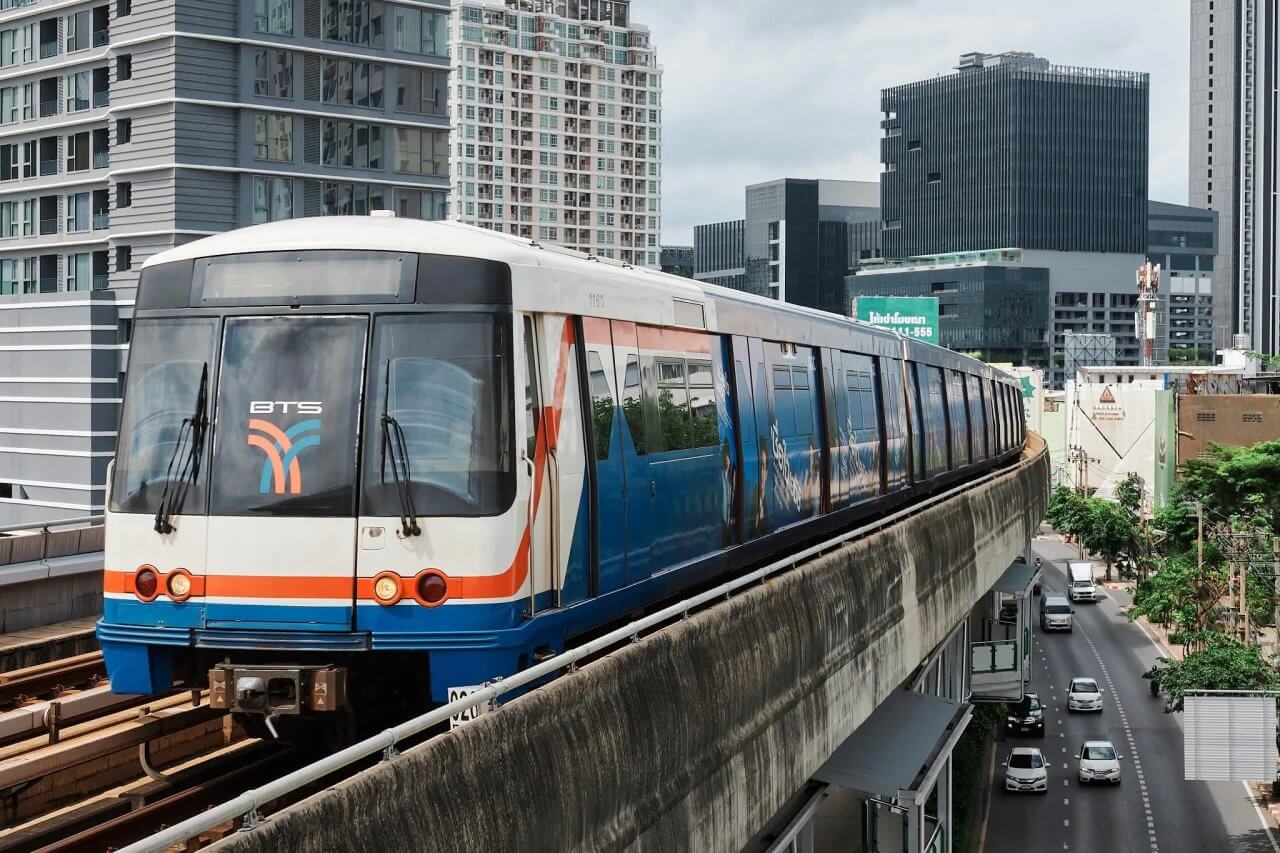
Managing Bangkok transport with children is straightforward once you understand the system’s structure and plan around the BTS/MRT.
For a complete guide to fares, routes, and how each transport mode handles family logistics, the getting around Bangkok with kids guide covers elevators at specific BTS stations, Grab car seat booking, and river ferry family routing in detail.
Airport Transfers with Car Seats
Bangkok’s standard metered taxis do not carry child car seats.
Options for arriving families:
- Airport Rail Link (Suvarnabhumi → Phaya Thai BTS): ฿45 per person, approximately 26 minutes. Children under 90 cm ride free. No car seat issue; suitable for families with older children who can sit independently and manageable luggage. Trains run from 5:30 AM to midnight daily.
- Pre-booked private transfer with car seat: Services through Klook, GetYourGuide, and hotel concierge arrange vehicle-with-car-seat for Suvarnabhumi and Don Mueang arrivals. Book ahead with specific child ages and car seat type requirements. Cost: approximately ฿1,500–3,000 for a 4–5 passenger vehicle to central Bangkok — prices vary by operator and whether a car seat is specifically requested; always confirm the car seat type and weight range when booking.
- AOT Official Limousine Service (Suvarnabhumi): Counter is located at the Arrivals Level (2nd floor); this is a walk-up service with no advance online booking. Car seat availability is not guaranteed and is not part of their standard offering — families requiring a car seat should use a pre-booked private transfer instead.
GrabFamily (a Grab option that includes a pre-installed car seat) is not currently available in Bangkok.
Standard GrabCar and GrabXL are widely used for airport runs, but neither provides car seats.
Thailand has a car seat law on the books, though it is not currently enforced; families are strongly advised to bring a portable travel car seat from home or arrange one through a specialist transfer service.
BTS Skytrain with Strollers
All BTS stations have elevators; the challenge is finding them — they’re not always at the main entrance.
Look for elevator symbols on station maps at ground level and follow the marked accessible routes.
Most are located toward the ends of platforms.
Practical tips:
- Board the first or last car: less crowded than the middle cars
- Off-peak hours (before 7:30 AM, 10 AM–4:30 PM, after 7:30 PM): significantly more manageable with a stroller and bags than peak commuting hours
- Rabbit cards (purchased at any BTS station) remove the need to handle cash per trip — load sufficient credit for your stay
- BTS is air-conditioned throughout; useful as a scheduled cool-down on hot days
MRT Blue Line stations are also elevator-equipped and serve Chatuchak, Chinatown (Hua Lamphong), and the connection to Sukhumvit (Asok interchange).
Taxis and Grab
Metered taxis: Start by confirming the meter is running before departure.
The flag fall is ฿40 for the first kilometer, then ฿6.50/km up to 10 km — a typical central Bangkok trip of 5–10 km runs ฿80–150 baht under normal traffic conditions.
Longer cross-city trips or rides during peak-hour gridlock can push closer to ฿200–250 once the waiting-time charge (฿3/minute when traffic drops below 6 km/h) kicks in.
Expect the driver not to have change for 1,000-baht notes — carry smaller bills.
Note: taxis hired from official airport queues at Suvarnabhumi or Don Mueang carry a legitimate ฿50 airport surcharge on top of the meter; expressway tolls (฿25–75 depending on route) are also paid separately by the passenger.
Grab: Fixed price confirmed before booking; eliminates negotiation and meter uncertainty.
Suitable for evening trips when carrying tired children and wanting confirmed transport home.
Larger vehicle types (GrabCar Plus, GrabVan) provide more space for families with strollers or multiple bags.
For travelling with newborns or infants requiring a car seat: arrange a pre-booked private transfer with a specific seat as the only reliable option in Bangkok.
River Boat Transport with Children
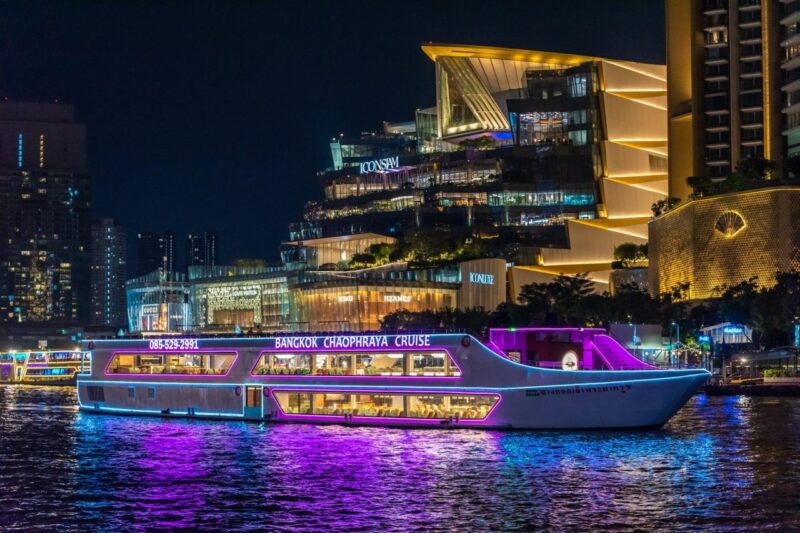
The Chao Phraya Express Boat serves key family-relevant stops: Saphan Taksin (Silom BTS interchange), Maharaj Pier (Wat Pho/Grand Palace), Phra Arthit Pier (Banglamphu/Khao San Road), and further north toward Nonthaburi.
Note that Oriental Pier (N1) is currently closed for renovation as of mid-2026 — plan alternative disembarkation points for the Charoen Krung/Mandarin Oriental area.
Children find the river boat journey itself engaging — a 20–30 minute boat ride to the temple area works as both transport and activity.
Life jackets for children are available on board and should be requested from the crew, particularly for young children.
The orange flag express boats run daily from 6:00 AM to 7:00 PM, roughly every 5–20 minutes depending on time of day, and now cost ฿19 per person flat rate (updated May 2026) — still among the best-value transport options in the city.
Private Driver Services
A private driver with car (typically ฿1,800–3,200 for an 8–10 hour day depending on vehicle type and whether fuel is included) eliminates all transport logistics: no stroller management on BTS, no language barrier, and flexibility to adjust the route when a child falls asleep.
For budget-conscious families, informal arrangements via driver networks run as low as ฿1,500/day, though a van large enough for a family of 4 with luggage and a stroller will sit closer to the upper end of that range.
For families with children under 4 who still nap in strollers or car seats, a private driver makes a day trip to Ayutthaya or a floating market tour significantly easier.
Hotel concierge, Klook, and GetYourGuide all arrange these services.
Top Family Attractions in Bangkok
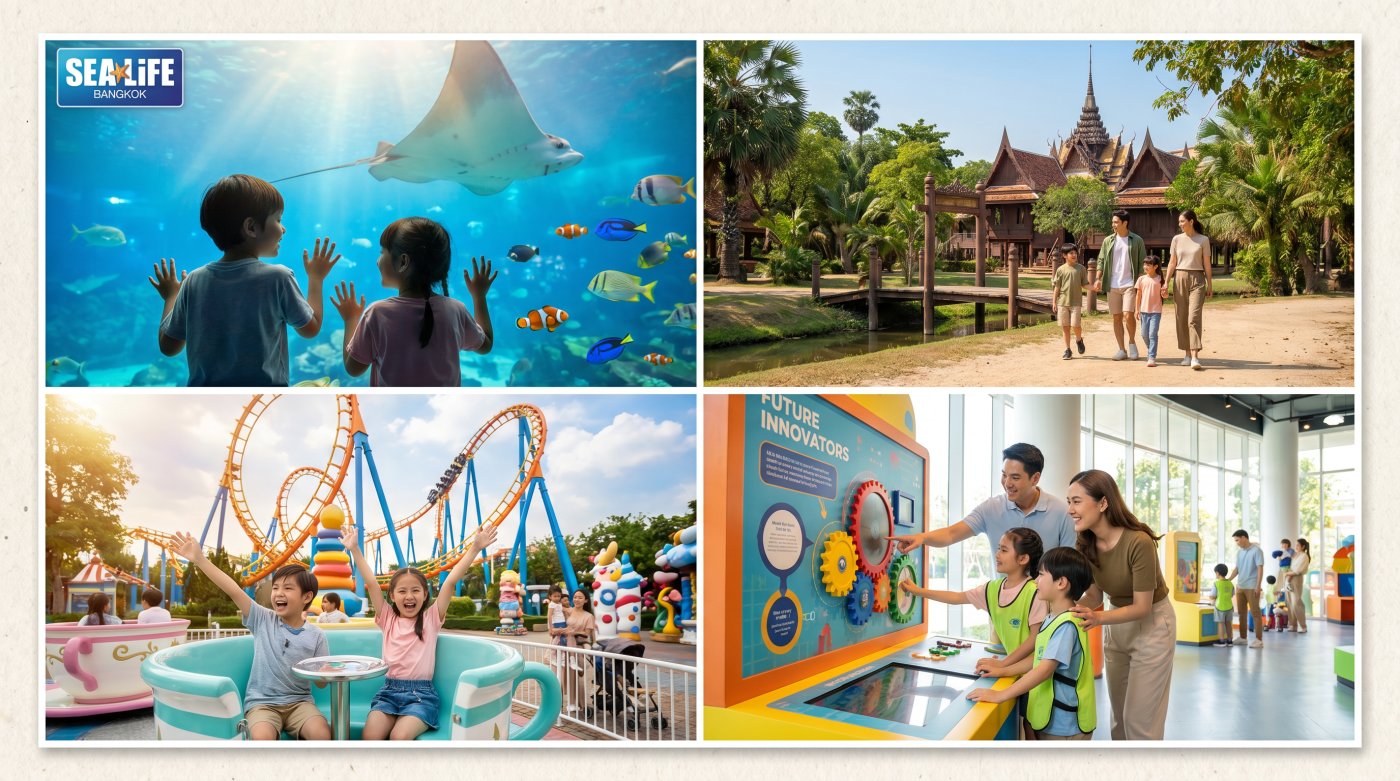
Bangkok’s family attractions divide into two categories: the city’s own dedicated family entertainment venues (Safari World, Dream World, SEA LIFE, KidZania) and its cultural sites (temples, the Grand Palace, Museum of Siam).
The former require no cultural context to enjoy; the latter benefit from brief preparation before visiting.
Safari World

Safari World is closed on Mondays — a detail worth confirming before scheduling a family day trip.
The park divides into two sections:
- Safari Park (drive-through): Families board shared open-top buses (or drive personal vehicles) through open habitats. Giraffes, zebras, oryx, ostriches, lions, tigers, and a wide range of bird species are the primary animals — giraffes in particular approach vehicles closely, and giraffe feeding is available from 9 AM to 4:30 PM on weekdays, 9 AM to 5 PM on weekends. This is the strongest feature — children encountering animals at vehicle-level in a drive-through format is genuinely different from a zoo visit.
- Marine Park: Sea lion and dolphin shows, a bird show, River Safari boat ride, and an orangutan show. The dolphin show runs at 10:00 AM and 2:10 PM; the sea lion show at 10:40 AM and 2:15 PM. The shows are professionally produced and age-appropriate for children. The orangutan show is optional entertainment that some families find uncomfortable from an animal welfare perspective.
Current ticket prices (walk-in counter): combined Safari Park + Marine Park entry runs approximately ฿1,500–1,800 per adult; children between 100–140 cm pay ฿350; children under 100 cm enter free.
Booking online in advance (via Klook, GetYourGuide, or the park’s own site) brings the combo down to around ฿950 per person — worth doing for a family of 4.
Safari World is located northeast of central Bangkok at 99 Panyaintra Road, Khlong Sam Wa — approximately 40–60 minutes by taxi from Sukhumvit depending on traffic (the road distance is 29 km).
Plan for a full day: Safari Park is open 9 AM–4:30 PM weekdays, 9 AM–5 PM weekends; Marine Park runs slightly later at 9 AM–5 PM weekdays, 9 AM–5:30 PM weekends.
Pack lunch or purchase at the park’s food courts; catering is adequate but standard theme-park pricing.
Arriving by 9–9:30 AM is strongly recommended to catch the first dolphin and sea lion shows before afternoon heat builds.
Dream World Amusement Park
Dream World spreads across four main themed zones, with Snow Town available as a separate add-on:
| Zone | Best for | Key attraction |
|---|---|---|
| Adventure Land | Ages 10+ | Hurricane roller coaster, Sky Coaster, thrill rides |
| Fantasy Land | Ages 4–10 | Family rides, Fantasy Lake boat ride, spinning attractions |
| Dream Gardens | All ages | Garden walks, paddle boats, scenic outdoor area |
| Dream World Plaza | Ages 3–8 | Kiddie rides, entry zone attractions |
| Snow Town (add-on) | All ages | Indoor snow experience; ice slides, snowball area — ticketed separately |
Snow Town is the genuine differentiator — Bangkok children treating artificial snow as a novelty while international visitors use it as air-conditioned relief is a reliably amusing 45–60 minute activity.
It is not included in the standard entry ticket and must be booked as a separate add-on or as part of a combo package.
It requires changing into provided warm clothing, which adds time.
Dream World is located in Thanyaburi, Pathum Thani, approximately 35–50 minutes north of central Bangkok by taxi (the road distance is about 39 km).
It is not directly on the BTS or MRT network, but the park operates a free shuttle bus from BTS Mo Chit station — a practical option for families not using a private transfer.
Shared transfers from central Bangkok via booking platforms (Klook, GetYourGuide) are also available from around ฿550 per person return.
Current ticket prices (walk-in):
- Super Visa (all-rides, unlimited): ฿1,100–1,200 per adult / ฿700 per child (under 145 cm or ages 4–12) / children under 90 cm enter free
- Snow Town add-on: purchased separately at the park or as part of an online combo package (total combo from around ฿1,150–1,500 per person online)
- A family of 4 (2 adults + 2 children) buying combo tickets online including Snow Town access typically runs ฿4,600–6,000 total
Opening hours: 9:30 AM–5:00 PM Monday to Friday; 9:30 AM–6:00 PM Saturday and Sunday.
Arrive at opening to complete the main thrill rides before early-afternoon crowds build up.
SEA LIFE Bangkok Ocean World
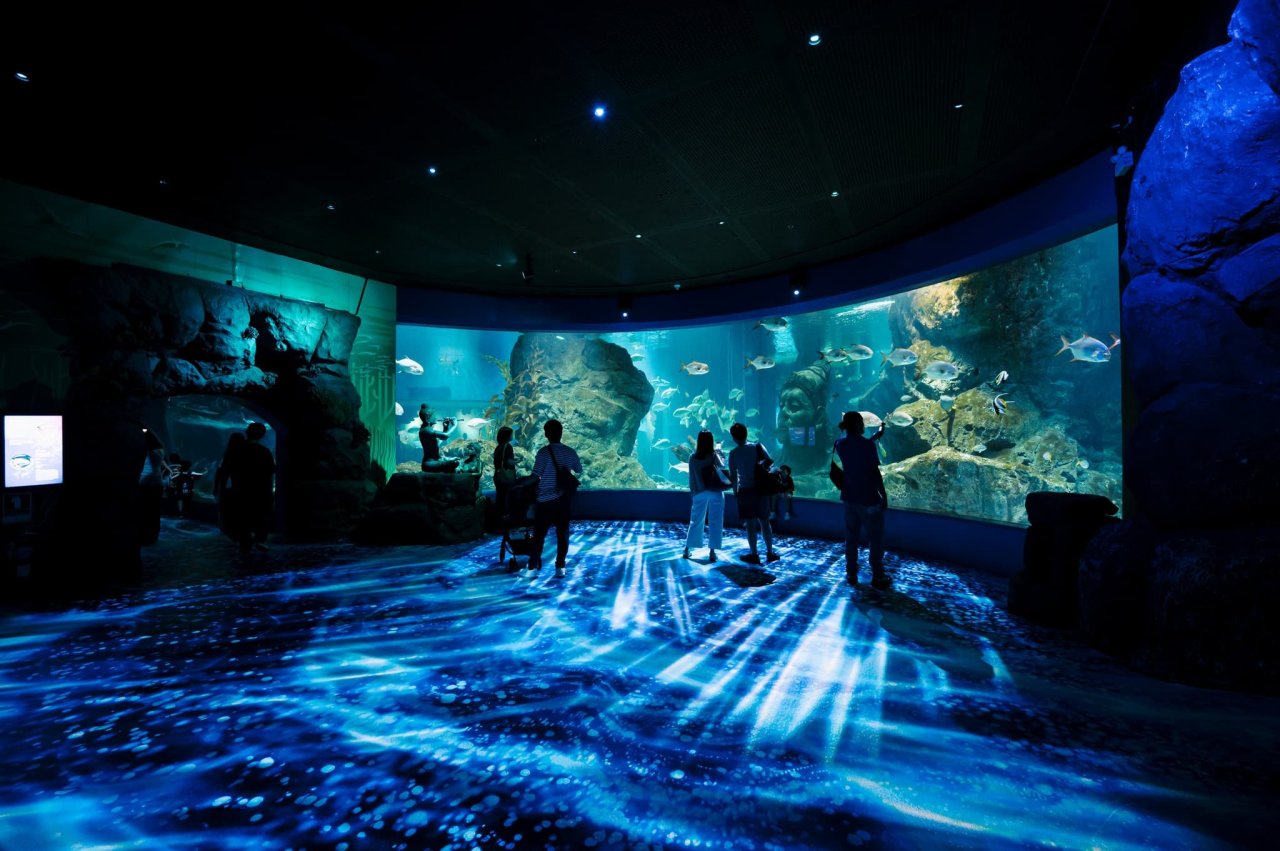
Located in the basement of Siam Paragon (direct connection to Siam BTS station), SEA LIFE Bangkok works as an afternoon activity that pairs well with shopping or a mall food court before or after.
No transport logistics beyond the BTS required — one of the easiest major attractions in the city to reach with a stroller or tired child.
Key experiences:
- Ocean tunnel: 270-degree wrap-around walk-through with sharks, rays, and large pelagic fish swimming overhead. This is the headline feature — children under 12 typically find it memorable.
- Touch pool: Supervised hands-on interaction with small marine animals (sea cucumbers, starfish, horseshoe crabs). Engaging for roughly the 4–12 age range before it becomes too basic.
- Glass-bottom boat: Short ride over the main shark tank — included in the Combo package ticket but charged as an add-on if purchasing a standard single entry ticket.
- 4D cinema: Short films with motion effects and light water spray; good for the 5–10 age range — also included in the Combo package, not standard single entry.
- Feed and talk shows: Daily sessions from 11:30 AM to 4:30 PM with penguins, rays, and sharks — free with all ticket types.
The aquarium houses over 30,000 marine creatures across more than 400 species, making it the largest aquarium in Southeast Asia.
Allow 2–3 hours for a thorough visit; 90 minutes for families with impatient older children.
Opening hours: 10:00 AM–8:00 PM daily (last entry 7:00 PM).
Current ticket prices (online booking — foreigners):
- Single Entry (online): from ฿799 per child (ages 2–11) / adults from approximately ฿1,199 online (walk-in counter prices are higher)
- Combo Package (entry + 4D cinema + glass-bottom boat + digital photo + Madame Tussauds Bangkok): from ฿1,190 per child / ฿1,599 per child walk-in
- Children aged 0–1 enter free
- Note: Thai residents and expats on resident visas pay approximately half the foreigner rate — bring a Thai ID or work permit if applicable
Online booking avoids the queue at the ticket desk during weekends and school holidays, and saves meaningfully versus walk-in pricing.
Museum of Siam
The Museum of Siam (MRT Sanam Chai, Exit 1; Rattanakosin area) approaches Thai identity and history through interactive exhibits, digital displays, and hands-on activities rather than static display cases.
Children in the 7–14 age range engage with it more readily than standard history museums because the format actively involves them.
Note that the museum is closed on Mondays — plan accordingly if your Rattanakosin day falls midweek.
The building is the former Ministry of Commerce — a handsome neoclassical structure dating from the early 20th century — and the exhibits wrap through the building’s interior in a logical narrative arc from ancient Southeast Asia to contemporary Thai identity.
Air-conditioned throughout.
Entry: ฿100 per adult; free for children under 15; ฿50 for students aged 15+ with a valid student ID.
Open Tuesday–Sunday, 10:00 AM–6:00 PM.
For a family of 4 with two children under 15, total entry runs just ฿200 — genuinely exceptional value compared to any commercial attraction in the city.
Activities for Children Under 5
Bangkok’s best options for toddlers and children under 5:
- Lumpini Park: Wide paved paths, lake with free paddle boats (duck-shaped boats; 20-minute sessions; life jackets provided), and open grass areas. Monitor lizards are regularly visible along the lake bank in the afternoon — a genuinely memorable free encounter for young children. The park is open 4:30 AM to 9:00 PM daily; free entry. Nearest MRT: Lumpini or Si Lom.
- Playmondo at CentralWorld (2nd Floor, CentralWorld; Siam/Chit Lom BTS): Air-conditioned indoor play center designed for ages 1–10; padded zones, climbing structures, and activity stations. Admission: ฿660 per child / ฿260 per accompanying adult for a 2.5-hour session; babies (non-walking) enter free. Open daily 10:00 AM–8:00 PM. Additional locations at Central EastVille and Central Ladprao for families staying in those areas.
- Hotel pool: Essentially necessary as a daily activity for this age range in Bangkok.
- Chatuchak Market pet section: Walk-through engagement for children who like animals; free; manageable even with strollers in the outer aisles. Note: animal welfare standards in this section are inconsistent — treat it as a browse rather than a destination activity.
Educational Attractions
For families prioritizing learning alongside entertainment:
- Jim Thompson House (National Stadium BTS, 5-minute walk; open daily 10:00 AM–5:00 PM, last guided tour at 5:00 PM): American silk merchant whose 1967 disappearance in Malaysia remains unresolved. The house complex — six traditional Thai teak houses assembled along the canal — demonstrates Thai domestic architecture at scale, and all visits are guided tours in English, Thai, French, Chinese, or Japanese. Entry: ฿250 per adult / ฿150 for ages 10–21 (ID required) / free for children under 10 accompanied by an adult. No reservation required; tickets purchased at the gate only.
- Grand Palace and Wat Pho: Cultural education at the highest-quality historical site in Bangkok; see Temple Visits section below.
- Museum of Siam / National Museum: More traditional museum format; better for children 10+.
Indoor Entertainment for Hot or Rainy Days
| Option | Age range | Location | Notes |
|---|---|---|---|
| KidZania Bangkok | 4–16 | Siam Paragon | Career role-play city; requires several hours |
| SEA LIFE Bangkok | All ages | Siam Paragon | 2–3 hours |
| Dream World Snow Town | All ages | North Bangkok | Requires full-day trip |
| Cinema (SF/Major Cineplex) | 5+ | Major malls | English audio; Thai subtitles standard |
| Timezone / gaming arcades | 6+ | Major malls | Variable; controlled spend important |
| Funarium | 3–12 | Ratchayothin | Multi-level play center; suburban location |
Outdoor Adventures and Parks in Bangkok
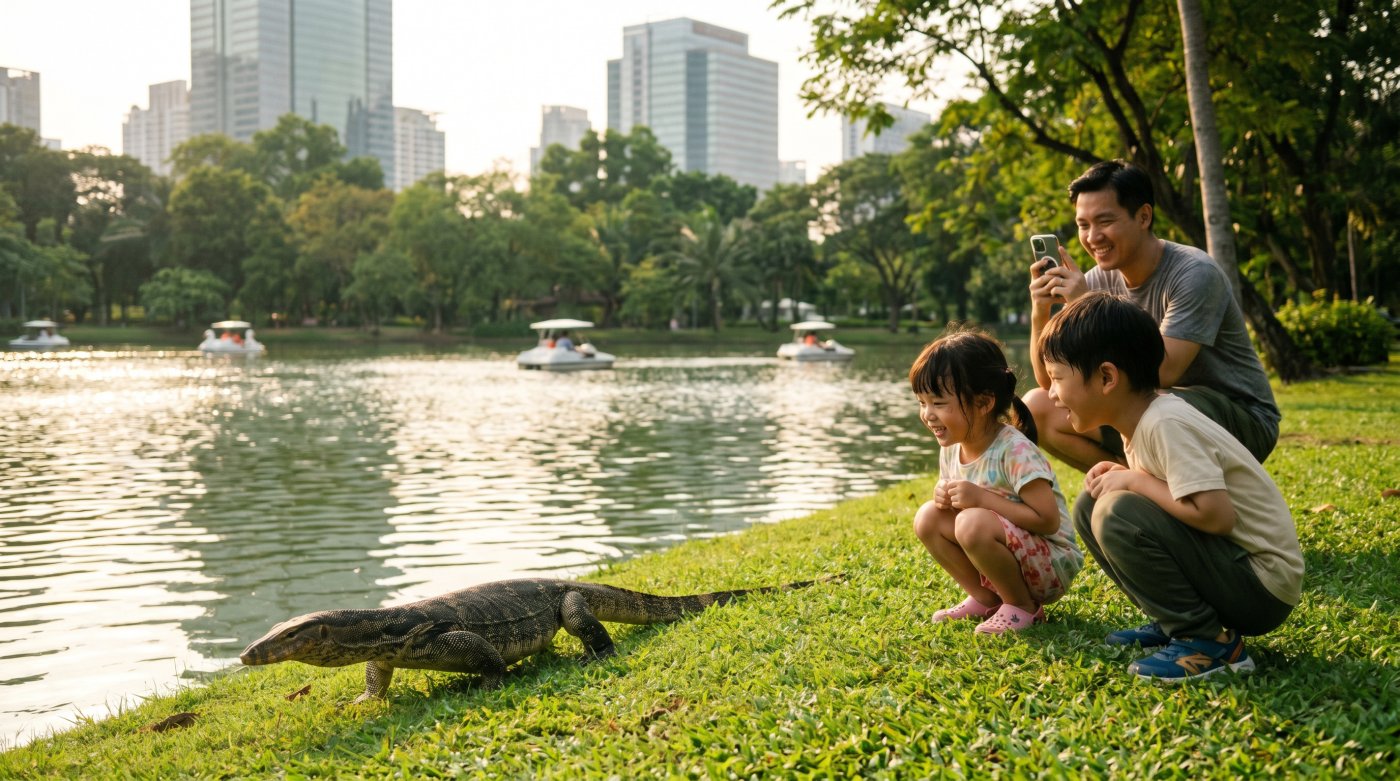
Bangkok’s parks and outdoor spaces are genuine assets for families staying in the city for more than a few days.
They provide paced outdoor time without cultural obligations and serve as a reset between more structured activities.
The free family activities in Bangkok guide covers parks, free temple entry, and zero-cost activities in detail.
Lumpini Park
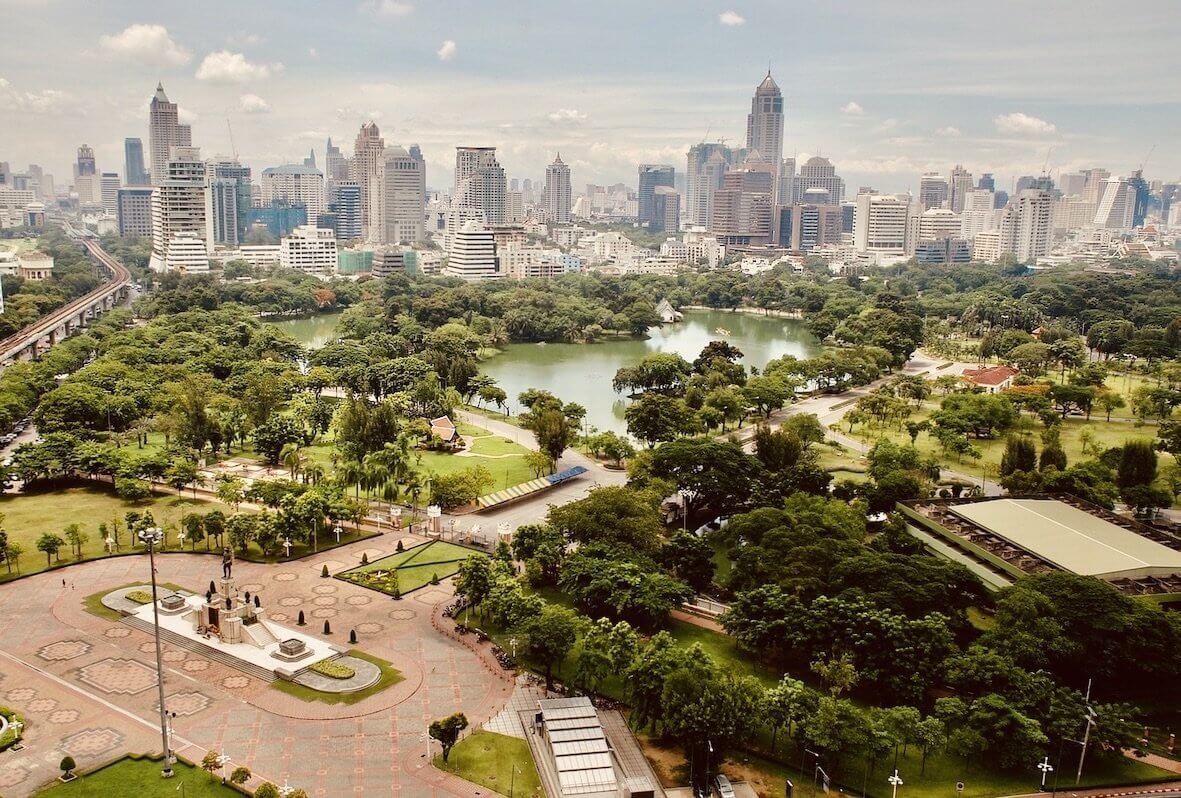
Open 4:30 AM–9:00 PM daily; free entry.
The park’s best family features:
- Paddle boats on the central lake: free (duck-shaped boats, 20-minute sessions, life jackets provided); gentle enough for young children and consistently popular with toddlers
- Playground equipment: standard swings and climbing structures, with open grass areas adjacent — useful for burning energy before or after a BTS-heavy day
- Monitor lizards: visible in the afternoon near the lake edge; 1–2 meter wild Nile monitor lizards that Bangkok residents largely ignore but children consistently find remarkable — keep a respectful distance and do not feed them
- Morning exercise culture (6:00–8:00 AM): organized aerobics and tai chi groups provide ambient entertainment and genuine context for everyday local life
Located at Silom/Sathorn; MRT Lumpini (Exit 3) or MRT Si Lom (Exit 2) both provide direct access within a short walk.
Chatuchak Park
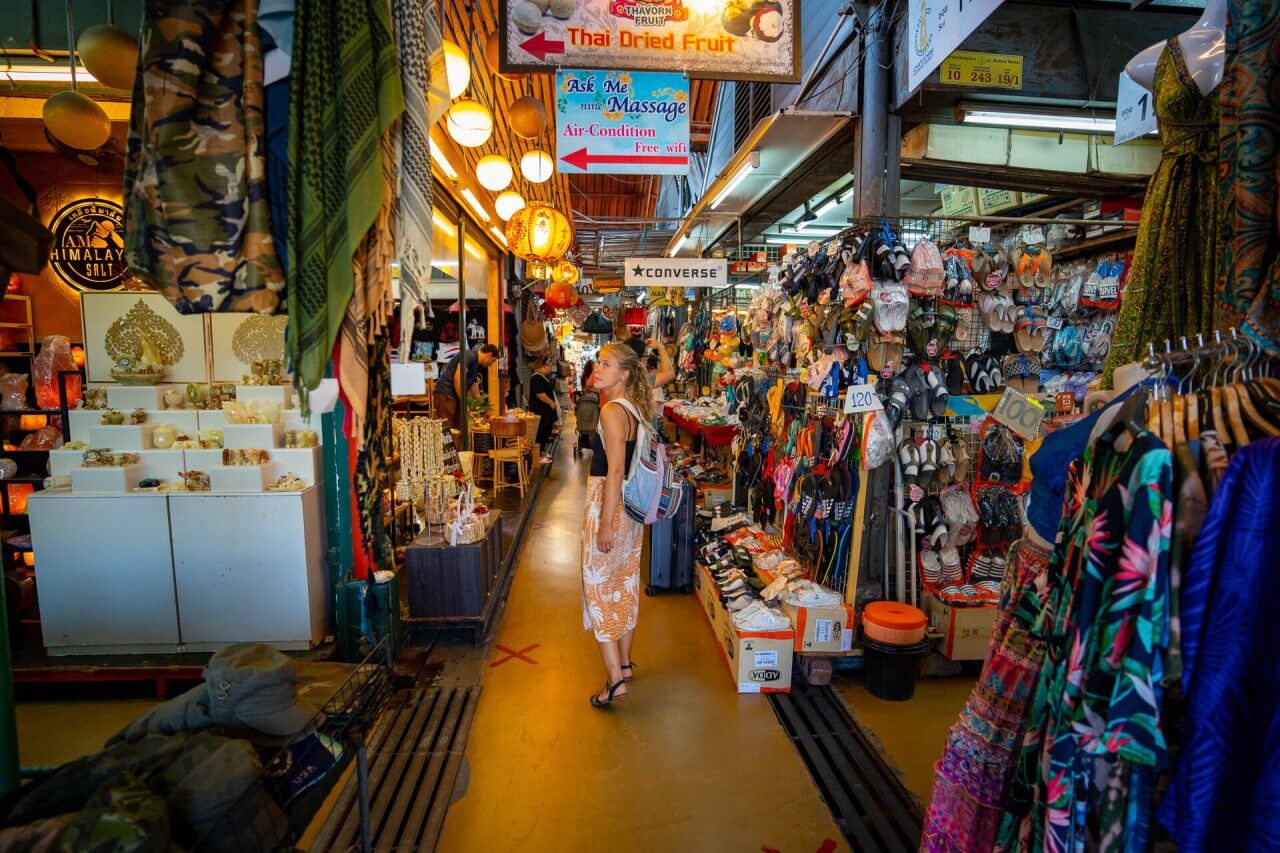
The open green area adjacent to the weekend market provides the most useful combination: post-market recovery space with clean facilities, shaded pavilions, and more elaborate playground equipment than most central Bangkok parks.
Children who have been walked through the market for 3 hours need a park.
This one is there.
Open daily; free entry.
Mo Chit BTS and Chatuchak Park MRT both give direct access.
Benjakitti Forest Park
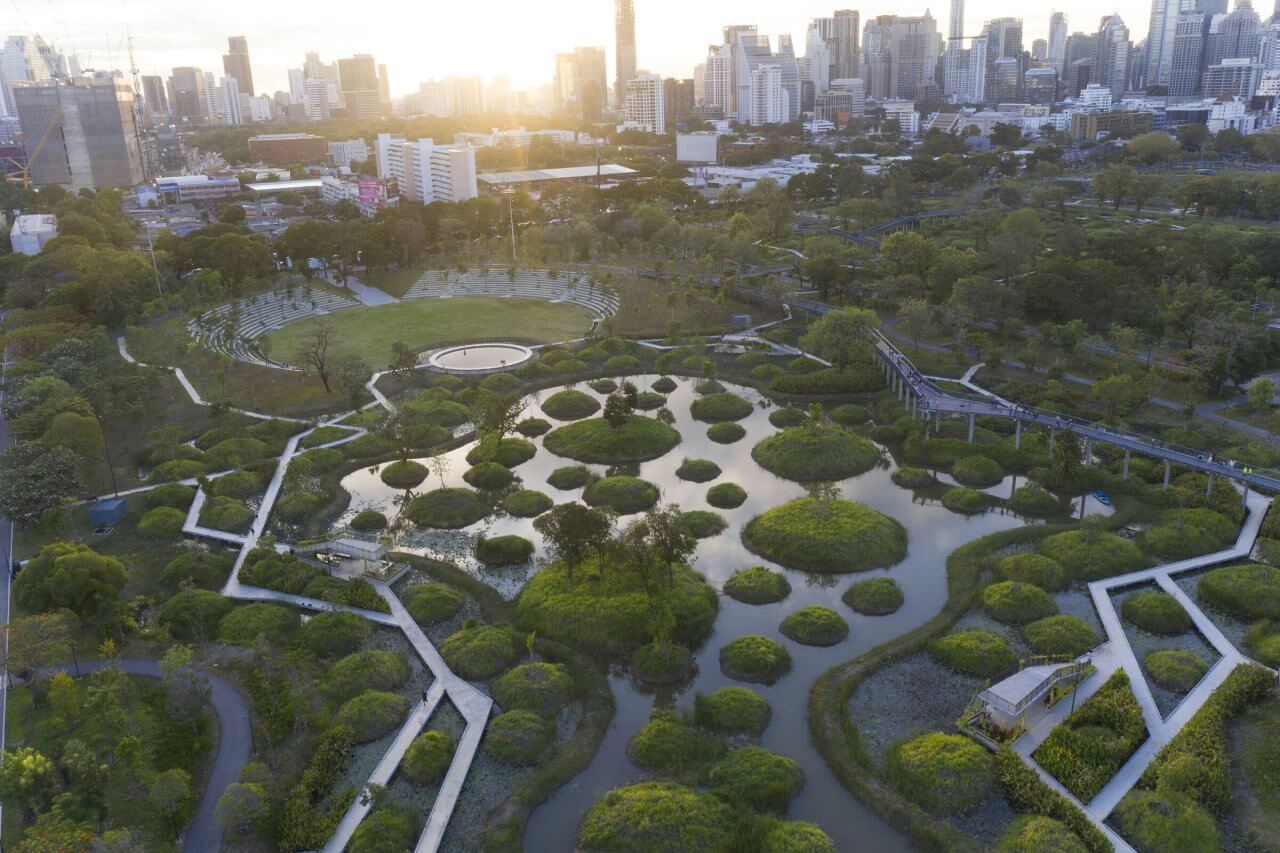
Open daily 5:00 AM–9:00 PM; free entry. Lake-centered park in the Sukhumvit area, now significantly expanded as Benjakitti Forest Park with elevated skywalks, wetland boardwalks, and native forest zones added to the original lakeside circuit.
The 2 km flat cycling path around Lake Rajada is separated from walking and jogging tracks, making it appropriate for children learning to cycle or for family cycling with younger children on attached seats.
Bicycle hire is available through Bangkok Forest Cycling (located at Sethiwan Palace, approximately 3 minutes’ walk from the park entrance): ฿350/2 hrs for a city bike; ฿250/2 hrs for a kids’ bike; ฿550/half-day and ฿350/half-day respectively.
Helmets included.
Rental shop opens 8:00 AM–5:00 PM; closed Tuesdays.
A valid ID or passport is required as deposit.
Walk-in rentals are available but advance booking via their website is recommended on weekends.
Evening hours (5:00–9:00 PM) are the most popular: the park lights up along the skywalks and boardwalks, the temperature drops, and a lively local crowd makes it one of the more genuinely pleasant free evening activities in central Bangkok.
Nearest MRT: Queen Sirikit National Convention Centre (QSNCC), Exit 3 — directly at the park edge.
From Asok BTS, allow a 10–15 minute walk or transfer one stop on the MRT to QSNCC.
King Rama IX Park
Bangkok’s largest park (Suan Luang Rama IX), located in the outer east of the city in Prawet District.
Now accessible via the MRT Yellow Line — alight at Suan Luang Rama IX Station, near Seacon Square shopping mall; the park entrance is a short walk from the station exit.
This makes it considerably more practical than it was before the Yellow Line opened, though it still suits families with half a day to spend rather than a quick BTS-trip park visit.
Open daily 5:00 AM–7:00 PM. Entry: ฿10 per person.
Highlights include botanical gardens, a large lake with duck paddle boats (฿100/boat), a garden tour bus (฿10/person) covering the park’s full 200-acre circuit, cycling paths, and open grass areas for children to run freely.
Best visited early morning or late afternoon; midday heat in this largely open park is significant March–October.
Water Play in Bangkok’s Parks
Several Bangkok parks have spray fountains and splash areas — most useful from March through October when heat makes standard playground equipment uncomfortable.
Benjakitti Forest Park has water features along its newer boardwalk zones, and some sections of Chatuchak Park have seasonal spray areas.
However, water features in Bangkok’s public parks operate on variable maintenance schedules and are not always active.
Confirm current status with your hotel or check the park’s social media before making it a primary plan — this is genuinely unpredictable and worth a quick check the day before.
Cultural Experiences and Temple Visits in Bangkok
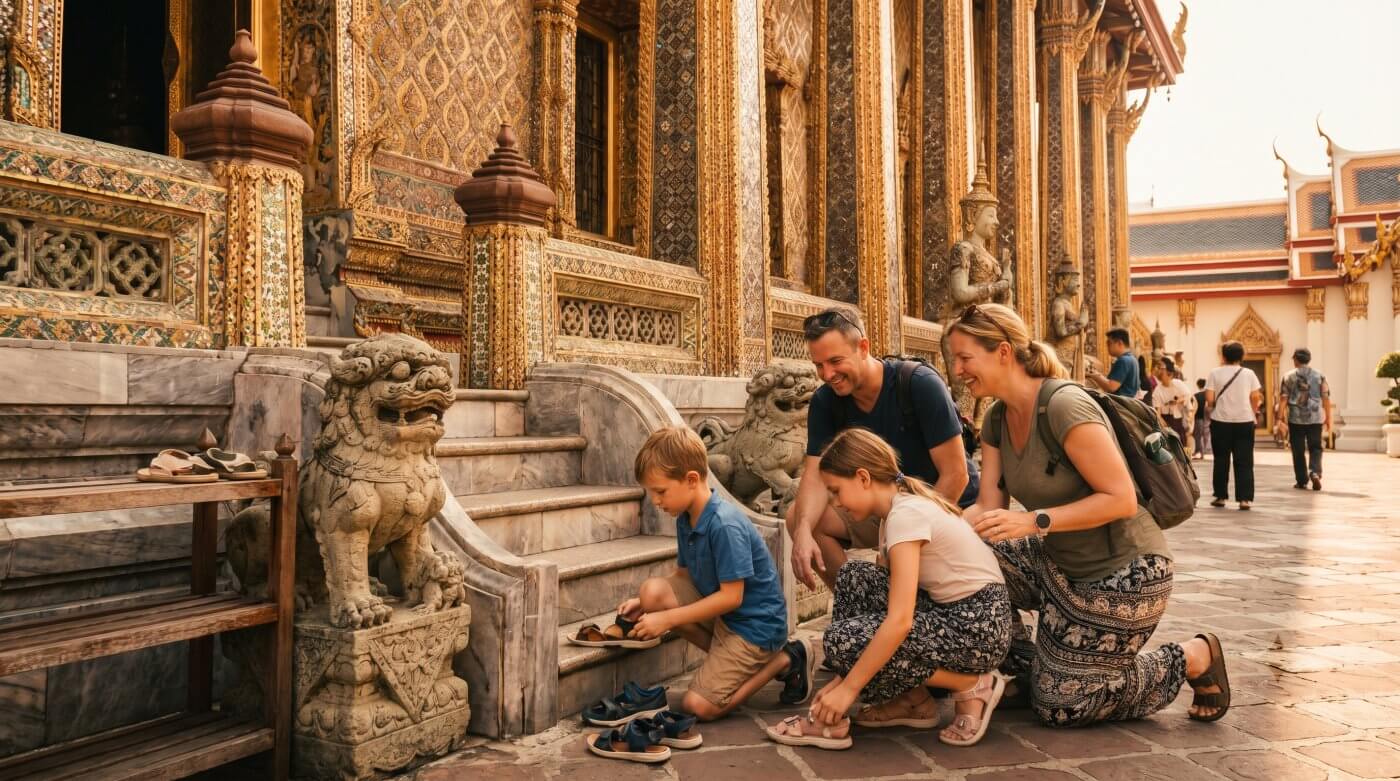
Temples work better as family activities than they might appear on paper, but they require specific preparation.
The main challenges are dress code compliance (easier with advance planning than improvised at the entrance), heat management at outdoor sites, and children’s attention at purely architectural sites versus interactive ones.
Temple Etiquette with Children
The rules are consistent across Bangkok’s temples:
- Shoulders and knees covered for everyone, including children. Light linen or cotton trousers and a loose short-sleeved top work for children year-round.
- Shoes removed before entering temple buildings. Many parents turn this into a practical sequence: shoes off, hands cleaned, enter.
- Voices kept low inside prayer halls and near monks.
- No pointing at Buddha images or monks.
- Photography generally permitted in temple grounds and courtyards; check for signage in prayer halls.
Most Bangkok temple entrances have scarves and sarongs for hire or purchase if family members arrive insufficiently covered.
Having children involved in dressing appropriately (choosing a sarong color, tying it on) before entering tends to reduce resistance to the dress code.
Wat Pho Temple Complex
Wat Pho is the most family-accessible of Bangkok’s major temple complexes.
Open daily 8:00 AM–6:30 PM.
The massage school pavilions close at 6:00 PM.
- Reclining Buddha: 46 meters long and 15 meters high, gold-plated with mother-of-pearl inlaid feet depicting the 108 auspicious signs of the Buddha. Visible from the entrance to the building and immediately understandable as a remarkable object to children — scale does the work without explanation.
- Courtyards and chedis: Dozens of colored ceramic-inlaid spired towers that children find visually engaging; spacious enough to walk without congestion.
- Traditional massage school on-site: An adult activity (Thai massage: ฿340/30 min; ฿520/1 hour) that older children can observe; interesting as a cultural reference point.
- Multiple entrances and good shade: The complex doesn’t require a linear circuit; families can take their own pace.
Entry: ฿300 per person (foreigners); free for Thai citizens; free for children under 120 cm. The ticket includes a complimentary bottle of water, collectible at a kiosk inside.
Cash only at the ticket counter.
Wat Pho is directly accessible from Tha Tien pier (Chao Phraya Express Boat, ~5-minute walk) and a 5-minute walk from Sanam Chai MRT (Exit 1).
Wat Traimit (Golden Buddha)
Located in Chinatown, Wat Traimit houses the world’s largest solid gold Buddha statue — 5.5 tonnes of solid 18-karat gold, standing approximately 3 meters tall, discovered in the 1950s when its plaster covering cracked during a move [the plaster was applied centuries earlier, believed to conceal it from invaders or thieves].
The story holds well for children aged 7+: a gold statue hidden under plaster for centuries to protect it from invaders, accidentally revealed when it cracked during relocation.
The on-site museum covers both the statue’s history and the broader history of Bangkok’s Chinatown.
Entry: ฿100 for the Golden Buddha exhibit / ฿100 for the Chinatown history museum (separate tickets); open daily 8:00 AM–5:00 PM; museum closed Mondays.
Nearest MRT: Wat Mangkon (MRT Blue Line) — closer than Hua Lamphong and opened in 2019, making it the more practical option.
Practical note: combining Wat Traimit with a Chinatown street food walk in the late afternoon works well as a combined cultural and food activity.
Grand Palace
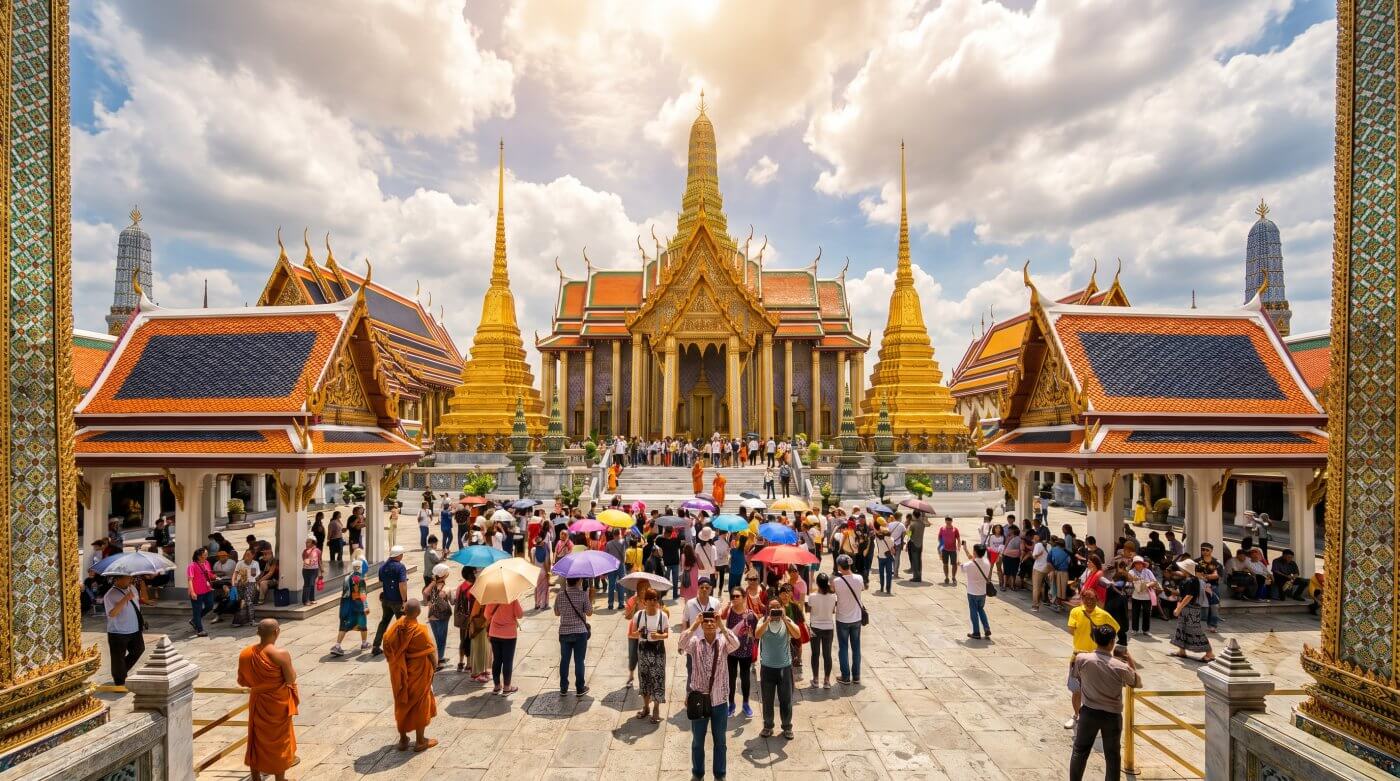
The Grand Palace is Bangkok’s most-visited cultural site and requires specific family planning.
Open daily 8:30 AM–3:30 PM (ticket sales close at 3:30 PM; the complex itself closes at 4:30 PM).
Enter via Mani Nopparat Gate — the entrance was moved from the old Visetchaisri Gate in January 2024, and many older guides still list the wrong gate.
- Entry fee: ฿500 per adult; free for children under 120 cm. The ticket covers Wat Phra Kaew (Temple of the Emerald Buddha), the Queen Sirikit Museum of Textiles, and selected palace buildings — good value for what’s included. Tickets can be purchased online up to one month in advance via the official Grand Palace website, which also lets you skip the walk-in queue.
- Heat exposure: The main Wat Phra Kaew courtyard is fully exposed to direct sun with limited shade. Morning visits (arrive by 8:30–9:00 AM at opening) are significantly more comfortable than midday. Avoid 10:00 AM–2:00 PM during hot season.
- Size: The complex takes 2–4 hours for a thorough visit; budget 2–3 hours minimum for the palace and Wat Phra Kaew. Toddlers will need carrying for some or all of it.
- Crowds: Weekdays before 10:00 AM are the best timing. Weekends and Chinese New Year periods are very crowded.
- Guided family tours: Audio guides are available; a family-oriented guided tour of the Wat Phra Kaew section specifically is worth considering — the stories about the Emerald Buddha’s three seasonal costume changes (changed by the King himself) engage children who would otherwise simply see “another temple.” Khon masked dance performances (traditional Thai court dance) run Monday–Friday at 1:00 PM, 2:30 PM, and 4:00 PM at Sala Chalermkrung nearby — a worthwhile 25-minute add-on for children aged 6+.
- Dress code: Strictly enforced — shoulders and knees must be covered for all visitors including children. No sleeveless tops, shorts, or ripped jeans. Sarongs available for loan at the gate.
The Emerald Buddha — despite its name, carved from a single piece of green jade rather than emerald — is a small figure seated high above the altar.
Children often expect it to be large; adjust expectations before entering.
Its gold and diamond seasonal robes are changed three times a year according to Thailand’s seasons.
Bangkok History for Children
Effective ways to make Bangkok’s history engaging for children:
- Jim Thompson House: The disappearance mystery; the collection of Asian antiques; the canal-side setting. Engages children who like mystery narratives.
- National Museum: More traditional format but interactive sections exist; best for 10+.
- Ancient City (Muang Boran): Full-scale replicas of Thailand’s significant temples and monuments in an outdoor park 33km from Bangkok. See Day Trips section.
Traditional Thai Dance Performances
| Venue | Show times | Duration | Kid-friendliness |
|---|---|---|---|
| Permanently closed (2021) | — | No longer available; Siam Niramit Phuket remains open | |
| National Theatre (Rattanakosin) | Occasional weekend afternoon performances — check current schedule at the Fine Arts Department website before visiting | ~60–90 minutes | Better suited to children 10+; scheduling is irregular |
| Sala Rim Naam (Mandarin Oriental) | Dinner from 7:00 PM; performances 7:30–9:30 PM, Wednesday–Sunday only | ~90 minutes (ongoing during dinner) | High-quality; dinner format means children need to be comfortable at a formal table for 2+ hours; suits families with children 8+ |
Traditional Thai classical dance performances involve elaborate costumes, stylized gesture language, and dramatic stories from the Ramakien (Thai version of the Ramayana).
Children who engage with theatrical narrative typically find them interesting; those who don’t may not last the full performance. Sala Rim Naam set dinner: ฿2,800/person (4-course) or ฿3,400/person (5-course)
, plus 10% service charge and government tax — a significant cost for a family of 4; plan accordingly.
Shorter cultural dance offerings are also visible for free at the Erawan Shrine (Chit Lom BTS) when devotees commission performances for religious purposes — not scheduled, but available to observe on any given day.
Hands-On Cultural Activities
Activities that produce a tangible result children can take home:
- Thai cooking classes designed for families: Hands-on, supervised, typically 3–4 dishes over 3–4 hours. Tourist-oriented family cooking classes run ฿1,500–2,500 per person; dedicated children’s cooking schools (for ages 2–12) offering single-session classes are also available across Bangkok and cost ฿500–1,200 per child per session. Classes with a morning market visit component add 30–60 minutes but provide a genuine food-sourcing context. Book dedicated family or children’s classes rather than adult classes with child participation — the pacing and supervision differ significantly.
- Silk painting / Thai craft workshops: Available through several cultural centers, some upscale hotels, and market venues including the BACC (Bangkok Art and Culture Centre, Siam BTS). Prices and availability vary by session; hotel concierge can arrange introductory sessions for ฿600–1,500 per person.
- Pottery workshops: Less common in Bangkok than Chiang Mai, but available through select cultural centers and craft studios in the Ari and Thonglor neighborhoods. Expect ฿800–1,500 per person for a 2-hour session; search current listings via Airbnb Experiences or Klook.
Terminal 21
Each floor represents a different global city — from the Caribbean in the basement up through Rome, Paris, Tokyo, Istanbul, London, San Francisco, and Hollywood across nine floors.
The themed decor (matched to each floor’s public bathrooms, signage, and architecture) functions as a free activity for children who engage with the concept — escalators between “countries” and photo opportunities throughout.
The Hollywood floor at the top houses the cinema.
Pier 21 Food Court (5th floor, San Francisco level) is one of Bangkok’s best-value food courts: cashless prepaid card system (load cash onto a card at kiosks near the entrance; unused balance refundable), broad Thai and Asian selection, all English menus, and free filtered water stations.
Individual main dishes run ฿27–80 per item — pad thai, stir-fries, soups, grilled meats, fresh fruit, and desserts are all in that range.
A family of 4 eating 2–3 dishes each comfortably comes to ฿300–500 total.
Each person should get their own card to speed up ordering.
Open 10:00 AM–10:00 PM daily.
Terminal 21 sits at Asok BTS/Sukhumvit MRT interchange — the most transit-accessible major mall in Bangkok, with direct covered walkway connections to both train systems.
Siam Paragon
Siam Paragon contains SEA LIFE Bangkok in the basement, KidZania on the upper floors, a 16-screen cinema complex, and a vast food hall (Gourmet Market) in the basement adjacent to the aquarium.
A Siam Paragon family day can involve multiple distinct activities without leaving the building.
The Gourmet Market’s prepared food section and food hall provide reliable quality and menu variety for picky eaters — more expensive than street food but with English labeling and staff who can discuss ingredients.
MBK Center
Eight floors of merchandise including electronics, mobile accessories, fashion, and toy stalls.
The format is semi-wholesale market within a mall structure: individual stalls rather than brand stores, prices negotiable, mix of genuine and counterfeit merchandise.
For families: the ground-level food courts offer extremely low-priced Thai food; the electronics floors are genuinely interesting for tweens and teens; the toy and game sections provide souvenir options.
Cash preferred by most vendors; ATMs throughout the building.
Chatuchak Weekend Market — Family Sections
Chatuchak on Saturday or Sunday (opens 6 AM, peak 10 AM–noon, closes 6 PM) includes sections that work well for families with children:
- Food vendors through the main sections serving local breakfast dishes
- A plant section (Wednesday and Thursday only for plants; weekend visitors can still browse) that children who like nature find interesting
- A pets section — tortoises, rabbits, unusual birds, aquarium fish; a walk-through engagement for children who like animals (note: animal welfare standards in this section are inconsistent — treat it as a browse rather than a dedicated activity)
- Arts and craft sections in the northern area
With children under 8, the perimeter areas and Chatuchak Park adjacent to the market provide the most manageable experience.
The interior market passages are narrow and crowded after 10 AM on weekends.
An early arrival and perimeter-focused visit is more comfortable than attempting to cover the full 15,000+ stalls across 35 acres with young children.
Nearest transit: BTS Mo Chit or MRT Chatuchak Park / Kamphaeng Phet — all with direct exits to the market.
Bangkok Malls and Children’s Entertainment
KidZania Bangkok (5th Floor, Siam Paragon; Siam BTS) operates a detailed role-play city where children aged 4–14 perform jobs, earn KidZos (the internal currency), and spend within the KidZania economy.
Plan 3–5 hours minimum — most children want to stay longer.
Open Monday–Friday 10:00 AM–5:00 PM; Saturday–Sunday and public holidays 10:30 AM–8:30 PM.
Advance booking is strongly recommended on weekends and Thai school holidays.
Current ticket prices:
- Weekdays: Children (ages 4–14) ฿750–850; Adults (15+) ฿350–450; Toddlers (ages 2–3) ฿550–650; under 2 free
- Weekends/public holidays: Children ฿950–1,350; Adults ฿450–550
The Rink at CentralWorld (2nd Floor, CentralWorld; Chit Lom BTS, Exit 3, 5-minute walk) is Bangkok’s largest indoor ice rink — confirmed operational.
Sessions run approximately 90 minutes; entry includes skate rental and helmet.
Cost: ฿200–260 per person per session, with a penguin/seal skating aid available to rent for young beginners (฿100–200).
A practical cooling-off activity for families with children who have never skated; manage expectations on ice quality as this is a mall rink, not a dedicated arena.
Open 10:30 AM–7:15 PM daily.
Can Children Eat Safely from Bangkok’s Street Food Stalls?
Yes, with specific selection criteria. Choose stalls with a local queue of regular customers, watch food cooked from raw to finished, and avoid shellfish and pre-cooked items sitting at room temperature during midday heat. These three criteria address 90% of the food hygiene risk at street stalls.
Street Food Safety in Practice
Bangkok’s street food is the food that Bangkok’s population eats daily.
The risk is not generalized across all street food — it concentrates at specific risk points: raw preparations, low-turnover stalls, and food held at room temperature for extended periods in the heat.
Child-safe street food approach:
- Grilled items on skewers (satay, sai ua, moo ping): freshly cooked to order, immediately served; low risk
- Noodle soups (boat noodles, kuay tiew): broth maintained at near-boiling; noodles added fresh per order
- Pad thai and rice dishes: watch them cook per order; common, familiar enough for most children
- Pre-cut fruit from sealed bags: safe; avoid pre-cut fruit on open display in heat without refrigeration
Items worth avoiding with children: raw shellfish, som tam with raw fermented crab (poo plaa raa), pre-cooked meats in glass display cases that have been sitting since early morning.
Ice: manufactured ice (the type with a hole through the center, called “tube ice”) is food-grade.
Random ice blocks are higher risk.
Most street food vendors and all 7-Eleven convenience stores use manufactured ice.
Water: bottled water only.
Not tap water, not ice of uncertain origin.
This rule applies to brushing teeth in most Bangkok hotels as well — use bottled or filtered water.
Restaurants with Child Facilities
Practical family-friendly restaurant contexts in Bangkok:
| Venue type | What works | What doesn’t |
|---|---|---|
| Mall food courts (Terminal 21, Siam Paragon) | High chairs; multiple cuisine options; familiar choices alongside Thai | Can be crowded on weekends |
| Hotel restaurants | Reliable quality; high chairs; kids’ menus at family hotels | Expensive by Bangkok standards |
| Local family restaurants near parks | Typically equipped for Thai families; high chairs common | Menu may be Thai-language only |
| Tourist-facing restaurants near Grand Palace or Khao San | English menus; tourist-adjusted spice levels | Price premium; food quality variable |
International Options for Picky Eaters
Bangkok’s shopping malls contain every international food chain: McDonald’s, KFC, Pizza Company (Thai-owned; reliably cheese-forward), Yoshinoya, MOS Burger, and Swensen’s (ice cream chain with Thai flavors).
These are genuinely useful if a child has rejected Thai food and needs a meal before the next activity rather than a family negotiation.
Japanese family restaurants (karaage sets, onigiri, miso soup, plain rice) and Indian restaurants (naan, mild curries) often bridge the gap for children who are cautious about Thai spice levels but open to other Asian food.
Food Allergies and Dietary Needs
Peanuts, fish sauce, and shrimp paste are used broadly in Thai cooking, including in dishes where they might not be obvious.
For children with nut or shellfish allergies, mid-range restaurants and hotel restaurants where staff can communicate directly about ingredients are the most reliable option.
Street food preparation typically uses communal equipment and shared ingredients; cross-contamination risk is real.
Useful Thai phrases:
- “แพ้ถั่ว” (phaae thua) — allergic to peanuts
- “ไม่ใส่น้ำปลา” (mai sai naam pla) — no fish sauce
- “ไม่เผ็ด” (mai phet) — not spicy
Allergy translation cards in Thai are available through apps like SelectWisely and printable from several allergy travel websites.
Cooking Classes for Families
Family cooking classes (3–4 hours, market visit + cooking session + eating) are among the most reliably positive Bangkok family activities because they’re participatory, air-conditioned for the cooking portion, and produce an immediate result that children eat.
Current prices for tourist-oriented family cooking classes with a market visit component run ฿1,300–1,800 per person for group classes; private family-format classes run closer to ฿2,000–2,500 per person.
The best classes are small-group, home-kitchen format rather than hotel kitchen operations.
Dedicated family cooking classes accepting children aged 6+ are available from around $38–46 USD per person — book ahead as family-format sessions fill faster than standard adult classes.
What Are the Best Day Trips from Bangkok for Families?
The Ancient City (Muang Boran) is the most practical for younger children — full-scale replicas of Thailand’s most important historical sites across 200 acres, 33 km from Bangkok. Elephant sanctuaries offer ethical wildlife encounters. Floating market boat tours work well for children who engage with water and boat travel.
Ancient City (Muang Boran):
- Location: Samut Prakan, approximately 30 km southeast of Bangkok; accessible by MRT Yellow Line to Samrong station then taxi/Grab (20 minutes), or by private transfer
- Entry: ฿700 per adult / ฿350 per child (ages 6–14) for foreigners; under 6 free; Thai residents pay half price. Klook tickets available at significantly reduced rates (~฿350/adult) — worth checking before buying at the counter
- Hours: Daily 9:00 AM–7:00 PM (last entry 6:00 PM)
- Transport within: Electric cart, bicycle, and tram tours available at extra cost — a cart is recommended with children under 8 given the site’s scale
Floating Market Tours (Damnoen Saduak / Amphawa):
- No entry fee to the markets themselves; boat tours run ฿300–400 per person at the market (negotiate from higher opening prices)
- Pre-booked guided tours from Bangkok including transfers and a boat tour: ฿1,049–1,399 per person — recommended for families to avoid logistics of getting to a market 100 km from Bangkok independently
- Best timing: arrive by 8:00–9:00 AM — market activity winds down after 11:00 AM at Damnoen Saduak; Amphawa is primarily an evening/weekend market better for older children
For a full overview of logistics, costs, and what each destination delivers, see family-friendly day trips from Bangkok.
Ancient City (Muang Boran)
Muang Boran is a 320-hectare (approximately 800-acre) outdoor museum — shaped like the map of Thailand itself — containing over 116 structures including full-scale replicas and restorations of Thailand’s most significant temples, palaces, and monuments.
Families can walk, rent bicycles (included in the ticket price), hire golf carts, or take the guided tram between the sites, which are spread across landscaped grounds and positioned geographically according to where they appear in Thailand.
Why it works for families:
- Children can move around freely without the constraints of active sacred spaces
- Scale replicas of temples and palaces children will encounter in Bangkok (Grand Palace, Wat Pho, Wat Phra Kaew) create a useful comparison point
- The park format means there’s no wrong pace or direction
- Golf cart hire is available for families with smaller children: ฿350 for the first hour / ฿200 per additional hour for a 4-seater
Located in Samut Prakan Province, approximately 30 km southeast of Bangkok.
Access options:
- BTS Skytrain to Kheha Station (E23), then taxi or songthaew to the entrance — approximately 5 minutes and ฿80–100 from the station exit. On Saturdays and Sundays, a free shuttle runs between Kheha Station and the park entrance.
- Private transfer from central Bangkok: approximately 45–60 minutes depending on traffic; the most convenient option for families with young children and strollers
- Organized tour with van pickup from Bangkok hotel: available from ฿350–800 per person via Klook and GetYourGuide, often including transfers and guide
Entry (foreigners): ฿700 per adult / ฿350 per child (ages 6–14) / under 6 free. Bicycle hire is included in the ticket price.
Audio guide also included.
Tram tour (guided, 2 hours) available at extra cost.
Open daily 9:00 AM–7:00 PM; ticket sales close at 6:00 PM.
Half-day to full-day depending on pace; golf cart users typically cover the park in 3–4 hours.
Floating Market Boat Tours
Damnoen Saduak and Amphawa floating markets offer longtail boat rides through canal-side vendor stalls.
What children actually experience:
- A boat ride through narrow canals — the primary engagement point regardless of market content
- Vendors paddling alongside offering fresh fruit, coconuts, and sweets from their boats
- Cooking demonstrations visible from the water at some stalls
Practical note for families considering a closer option: Taling Chan Floating Market (Bangkok, near Chao Phraya) is only 30 minutes from central Bangkok and open weekends 8:00 AM–5:00 PM — a lower-commitment introduction to floating markets before committing to the longer trip.
It’s less “classic” in appearance but significantly more practical for families with toddlers or tight schedules.
- Life jackets: Not guaranteed at all operators. Some paddle boats at Damnoen Saduak specifically do not carry life jackets sized for very young children — if traveling with children under 5, bring a compact children’s travel life jacket or confirm child-sized provision with the specific tour operator before booking. Request life jackets explicitly; don’t assume they’re offered automatically. Reputable Bangkok-based tour operators (Klook, Viator, hotel-arranged transport) are more likely to have them available than walk-up local boat hires.
- Damnoen Saduak: Most commercially developed; easiest to access from Bangkok by organized tour. Approximately 1 hour 40 minutes (100 km southwest) from central Bangkok by road. Open daily 8:00 AM–4:00 PM — arrive by 8:00–8:30 AM as vendor activity peaks early and winds down significantly after 11:00 AM. Walk-up boat tours: ฿300–400 per person at the market; longtail boats available. Entry to the market itself is free.
- Amphawa: Smaller, more functional as a local market; operates Friday–Sunday only, from approximately 2:00 PM–9:00 PM. Approximately 1 hour 30 minutes from Bangkok. The afternoon/evening timing makes it less practical for families with young children who follow morning activity schedules; better suited to families with older children (10+) who can manage later hours and the firefly boat tour (available at dusk — a genuinely memorable activity for children aged 7+).
Ethical Elephant Encounters
Several sanctuaries within 1.5–3 hours of Bangkok offer half-day or full-day programs where families observe and interact with elephants in a non-riding, non-performance context.
The closest confirmed ethical options as of 2025–2026:
- Living Green Elephant Sanctuary — approximately 1.5 hours from Bangkok (Kanchanaburi area); a 40-acre sanctuary with a small herd, capped daily visitor numbers, and family-friendly programs including walking with elephants and feeding. Currently one of the most accessible ethical options for Bangkok day trips.
- ElephantsWorld (Kanchanaburi, ~32 km outside town) — approximately 2.5 hours from Bangkok; established sanctuary for disabled, injured, and former working elephants. Programs include food preparation, feeding, and river-based interaction. Note that some programs include bathing elephants — whether this aligns with your ethical framework is worth confirming at booking, as attitudes toward direct elephant contact vary among conservation organizations.
- Wildlife Friends Foundation Thailand (WFFT) (Phetchaburi Province) — approximately 2.5 hours from Bangkok; a broader wildlife rescue center that includes an elephant sanctuary component. Half-day tour: ฿1,100 per adult / ฿550 per child; full-day: ฿1,600 per adult / ฿800 per child. Visitor numbers are capped — book well in advance, especially for weekends and school holiday periods. Round-trip private transport from Bangkok adds approximately ฿3,500–5,000 for a car or minivan.
What families with children actually experience:
- Walking with elephants through sanctuary grounds with staff supervision
- Feeding supervised by mahouts (fruits and vegetables provided or brought by visitors)
- Educational sessions about elephant behavior, history, and conservation status
For families with children aged 6+, this is one of the most memorable day trip options from Bangkok.
For children under 6, the interaction format is manageable but the 6–8 hour total day including travel is long — plan for a full rest day before and after.
Ethical indicators to verify before booking: no riding, no performance shows (including painting or ball tricks), free elephant movement within the sanctuary space, capped daily visitor numbers, and no use of bullhooks or restraint chains except in documented medical situations.
When in doubt, check TripAdvisor and Google photo reviews — visitor photos reveal practices that descriptions omit.
Beach Day Trips
| Destination | Travel time from Bangkok | Transport |
|---|---|---|
| Bang Saen | 1.5–2 hours | Eastern Bus Terminal (Ekkamai BTS) |
| Pattaya + Koh Larn | 2 hours | Eastern Bus Terminal; then ferry |
| Hua Hin | 2.5–3 hours | Southern Bus Terminal or train |
Bang Saen is a low-key Thai beach resort popular with Bangkok families on weekends — not scenic for international visitors but functional as a half-day beach break.
Koh Larn (30-minute ferry from Pattaya) has clearer water and a cleaner beach than Pattaya proper; the trip from Bangkok including ferry is a full day.
Hua Hin suits families doing a 2-night stay rather than a day trip — the 3-hour each-way travel makes a single-day visit exhausting with children.
Tour Company Selection for Family Day Trips
When booking family day trips through operators, check for: child age minimum (some elephant sanctuaries have minimum ages), maximum group sizes (smaller groups are more manageable with children), and what’s included in the price (often tour price excludes entry fees or lunch).
Klook and GetYourGuide both have Bangkok family tour listings with user reviews that specify whether the experience worked with specific age groups — a more useful filter than generic “family-friendly” labeling.
Is Bangkok Safe for Children?
Yes, with standard precautions. The main health risks are heat exhaustion (manageable with early-morning activity timing and AC breaks), food hygiene (choose high-turnover vendors), and mosquito-borne dengue fever (DEET repellent is the practical protection). Bangkok’s private international hospitals provide world-class pediatric care ranked among the best in Asia-Pacific.
Medical Facilities
Bangkok’s private international hospitals are among the best in Southeast Asia for English-speaking pediatric care:
- Bumrungrad International Hospital (Nana BTS): Dedicated Children’s Center on the 17th floor of Building A; ranked 27th among Asia-Pacific specialist hospitals in 2024; 24/7 emergency line (+66 61 409 1613 daytime / +66 2 066 8888 after hours); full international insurance coordination; English-speaking staff throughout. Children’s Center hours: daily 7:00 AM–8:00 PM.
- Bangkok Hospital Sukhumvit and other Bangkok Hospital Group locations: Family services; pediatric specialists; international billing across multiple Sukhumvit-area branches.
- Samitivej International Children’s Hospital: Thailand’s first dedicated private pediatric hospital, with two campuses — Sukhumvit 49 (established location) and a new Srinakarin Campus (opened January 2025, 488 Srinakarin Road). Over 100 pediatric specialists covering all subspecialties. The expat community’s most cited preference for children’s inpatient care.
These hospitals operate at international standards with transparent pricing and accept major international health insurance policies directly.
Emergency department visits and outpatient consultations are significantly more affordable than equivalent care in the US, UK, or Australia — specialist consultations run ฿1,000–3,000; flu or fever treatment typically totals ฿2,000–6,000 including medications.
However, inpatient stays escalate quickly: standard private room charges at top-tier hospitals run ฿6,000–11,200 per night before doctor fees, medications, or procedures.
Travel insurance with medical coverage that specifically includes hospital admission costs is essential.
A hospital deposit for admission at a top-tier Bangkok private hospital typically runs ฿50,000–150,000 upfront before insurance reimbursement — this is standard practice across all major private hospitals, not a signal of billing problems.
Confirm your insurer has a direct billing arrangement with your chosen hospital before travel; Bumrungrad and Samitivej both maintain lists of direct-billing insurance partners on their websites.
Pharmacies
Boots, Watsons, and Fascino pharmacies are in most shopping malls and on major streets; some operate extended hours.
Common children’s medications (paracetamol/Tylenol, antihistamines, electrolytes) are available; brand names differ from Western equivalents but pharmacists can match generics.
Bring any prescription medications from home in original labeled containers.
24-hour 7-Eleven convenience stores carry basic over-the-counter medications in most neighborhoods.
Emergency Contacts
Program before leaving the hotel each day:
- Tourist Police: 1155 (English-speaking; available 24/7)
- Emergency services (ambulance/police): 191 (police), 1669 (medical emergency)
- Your home country’s embassy or consulate: Locate the 24-hour emergency line before travel; primary contact for passport loss, serious legal issues, or major medical emergencies requiring evacuation
The Tourist Police (1155) are specifically trained for situations involving foreign visitors and can communicate in English in ways that general emergency dispatch may not.
For non-emergency situations involving tourists, they are the first call.
Child Safety in Markets and Public Spaces
Bangkok markets — Chatuchak, Chinatown, Pratunam — are dense and crowded.
Practical measures:
- Bright clothing for young children: Visible in a crowd
- Designated meeting point: Agree on a landmark before entering a market; review it with children 7+ who can navigate to it independently if separated
- Wristbands with contact number: For children under 8, a waterproof wristband with a local phone number is more practical than relying on children memorizing numbers
- Stroller or carrier for under-5s: Prevents crowd separation; also eliminates “I’m tired, carry me” negotiation on uneven market floors
Heat Management for Children
Bangkok’s heat affects children faster than adults.
Practical prevention:
- Activity timing: outside only before 10 AM and after 4 PM during hot season
- Air-conditioned break every 60–90 minutes during active outdoor time
- Electrolyte drinks rather than plain water during extended outdoor activity — 7-Eleven sells Pocari Sweat and similar drinks; hydration is not just about volume but also electrolyte replacement in Bangkok’s humidity
- Sun protection: lightweight, full-coverage clothing plus hat; sunscreen on exposed skin; reapply every 2 hours
Signs of heat exhaustion to watch for in children: flushed skin, decreased urination, unusual irritability, and stopping sweating despite being active.
Move to air-conditioning and provide electrolyte fluid; if symptoms don’t resolve within 15–20 minutes, this warrants medical attention.
Mosquito Protection for Families
Standard DEET-based repellent is the most effective protection.
For children, up to 30% DEET is considered safe for children aged 2 months and older when traveling to dengue-endemic areas — lower concentration (10%) for routine low-exposure situations, higher when spending time near parks, water, or open-air restaurants.
Apply sunscreen before applying repellent.
Picaridin-based alternatives are gentler on skin and clothing and equally effective — a practical choice for children with sensitive skin or who object to DEET’s texture and smell.
Reapply every 3–4 hours and after swimming or sweating.
Dengue fever is endemic year-round in Bangkok and across Thailand.
2025 saw a significant global dengue surge with over 3.6 million recorded infections worldwide; while Bangkok is not currently under a specific outbreak alert, the baseline risk remains present throughout the year. There is no anti-malarial recommendation for Bangkok
— malaria risk is confined to Thailand’s forested border regions, not the city.
A dengue vaccine (Qdenga) is now available in Thailand and can be administered to travelers aged 4 and above regardless of prior infection history — unlike the older Dengvaxia.
However, most travel health clinics do not routinely recommend the dengue vaccine for short-stay tourists due to the two-dose schedule (doses at month 0 and month 3) making pre-trip completion impractical.
Families relocating to Bangkok or planning extended stays (3+ months) should discuss the vaccine with a travel medicine specialist.
For standard 1–2 week family holidays, DEET or picaridin repellent remains the primary practical protection.
Long-Term Considerations for Families Living in Bangkok
Families considering extended stays of 3 months or longer have a different set of considerations than visiting families.
The neighborhood, school access, and healthcare decisions that are easily deferred for a 2-week trip become the primary planning questions for longer residency.
International Schools
Bangkok’s international school landscape divides into three clear fee tiers for the 2025–2026 school year:
| Tier | Annual Tuition (Primary) | Example Schools |
|---|---|---|
| Budget | ฿200,000–350,000 | Wells International, KIS, St Andrews Sathorn |
| Mid-tier | ฿450,000–650,000 | Bangkok Patana, NIST, Ruamrudee (RIS), ICS Bangkok |
| Premium | ฿700,000–1,200,000+ | ISB, Shrewsbury, Harrow, King’s College, Brighton College |
Secondary and IB Diploma years add 10–25% to primary fees.
The most expensive schools (Shrewsbury, ISB) reach ฿1,100,000–1,200,000 per year at high school level — tuition only, before school bus, uniform, trips, and activity fees.
- American curriculum (International School Bangkok/ISB, Concordian): Clustered around Nonthaburi and outer Sukhumvit; IB and AP programs
- British curriculum (Shrewsbury International School — Bangkok River Campus and City Campus; Bangkok Patana School; Harrow International School): Varying campus locations; school bus services available but add significantly to total annual cost
- Full boarding (Rugby School Thailand): Located in Chonburi Province near Pattaya, approximately 1.5–2 hours southeast of Bangkok — not a Bangkok campus; an independent boarding school that serves expat families across Thailand
Most schools have enrollment waitlists for popular year groups; contacting schools 6–12 months before a planned move is the minimum — some premium schools have 1–2 year waitlists for primary entry.
All schools charge a one-time non-refundable enrollment/placement fee (typically ฿100,000–200,000) on top of annual tuition.
Traffic in Bangkok is severe — the conventional advice is to live within 30 minutes of the chosen school.
Neighborhood choice and school choice should be made in parallel, not sequentially.
Expat Family Networks
Established resources for families arriving in Bangkok:
- American Women’s Club of Thailand: Events, newcomer networks, and family activities
- British Club Bangkok: Swimming lessons, tennis programs, children’s weekend programming
- Facebook groups (“Bangkok Families,” “Expats in Bangkok”): Active communities with recommendations for pediatricians, schools, domestic help, and area-specific practical questions
These networks provide the kind of practical information (which dentist sees children, where to buy specific dietary products, current visa renewal experience) that no guide can maintain.
The Facebook groups in particular are active enough to get responses to specific questions within hours.
Healthcare for Long-Term Residents
International health insurance covering Bangkok private hospitals is the standard choice for expat families.
Key variables:
- Coverage at Bumrungrad, Bangkok Hospital, and Samitivej specifically (most international policies cover these)
- Emergency evacuation coverage
- Whether policy covers pre-existing conditions for all family members
Local Thai insurance policies (if available for your nationality) typically cost less but cover different facilities.
Some families use local insurance for routine care and international insurance for major events.
Bangkok’s medical costs are lower than Western countries for most procedures; many expat families find that high-quality specialist care (pediatric allergists, orthodontists, developmental pediatricians) is more accessible in Bangkok than it was at home, both in terms of cost and wait times.
Recreation for Children
Sports and activity programs available through Bangkok’s expat community:
- Bangkok Dolphins Swimming Club: Competitive swimming training
- Various football (soccer) academies: Multiple locations in Sukhumvit area
- Tornado Tennis Academy and British Club tennis programs: Structured coaching
- Gymnastics, martial arts, dance: Available through commercial studios in all central neighborhoods
International schools provide most sports infrastructure for enrolled students.
The supplementary programs above serve children in smaller schools, homeschooled children, or those who want additional training outside school hours.
Practical Tips for Bangkok Family Trips
A little preparation goes a long way in Bangkok, where heat, humidity, and sudden afternoon downpours can derail even the best-planned family day.
The tips below focus on what actually makes a difference on the ground — not general tropical travel advice, but specifics shaped by Bangkok’s pace, climate, and the realities of moving around a large city with children.
Packing for Tropical Climate with Children
Essential items specific to Bangkok with children:
- Quick-dry clothing: Sweat-soaked clothing in Bangkok humidity takes hours to dry if left to air-dry indoors. Quick-dry fabrics manage this as a daily default rather than a special consideration.
- Compact umbrella or packable rain jacket: One per family unit minimum. Available in Bangkok at most 7-Eleven and Family Mart convenience stores for approximately ฿150–300; no need to pack from home if you forget.
- Lightweight sarongs (×2): Temple cover-ups, beach towels, stroller shade covers, and impromptu picnic blankets — one of the most versatile single items for Bangkok family travel
- Cooling towels: Activated with water; useful for immediate cooling during outdoor temple visits or any exposed midday activity from March through October
- Water-resistant sandals for children: Bangkok’s rainy season floods low-lying streets and market areas — closed-toe sandals or water-resistant shoes prevent ruined footwear and the misery of wet socks through a full afternoon
What not to overpack: heavy clothing; Bangkok’s laundry services are inexpensive (฿40–80 per kg at local laundromats), same-day or overnight turnaround is standard in most Sukhumvit areas, and quick-dry fabrics dry overnight on a room hanger regardless.
Managing Jet Lag in Children
Bangkok is GMT+7.
For families from Western Europe (GMT+1): 6-hour shift; from US East Coast: 11 hours; from Australia East Coast: 3 hours.
Effective adjustment approach:
- Shift bedtimes 15–30 minutes toward destination time for 1 week before departure
- On arrival, get children into natural daylight immediately; outdoor light is the most effective circadian reset
- Keep nap times brief on the first 2 days — long naps in the afternoon delay nighttime sleep adjustment
- Children typically adjust within 2–3 days; adults often take longer
Melatonin (dosage by weight; consult a pediatrician before use) can help initiate sleep on the first night in a significantly different time zone.
Available at pharmacies in Bangkok and most countries.
Long Travel Days
Useful during long-haul flights:
- Download content before departure: airlines’ onboard entertainment is increasingly unreliable; having films and apps available offline eliminates the problem
- Activity rotation roughly every 45–60 minutes: alternating between screen, physical (colouring, puzzle, sticker), and rest prevents extended screen time and the eventual screen-induced meltdown
- Small new items unwrapped mid-flight: the novelty effect of an inexpensive toy or activity pack opened at hour 6 is disproportionate to cost
Bangkok is well-served by wide-body aircraft from most long-haul origins; seat selection that allows the family to sit together and near an aisle is worth the upgrade fee on flights over 8 hours.
Frequently Asked Questions (FAQs)
There’s no practical minimum.
Families travel to Bangkok with infants and do so successfully, primarily because air-conditioned hotel rooms, serviced apartments with kitchens, and hotel pools exist at every price point.
Below age 2, the main activity is hotel pool and gentle park time; the cultural sites are logistically manageable but children at this age won’t engage with them as education.
Above 4–5, Bangkok’s attractions start to engage independently.
The age where Bangkok becomes genuinely rewarding as a cultural experience for children — rather than primarily a logistics exercise for parents — is roughly 6–8 and above.
The same way Bangkok residents do: early morning for outdoor activity, indoor or air-conditioned spaces from roughly 11 AM to 4 PM, then outdoor activity again in the late afternoon.
Temple visits before 10 AM and hotel pools from 1–3 PM is a structure that works for most age groups.
The heat is a scheduling constraint, not a reason to avoid Bangkok — it just means the day is organized differently than a trip to London or Tokyo.
No. All drinking water in Bangkok should be bottled or filtered.
This applies to children brushing teeth as well; use bottled water.
Bottled water is available in 600ml bottles for 5–10 baht at any 7-Eleven.
Stay-long families install water filters; hotels in the family tier provide filtered water dispensers or complimentary bottled water.
The tap water situation is the same across Thailand; it’s not a Bangkok-specific issue.
Hotel pool, Lumpini Park (paddle boats, open grass), SEA LIFE Bangkok Ocean World (if you manage the timing for a manageable crowd level — weekday mornings), and river boat rides on the Chao Phraya Express.
The Grand Palace and Wat Pho are manageable with toddlers if morning timing and stroller access are planned, but the cultural experience is largely for adults.
For this age range, Bangkok’s value is the hotel infrastructure, not the sightseeing density.
More information on timing and specific recommendations is in things to know before visiting Bangkok.
A lifestyle and OOTD blogger, Kannaya Nareswari enjoys the small pleasures of cooking, traveling, and documenting ordinary events. She uses genuine storytelling to communicate her love of fashion, culinary explorations, and wanderlust. She is based between Bali and Bandung. She enjoys enjoying coffee at a secret café or experimenting with recipes in the kitchen when she's not traveling to new places or styling her most recent ensemble.